


.png)
Adverbs of frequency play an essential role in English because they tell us how often an action happens, allowing you to describe habits, routines, and repeated behaviors with precision. Whether you are talking about daily activities, long-term patterns, or occasional events, these adverbs help make your communication clearer and more natural. By understanding their types, meanings, and correct placement in sentences, you can significantly improve both your writing and speaking skills in English.
Definition of adverbs of frequency
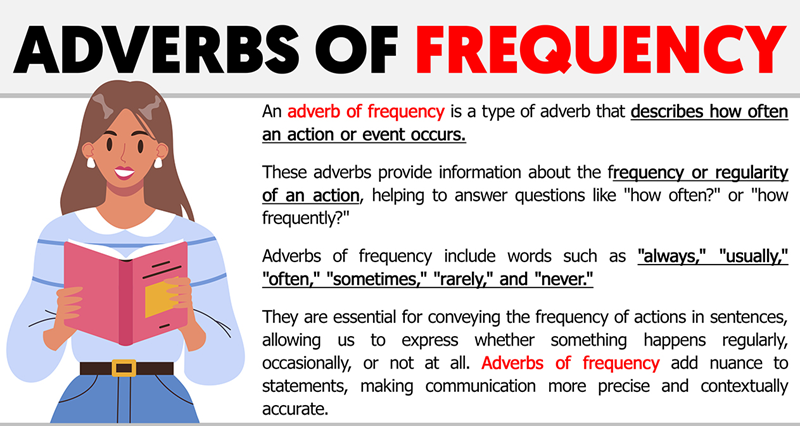
Adverbs of frequency are words that describe how often an action happens, helping you express repetition, habits, and regular patterns in daily life. They give your sentences clearer timing information without using exact numbers. These adverbs can be definite or indefinite depending on whether the frequency is measurable or not.
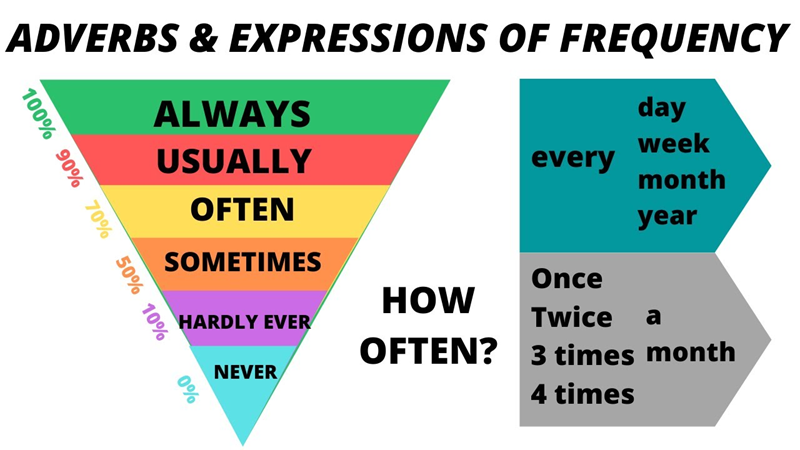
Definite frequency adverbs refer to actions that occur at specific, countable intervals, such as daily, twice a week, or every month. They provide a clear, numeric pattern of repetition. Because they are exact, they fit naturally with schedules, routines, and time-based descriptions.
Indefinite frequency adverbs describe how often something happens in general, without giving a precise number. Examples include always, usually, often, sometimes, and rarely. They are commonly used in everyday English because many habits cannot be measured with exact frequency.
These adverbs matter in English communication because they make descriptions more accurate, natural, and contextually meaningful. They help speakers express how regularly an action occurs without adding long explanations. In both writing and conversation, they improve clarity and make your message easier to understand.
Examples:
-
I usually drink coffee before starting work.
-
She visits her grandparents twice a month.
-
They rarely eat fast food during the week.
-
He always checks his email in the morning.
Types of adverbs of frequency
Adverbs of frequency fall into two main categories: indefinite and definite. Each type expresses how often an action occurs, but they differ in whether the frequency is measurable. Understanding both helps you describe habits and routines with greater clarity.
1. Common indefinite adverbs
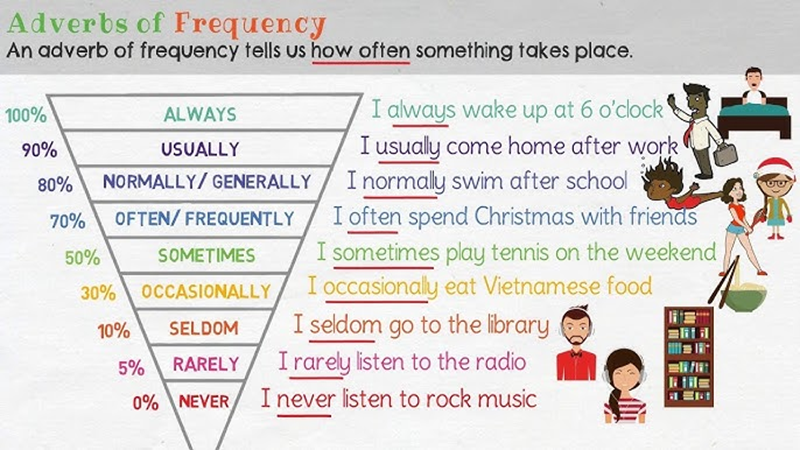
Indefinite adverbs of frequency describe how often something happens in general, without giving an exact number. Words such as always, usually, often, sometimes, rarely, and never indicate frequency on a scale from 0% to 100%. These adverbs are highly flexible and appear frequently in everyday communication because most habits cannot be measured precisely.
Examples:
-
I often read before going to bed.
-
She rarely skips her morning exercise.
-
They always arrive early for meetings.
2. Definite frequency adverbs
Definite adverbs of frequency specify clear, countable intervals, showing exactly how often an action occurs. Examples include daily, weekly, yearly, once a week, and three times a month, all of which express measurable repetition. These adverbs are especially useful when describing schedules, routines, and time-based commitments.
Examples:
-
He calls his parents once a week.
-
The team meets three times a month to review progress.
-
She practices piano daily to prepare for her exam.
Meaning & frequency levels
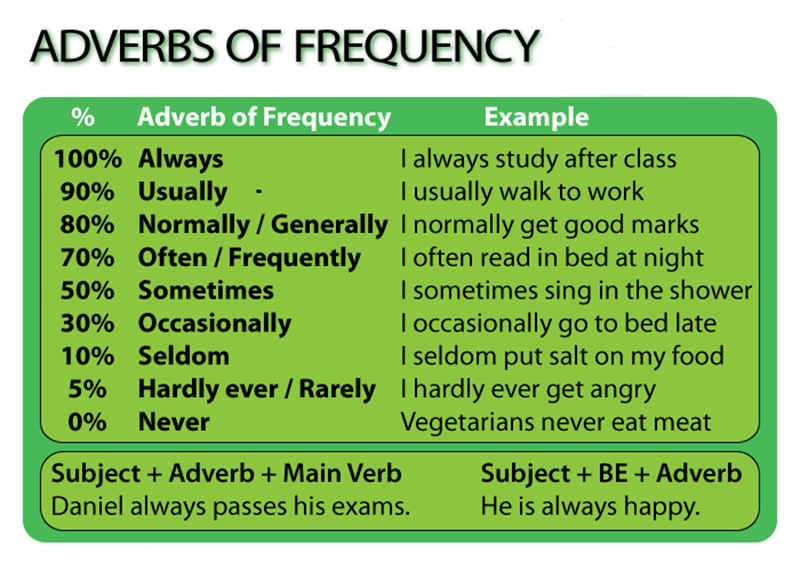
Adverbs of frequency can be understood more clearly when grouped by the approximate percentage of how often an action occurs. These levels help learners interpret meaning consistently and choose the right adverb for the situation. The scale ranges from actions that always happen to those that almost never occur.
100%: always, constantly
Adverbs at this level describe actions that happen every single time without exception. Always and constantly show absolute consistency and strong regularity. They are commonly used for fixed habits or predictable behaviors.
Example: She always checks the weather before leaving home.
80-90%: usually, regularly
These adverbs refer to actions that occur most of the time, but not necessarily every time. Usually and regularly show high frequency with occasional variation. They are ideal for describing strong routines or repeated patterns.
Example: He usually walks to work unless it rains.
50-60%: often, frequently
Adverbs in this range describe actions that happen many times, though not as consistently as higher levels. Often and frequently indicate repeated but not dominant habits. They work well for describing common but non-essential routines.
Example: They often eat out on weekends.
|
Give your child a strong English foundation from the very beginning with Monkey Junior. Start learning through fun games, native audio, and smart AI tools–perfect for kids aged 0-11. Help them build real skills in listening, speaking, reading, and writing step by step. Download Monkey Junior today and watch your child grow in confidence and English ability.
|


30-40%: sometimes, occasionally
These adverbs refer to actions that occur from time to time without forming a clear pattern. Sometimes and occasionally express moderate or irregular frequency. They are useful for describing behaviors that depend on mood or circumstance.
Example: She occasionally joins yoga classes after work.
0-10%: rarely, hardly ever, never
Adverbs at this level show actions that almost never happen. Rarely and hardly ever indicate very low frequency, while never means the action does not occur at all. These expressions help emphasize exceptions or unusual behaviors.
Example: He never drinks coffee at night.
Placement rules in sentences
Adverbs of frequency follow clear placement patterns that help maintain natural and grammatically correct sentence structure. Their position depends on the type of verb used in the sentence. Mastering these rules ensures your meaning remains accurate and easy to understand.
1. Between the subject and the main verb
Adverbs of frequency normally appear between the subject and the main verb when the verb is not to be. This placement highlights the regularity of the action without interrupting the flow of the sentence. It is the most common position for everyday communication.
Example: She usually eats breakfast at 7 a.m.
2. After the verb to be
When the main verb is a form of to be, the adverb of frequency follows directly after it. This rule applies to all forms such as am, is, are, was, and were. Placing the adverb before the complement keeps the sentence clear and natural.
Example: They are always friendly to new students.
3. Between the auxiliary/modal and the main verb
If a sentence contains an auxiliary or modal verb, the adverb of frequency is placed between the helping verb and the main verb. This structure maintains the logical order of the verb phrase while emphasizing how often the action occurs. It works with modals like can, will, must, and auxiliaries like have or do.
Example: He can sometimes forget his keys.
Mastering adverbs of frequency is a simple yet powerful way to enhance your English fluency, especially when describing how often actions occur. Once you understand their rules, common patterns, and typical sentence positions, you can express frequency with confidence and avoid common grammar mistakes. Keep practicing with real-life examples, short exercises, and everyday conversations to turn these adverbs into a natural part of your language skills.