

.png)
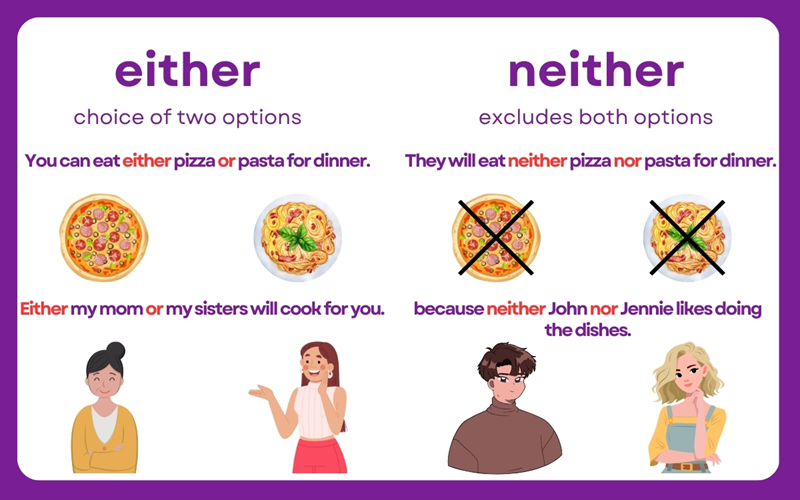
Understanding the difference between Either and Neither is essential for learners who want to speak and write English more accurately. This guide explains how to use these two words through simple definitions, clear examples, and practical exercises.
Compare Either and Neither
1. Similarities between Either and Neither
Either and Neither are both used to talk about two options, making them useful when comparing or referring to pairs. They help indicate agreement or shared characteristics between two people, things, or ideas. Both words can function in different grammatical roles, including as pronouns, determiners, and conjunctions, depending on the sentence.
Both Either and Neither appear in parallel sentence structures, which makes it easy to contrast their meanings directly. They are also commonly used in short responses to show agreement (positive or negative). Because of their similar forms, English learners often confuse them, so understanding their shared functions is an important first step before learning the differences.
Examples:
-
Either answer is acceptable, and neither answer is wrong in this context.
-
Either student can join the activity, and neither student needs extra instructions.
2. Differences between Either and Neither
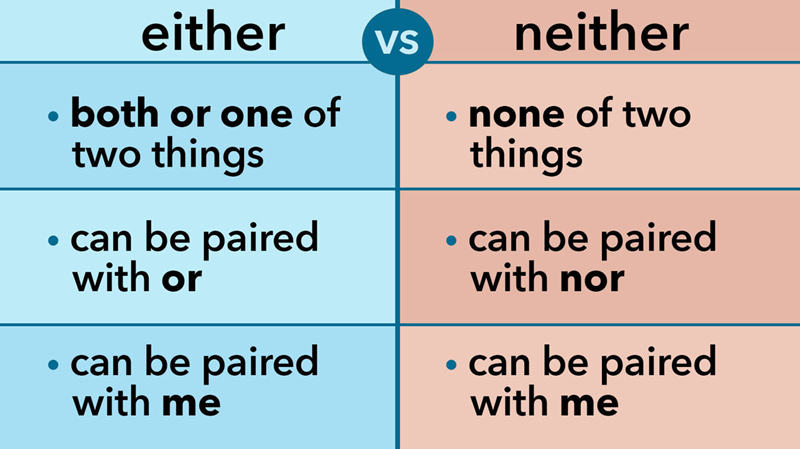
Either refers to one of two options in a positive or neutral way, while Neither expresses that not one of the two options is true, available, or chosen.
Comparison table:
|
Feature |
Either |
Neither |
|
Meaning |
One of two options; positive or neutral meaning |
Not one of the two options; negative meaning |
|
Used For |
Showing a choice or positive agreement |
Showing a negative statement or negative agreement |
|
Common Pairing |
Either … or |
Neither … nor |
|
Type of Agreement |
Affirmative agreement (e.g., “Me too.” → Me either in informal speech, though less common) |
Negative agreement (e.g., “I don’t like it.” → Me neither) |
|
Verb Form (with subjects) |
Verb agrees with the chosen subject (often singular) |
Verb is usually singular because both options are denied |
|
Example |
Either option works for me. → I accept one of the two choices. |
Neither option works for me. → I accept none of the choices. |
Sentence structures with Either/Neither
1. Sentence structures with Either
Sentence structures with Either include:
-
Either + noun: Use either before a singular noun to talk about one of two options; both choices are acceptable. (Example: Either option works for me.)
-
Either + of + plural noun/pronoun: Use either of before a plural noun or pronoun to refer to one of two specific people or things; the verb is usually singular. (Example: Either of the students is ready to present.)
-
Either … or …: Use this structure to show a choice between two subjects or actions; the verb agrees with the subject closest to it. (Example: Either my mom or my brothers are coming to pick me up.)
-
Either (in negative responses): Use either at the end of a sentence to agree with a negative statement. (Example: I don’t like spicy food. → I don’t like it either.)
2. Sentence structures with Neither
Sentence structures with Neither include:
-
Either + noun: Use either before a singular noun to talk about one of two options; both choices are acceptable. (Example: Either option works for me.)
-
Either + of + plural noun/pronoun: Use either of before a plural noun or pronoun to refer to one of two specific people or things; the verb is usually singular. (Example: Either of the students is ready to present.)
-
Either … or …: Use this structure to show a choice between two subjects or actions; the verb agrees with the subject closest to it. (Example: Either my mom or my brothers are coming to pick me up.)
-
Either (in negative responses): Use either at the end of a sentence to agree with a negative statement. (Example: I don’t like spicy food. → I don’t like it either.)
Either and Neither exercises (with answers)
Choose the correct word (either or neither) to complete each sentence.
-
I don’t like black coffee, and my sister doesn’t ______.
-
You can choose ______ the blue T-shirt or the red one.
-
______ of the answers is correct, so please try again.
-
My parents couldn’t come to the event, and my uncle couldn’t ______.
-
We can meet on Monday or Tuesday. ______ day works for me.
-
______ my friends nor my classmates knew the result.
-
You can use ______ of these two keys to open the door.
-
She didn’t call me yesterday, and I didn’t call her ______.
-
______ you apologize, or you leave the room.
-
______ of the restaurants we visited was open at night.
Answers:
-
either
-
either
-
Neither
-
either
-
Either
-
Neither
-
either
-
either
-
Either
-
Neither
|
Give your child a strong English foundation from the very beginning with Monkey Junior. Start learning through fun games, native audio, and smart AI tools–perfect for kids aged 0-11. Help them build real skills in listening, speaking, reading, and writing step by step. Download Monkey Junior today and watch your child grow in confidence and English ability.
|


Frequently asked questions
1. Can either and neither be used with more than two options?
No. Both either and neither are used specifically for two options, not more.
2. Is “me either” correct in standard English?
“Me either” is common in informal speech, but “me neither” is preferred in standard English.
3. Do either and neither always take a singular verb?
Usually yes, because they refer to one of two things; however, verb agreement can change in “either … or …” and “neither … nor …” depending on the subject closest to the verb.
4. Can I start a sentence with either or neither?
Yes. Both can begin a sentence, especially in parallel structures like “Either you join us, or you stay home” and “Neither of them agreed.”
5. Are either and neither used in formal writing?
Yes. Both are fully acceptable in formal and academic English.
Mastering Either and Neither becomes much easier when you review the structures, compare them directly, and practice with real examples. For young learners who want to build a strong English foundation, platforms like Monkey Junior offer a fun and effective way to keep improving every day.