
.png)
Understanding the difference between few and a few can be tricky for English learners. In this guide, we compare few and a few through easy-to-understand examples and practical exercises with answers.
Compare Few and A few
1. Similarities between Few and A few
Few and a few are both quantifiers used with countable plural nouns. They help speakers talk about a small number of people or things. Because of this, they often appear in everyday communication when the quantity is limited. Both expressions are commonly used with nouns such as students, books, days, or ideas.
Examples:
-
-
Few students understood the question.
-
A few students asked the teacher for help.
-
Another similarity is that few and a few can appear in similar sentence positions. They can be used before a noun, after a determiner, or as a pronoun without a noun when the context is clear.
Examples:
1. Before a noun
-
-
-
Few people know the answer.
-
A few children stayed after class.
-
-
2. As a pronoun (without a noun)
-
-
-
Many students joined the competition, but few won.
-
Only a few passed the difficult test.
-
-
In addition, both forms are widely used in spoken and written English, especially when describing limited quantities. They help learners express ideas more precisely instead of using general words like some or not many.
2. Differences between Few and A few
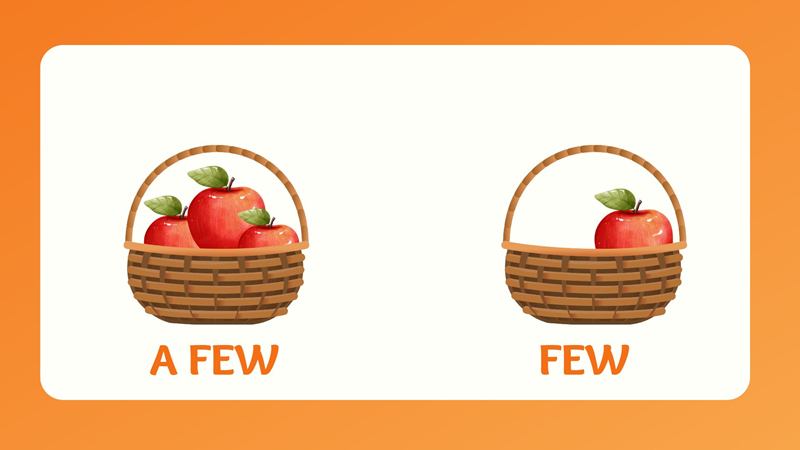
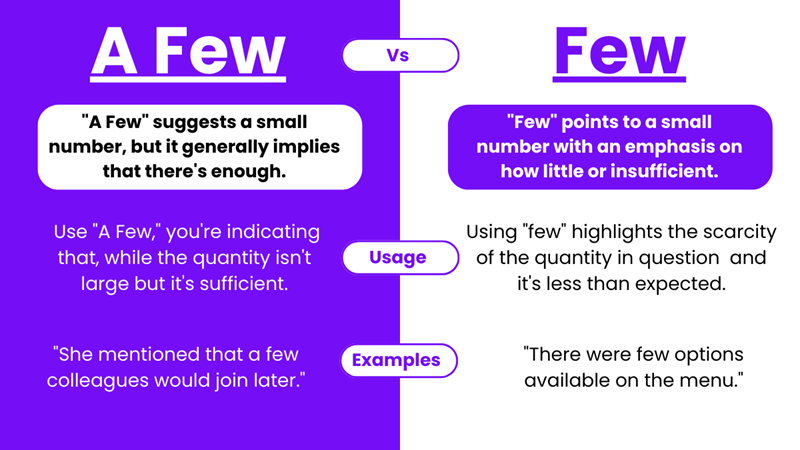
The main difference between few and a few is meaning and tone. Few has a negative meaning, implying “not many” or “almost none,” while a few has a positive meaning, suggesting “some” or “enough.”
Comparison table:
|
Feature |
Few |
A few |
|
Meaning / Tone |
Negative; emphasizes scarcity or insufficiency |
Positive; emphasizes presence or sufficiency |
|
Use with nouns |
Countable plural nouns |
Countable plural nouns |
|
Implied quantity |
Almost none; very small number |
Some; a small but sufficient number |
|
Effect on sentence |
Suggests “not enough” |
Suggests “enough” or “some” |
|
Example sentences |
Few people attended the meeting. → Almost no one attended (negative tone). |
A few people attended the meeting. → Some people attended (positive tone). |
|
Few students understood the lesson. → Not enough students understood. |
A few students understood the lesson. → At least some students understood. |
Sentence structures with Few/A few
1. Sentence structures with Few
Sentence structures with Few include:
-
Few + plural noun: Use few before plural countable nouns to express a very small number or scarcity. This structure emphasizes insufficiency or lack. (Example: Few children understand advanced English.)
-
Few + adjective + plural noun: Use few with an adjective to highlight that only a very small number of something exists. (Example: Few talented students applied for the scholarship.)
-
Few + plural noun + prepositional phrase: Use few with a prepositional phrase to specify the context or location of the small number. (Example: Few students in the class passed the test.)
-
Few + verb (without noun): Use few directly with a verb when the noun is understood from context, emphasizing that almost no one performs the action. (Example: Few can solve this puzzle.)
2. Sentence structures with A few
Sentence structures with A few include:
-
A few + plural noun: Use a few before plural countable nouns to express a small but sufficient number. This structure conveys a positive meaning. (Example: A few children understand advanced English.)
-
A few + adjective + plural noun: Use a few with an adjective to indicate that some of the described items or people exist. (Example: A few talented students applied for the scholarship.)
-
A few + plural noun + prepositional phrase: Use a few with a prepositional phrase to specify context or location while emphasizing that some exist. (Example: A few students in the class passed the test.)
-
A few + verb (without noun): Use a few directly with a verb when the noun is understood, showing that some people perform the action. (Example: A few can solve this puzzle.)
Few and A few exercises (with answers)
Fill in the blanks with few or a few:
-
Only ______ students understood the new lesson.
-
There are ______ apples left in the basket.
-
______ people know the secret of this puzzle.
-
I invited ______ friends to my birthday party.
-
______ children enjoy reading these days.
-
He has ______ books about English grammar.
-
______ students in the class can speak French fluently.
-
We saw ______ birds in the garden this morning.
-
______ people attended the meeting because of the rain.
-
I met ______ classmates after the lecture.
Answers:
-
few
-
a few
-
few
-
a few
-
few
-
a few
-
few
-
a few
-
few
-
a few
|
Give your child a strong English foundation from the very beginning with Monkey Junior. Start learning through fun games, native audio, and smart AI tools–perfect for kids aged 0-11. Help them build real skills in listening, speaking, reading, and writing step by step. Download Monkey Junior today and watch your child grow in confidence and English ability.
|

Frequently asked questions
1. Can we use Few and A few with uncountable nouns?
No, few and a few are only used with countable plural nouns. For uncountable nouns, use little or a little instead.
2. Do Few and A few change meaning in questions?
Yes, few still emphasizes scarcity, while a few suggests some presence. For example: Do few students like math? vs Do a few students like math?
3. Can we use Few and A few at the beginning of a sentence?
Yes, both can start a sentence to emphasize quantity.
Example: Few people know this fact. / A few people tried to help.
4. Is there a difference in spoken vs written English?
Both are common in spoken and written English, but few is often more formal, while a few is used in everyday conversation.
5. Can Few and A few be used with adjectives?
Yes, you can say few talented students or a few talented students to add more detail.
6. How do we know whether to use Few or A few?
Use few to stress not enough and a few to stress some, enough. The tone of the sentence usually guides the choice.
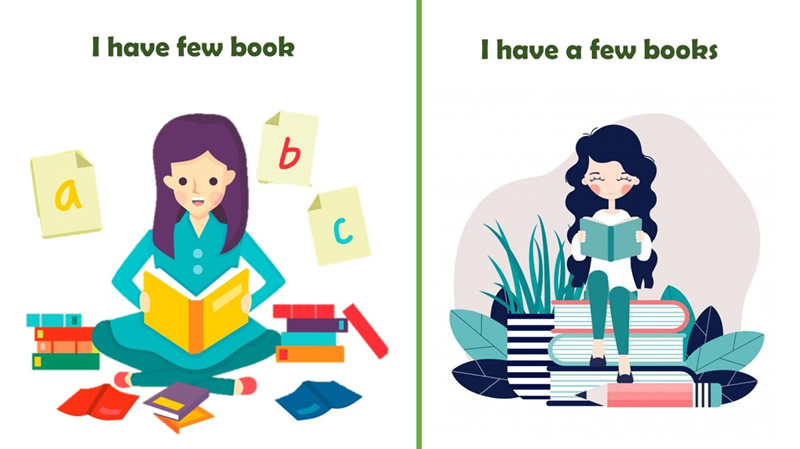
Mastering few and a few helps you express small quantities accurately in English. For more fun and interactive practice, children can also learn these patterns effectively with Monkey Junior.