

.png)
Understanding the difference between other and another is an important step for English learners because these words often appear in daily conversations and writing. In this guide, you will learn how to compare other and another through clear explanations, easy examples, and simple exercises with answers.
Compare Other and Another
1. Similarities between Other and Another
Although Other and Another are used in different grammatical structures, they share several important similarities in meaning and function. Both words are commonly used to talk about additional people or things or to refer to something different from the one already mentioned.
First, Other and Another both express the idea of addition or difference. They are used when the speaker wants to mention one more thing or a different option from what has already been discussed.
Example:
-
-
I don’t like this shirt. Can I try another one?
-
This shop is expensive. Let’s go to other stores.
-
Second, both words often appear when comparing choices or alternatives. They help speakers introduce a new option when the current one is not suitable or when more possibilities are available.
Example:
-
-
Do you have another question?
-
Are there other ways to solve this problem?
-
Finally, Other and Another are commonly used in everyday English conversations and writing. They help make sentences more natural when talking about extra items, alternatives, or different people/things.
Example:
-
-
She wants another cookie.
-
Some students finished early, but other students needed more time.
-
In short, both Other and Another are used to refer to something additional or different, which is why learners often confuse them. However, their grammar usage and sentence structures are different, which we will explore in the next section.
2. Differences between Other and Another
Although Other and Another have similar meanings, they are used in different grammatical situations. The main differences relate to number (singular or plural) and how the noun is used in a sentence.
Comparison table:
|
Criteria |
Another |
Other |
|
Basic meaning |
Refers to one more or an additional item of the same type |
Refers to different or additional people or things |
|
Number |
Used with singular countable nouns |
Used with plural nouns or uncountable nouns |
|
Main structure |
Another + singular countable noun |
Other + plural noun / uncountable noun |
|
Typical usage |
Talking about one more item |
Talking about different items or groups |
|
Example |
I would like another cup of milk. |
We should consider other options. |
Sentence structures with Other/Another
1. Sentence structures with Other
Other is commonly used to refer to different or additional people and things. It is usually followed by plural nouns or uncountable nouns, but it can also appear in several fixed grammatical structures in English. Include:
-
Other + plural noun: Use other before plural nouns to refer to different or additional people or things in a group. This structure is common when comparing or mentioning alternatives. (Example: Some students like math, while other students prefer English.)
-
Other + uncountable noun: Use other before uncountable nouns to talk about different types of something or additional information or resources. This structure often appears when discussing ideas, materials, or information. (Example: Do you have other information about this topic?)
-
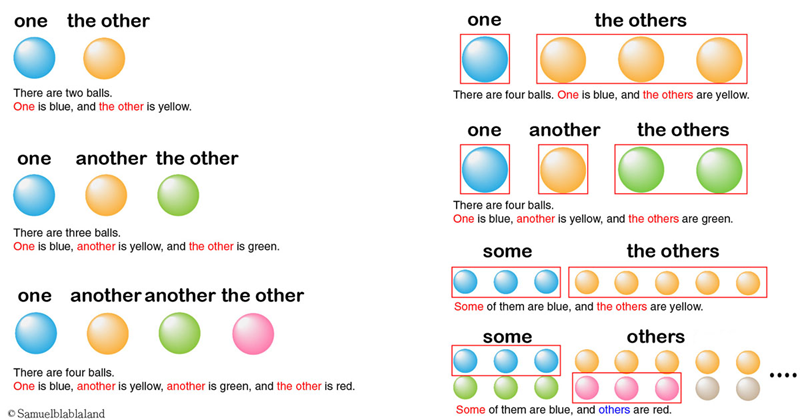
The other + singular noun: Use the other before a singular noun to refer to the second one of two people or things. It helps clearly distinguish between two specific items. (Example: I have two bags. One is black, and the other bag is blue.)
-
The other + plural noun: Use the other before plural nouns to refer to the remaining people or things in a specific group. It usually appears when some items have already been mentioned. (Example: Three students finished the test, but the other students are still working.)
-
Others (pronoun): Use others as a pronoun when the noun is already understood from the context. This helps avoid repeating the same noun in the sentence. (Example: Some children like reading, while others prefer playing outside.)
2. Sentence structures with Another
Sentence structures with Another include:
-
Another + singular countable noun: Use another before a singular countable noun to mean one more or an additional item of the same type. This structure is very common in everyday conversations when someone wants more of something. (Example: She ordered another cup of coffee.)
-
Another + number + plural noun: Use another before a number and a plural noun to express an additional quantity. This structure means “more” of a certain number of items. (Example: The teacher gave us another two exercises to complete.)
-
Another + one / pronoun: Use another one when the noun has already been mentioned and you want to avoid repeating it. This structure is common in casual conversations. (Example: This cookie is delicious. I want another one.)
-
Another + time expression: Use another with time expressions to indicate an additional period of time. It is often used when extending time for an activity or event. (Example: We need another ten minutes to finish the project.)
-
Another as a pronoun: Sometimes another can stand alone as a pronoun when the noun is understood from the context. This helps make the sentence shorter and more natural. (Example: This pen doesn’t work. Can I have another?)
Other and Another exercises (with answers)
Fill in the blanks with other or another to complete the sentences correctly:
-
I don’t like this book. Can I choose ______ one?
-
Some students finished the test early, but ______ students are still working.
-
She wants to buy ______ dress for the party.
-
Do you have ______ questions about the lesson?
-
This chair is broken. Let’s use ______ chair.
-
Some children like playing soccer, while ______ prefer swimming.
-
I’m still hungry. Can I have ______ sandwich?
-
We should consider ______ options before making a decision.
-
He finished one exercise and then started ______.
-
These shoes are too small. I need to try ______ pair.
Answers:
-
another
-
other
-
another
-
other
-
another
-
others
-
another
-
other
-
another
-
another
|
Give your child a strong English foundation from the very beginning with Monkey Junior. Start learning through fun games, native audio, and smart AI tools–perfect for kids aged 0-11. Help them build real skills in listening, speaking, reading, and writing step by step. Download Monkey Junior today and watch your child grow in confidence and English ability.
|

Frequently asked questions
1. What is the difference between “other,” “others,” and “another”?
Another refers to one more item and is used with singular countable nouns. Other is used before plural or uncountable nouns, while others is a pronoun that replaces the noun when it is already understood.
2. Can “another” be used with plural nouns?
Normally, another is used with singular countable nouns. However, it can appear before a number + plural noun to express an additional quantity.
3. When should I use “the other”?
Use the other when referring to the second item in a pair or the remaining items in a specific group. It is often used when the number of things is already clear.
4. Can “other” be used without a noun?
Yes, but in that case the form others is usually used as a pronoun. It replaces the noun to avoid repetition in the sentence.
5. How can learners remember the difference between “other” and “another”?
A simple tip is to remember that another = an + other, which means one more. Meanwhile, other usually refers to different or additional items in a group.

In summary, knowing how to use other and another correctly helps learners express additional ideas and make clearer comparisons in English. To help children master grammar naturally through stories, games, and interactive lessons, parents can explore the learning journey with Monkey Junior.