

.png)
Adverbs of manners describe how an action is done and add detail to verbs, making your English more precise and expressive. They are commonly formed from adjectives and are essential for both spoken and written English learners.
What are adverbs of manners?
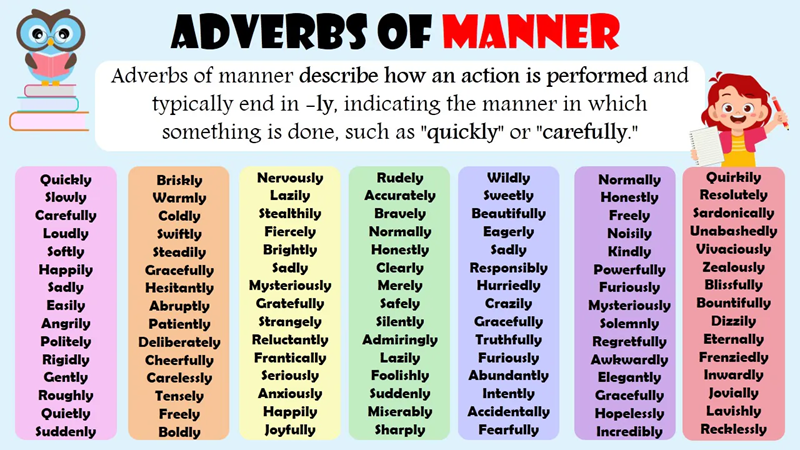
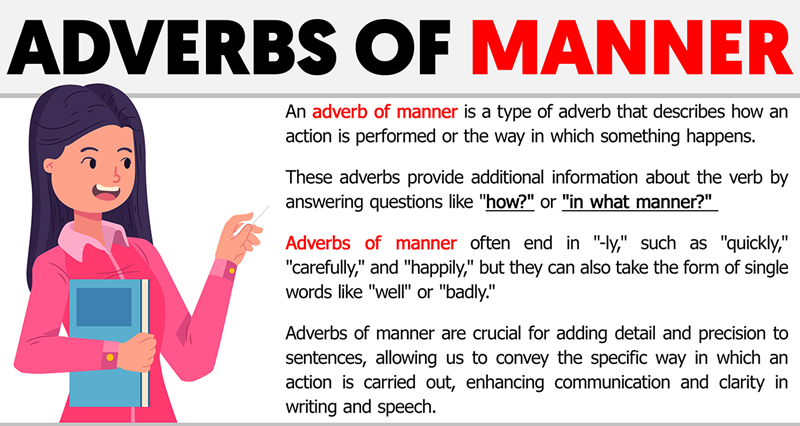
Adverbs of manners are words that describe how an action happens, giving readers or listeners a clearer picture of the way something is done. They add nuance to verbs and make descriptions more vivid and accurate in both spoken and written English.
These adverbs are important because they help express tone, attitude, and intention, allowing communication to sound natural and precise. Without them, sentences often feel incomplete or overly simple.
Adverbs of manners differ from adjectives in function and placement: adjectives modify nouns, while adverbs of manners modify verbs and typically answer the question “How?”.
Examples:
-
Adverb of manners: “She speaks softly.”
-
Adjective: “She has a soft voice.”
How to form adverbs of manner
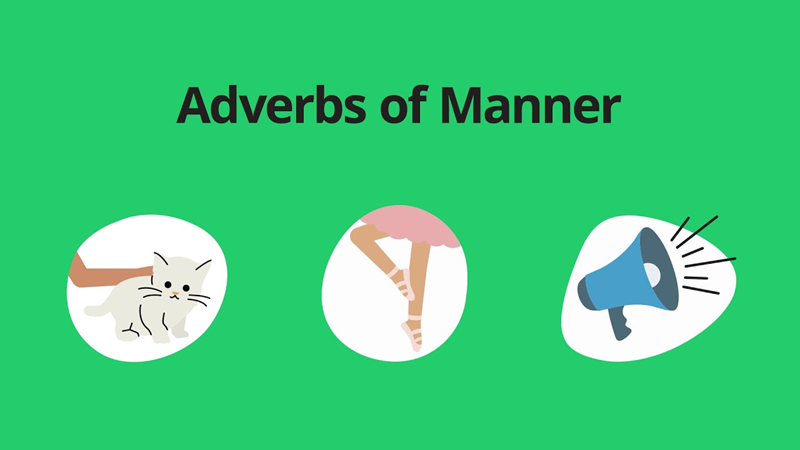
The most common way to form an adverb of manner is by adding -ly to an adjective. This pattern works for the majority of everyday adjectives and creates a smooth transition from describing a noun to describing how an action happens.
Some adjectives require spelling adjustments before adding -ly.
Common changes include:
Adjectives ending in -y → change y to i: happy → happily.
Adjectives ending in -le → drop the e: simple → simply.
Adjectives ending in -ic → add -ally: basic → basically.
A small group of adverbs of manners are irregular and do not follow the standard rules. They either keep the same form as the adjective or change completely.
Examples:
-
good → well
-
hard → hard
-
fast → fast
|
Give your child a strong English foundation from the very beginning with Monkey Junior. Start learning through fun games, native audio, and smart AI tools–perfect for kids aged 0-11. Help them build real skills in listening, speaking, reading, and writing step by step. Download Monkey Junior today and watch your child grow in confidence and English ability.
|


Placement of adverbs of manner in sentences
Adverbs of manners most often appear after the main verb, where they naturally describe how the action happens. This placement keeps the sentence clear and maintains a smooth reading flow. It is the default position used in everyday English.
When the verb is followed by an object, the adverb usually comes after the object rather than interrupting the verb - object pattern. This structure preserves clarity and avoids any break in meaning. It is preferred in both formal and informal writing.
Adverbs can also be placed before the verb when the speaker wants to emphasize the manner of the action. This position draws attention to the adverb and creates a more expressive tone. Although less common, it is stylistically effective when used intentionally.
Examples:
-
She laughed softly.
-
He completed the task carefully.
-
She deliberately paused before answering.
Practicing with exercises
Practicing adverbs of manners helps reinforce correct placement and builds confidence when forming sentences. The exercises below focus on real-world contexts, allowing you to apply the rules naturally and quickly. Try completing each task before checking the answer key at the end.
1. Fill-in-the-blank sentences (use an appropriate adverb of manner)
You may use any correct adverb that logically fits the sentence.
-
She whispered __________ so no one else could hear.
-
The students worked __________ to finish the project on time.
-
He drove __________ through the narrow street.
-
The baby slept __________ despite the noise outside.
-
They cheered __________ when their team won.
-
The chef chopped the vegetables __________.
-
The dog followed its owner __________.
-
The singer performed __________ on stage.
-
He handled the fragile box __________.
-
The athlete ran __________ toward the finish line.
Answer:
-
softly / quietly
-
diligently / quickly
-
carefully / slowly
-
peacefully / soundly
-
loudly / excitedly
-
finely / quickly
-
closely / obediently
-
confidently / beautifully
-
gently / cautiously
-
swiftly / powerfully
2. Short writing prompts (use at least one adverb of manner in each sentence you create)
Write 1 sentence for each prompt.
-
Describe how someone studies for an important exam.
-
Describe how a teacher explains a difficult concept.
-
Describe how a child reacts to surprising news.
-
Describe how a friend greets you after a long trip.
-
Describe how a musician plays their instrument.
-
Describe how a firefighter enters a burning building.
-
Describe how a teammate celebrates a victory.
-
Describe how a chef tastes a new recipe.
-
Describe how a student presents their project.
-
Describe how a parent comforts a crying child.
Answer:
-
She studied carefully for the exam.
-
The teacher explained the concept clearly.
-
The child reacted excitedly to the news.
-
My friend greeted me warmly.
-
The musician played the instrument skillfully.
-
The firefighter entered the building bravely.
-
The teammate celebrated joyfully.
-
The chef tasted the dish thoughtfully.
-
The student presented the project confidently.
-
The parent comforted the child gently.
Common mistakes and how to avoid them
Learners often make predictable errors when using adverbs of manner, and recognizing these mistakes helps improve accuracy and clarity.
-
Using adjectives instead of adverbs: Many learners mistakenly place an adjective after a verb, creating sentences that sound incomplete or incorrect. An adjective cannot describe how an action happens, so the sentence loses clarity. To avoid this, always use an adverb of manner when modifying a verb or answering the question “How?”.
-
Confusing irregular adverbs, especially hard and hardly: Hard means “with serious effort,” while hardly means “almost not,” and mixing them completely changes the meaning of a sentence. This confusion often leads to unintentional miscommunication. A simple fix is to pause and check whether the word expresses effort (hard) or near-absence (hardly).
Adverbs of manners are simple but powerful tools that help you give detailed descriptions of actions, answer the question “how?”, and make your English more dynamic. Regular practice with common adverbs and sentence placement will greatly improve your fluency and clarity.