

.png)
The object in English is an essential element that completes the meaning of a sentence. Understanding objects helps learners express ideas clearly and accurately.
|
WATCH THE VIDEO SUMMARY OF THE ARTICLE |
What Is an Object in English?
Before exploring deeper grammar rules, it's helpful to start with the basic definition. An object in English is the word or group of words that receives the action of the verb. In other words, the subject performs the action, and the object experiences it.
Examples:
-
She reads a book.
-
Tom bought a new phone.
-
They invited us.
Objects provide important details and make sentences more meaningful.
Why Objects Are Important in English Sentences
To understand why objects matter, consider how incomplete some sentences would be without them. Objects add clarity, help describe actions more fully, and make communication more precise. Without an object, many verbs would leave the listener confused.
Examples:
-
He fixed the car.
-
I love music.
Objects make communication clear and direct.
Types of Objects in English
To use objects correctly, learners need to recognize the different forms they can take. Each type explains how the action is received in a sentence.
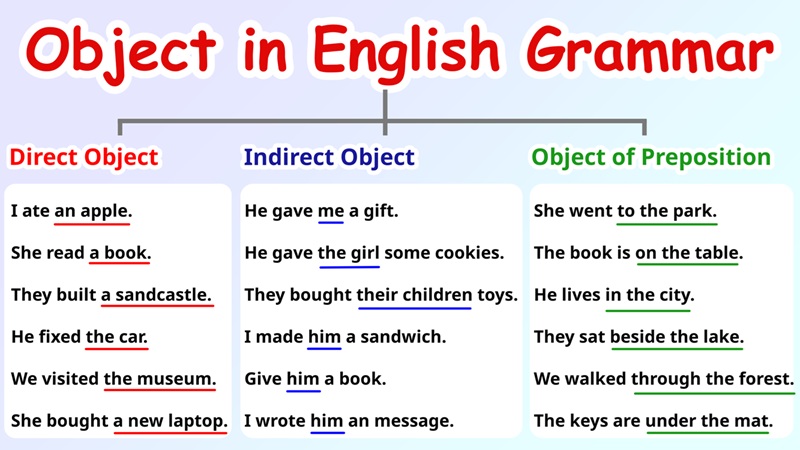
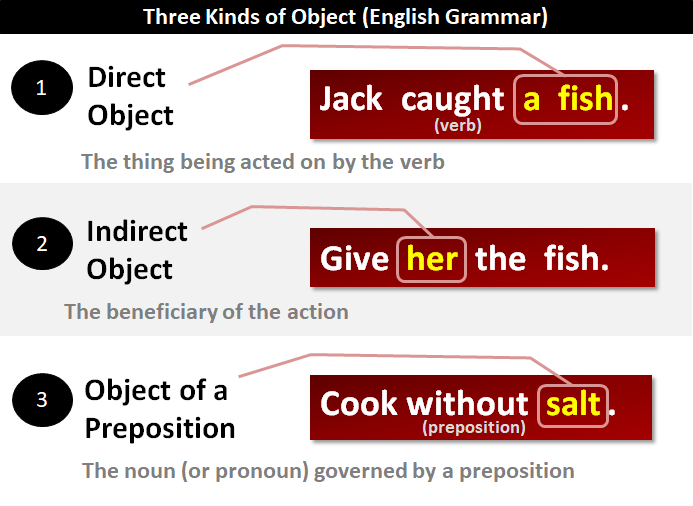
1. Direct Object
A direct object receives the action of the verb directly. It answers the question “what?” or “whom?”
Examples:
-
She cleaned the room. (cleaned what?)
-
They met their teacher. (met whom?)
Direct objects make the action complete and understandable.
2. Indirect Object
An indirect object shows to whom or for whom the action is done. This type often appears before the direct object.
Examples:
-
He gave me a gift.
-
She sent her friend a message.
Indirect objects explain the receiver of the action.
3. Object of a Preposition
Some objects follow prepositions and complete the meaning of a prepositional phrase.
Examples:
-
The cat is hiding under the bed.
-
They walked through the forest.
These objects help describe relationships in space, time, and movement.
4. Object Pronouns
Object pronouns replace nouns and prevent repetition. They include:
|
Subject Pronoun |
Object Pronoun |
|
I |
me |
|
you |
you |
|
he |
him |
|
she |
her |
|
it |
it |
|
we |
us |
|
they |
them |
Examples:
-
She called him.
-
They helped us.
Learning object pronouns makes sentences smoother and less repetitive.
5. Complex Objects
A complex object includes a noun or pronoun followed by an infinitive or another verb form.
Examples:
-
I want him to finish the work.
-
They saw the children playing.
This structure helps express more detailed actions.
Object Placement in English Sentences
Understanding object placement improves sentence clarity. Most English sentences follow the Subject + Verb + Object (SVO) structure.
Examples:
-
The girl (S) ate (V) a sandwich (O).
-
My brother (S) bought (V) a new car (O).
In sentences with both direct and indirect objects, the typical pattern is:
Indirect Object → Direct Object
She gave me a letter.
Direct Object → Preposition → Indirect Object
She gave a letter to me.
Mastering placement ensures that sentences remain natural and clear.
Common Mistakes with Objects in English
To avoid confusion, it’s helpful to review frequent errors learners make.
|
Mistake |
Correction |
Reason |
|
She gave to me a gift. |
She gave me a gift. |
Indirect object normally comes first. |
|
They invited he. |
They invited him. |
Use object pronouns. |
|
I explained the problem her. |
I explained the problem to her. |
Some verbs require a preposition. |
|
He asked a question to me. |
He asked me a question. |
Standard object order. |
Knowing these rules avoids unnatural sentence structures.
Examples of Objects in Use
To understand how objects work in various contexts, here are examples from different sentence types:
-
Affirmative: She wrote a poem.
-
Negative: They didn’t see the car.
-
Question: Who did you meet? (object = who)
-
Passive: A letter was written by her.
-
Complex sentence: I know that he is honest.
These examples show how flexible objects can be in English grammar.
Practice Exercises: Object in English
Exercise 1: Identify the Object
Find the object in each sentence:
-
He painted a picture.
-
They sent their parents a letter.
-
She walked through the garden.
-
I trust him completely.
-
The teacher explained the lesson to us.
Exercise 2: Choose the Correct Object Pronoun
Select the correct pronoun:
-
Tom invited (she / her).
-
They supported (we / us).
-
The manager called (they / them).
-
I saw (he / him) at the park.
-
She bought a gift for (I / me).
Exercise 3: Rewrite with Objects
Rewrite the sentence to include an appropriate object:
-
She baked.
-
They discovered.
-
The children watched.
-
He repaired.
-
I collected.
Answer Key
Exercise 1:
-
a picture
-
their parents / a letter
-
the garden
-
him
-
the lesson / us
Exercise 2:
-
her
-
us
-
them
-
him
-
me
Exercise 3 (suggested answers):
-
She baked a cake.
-
They discovered a secret.
-
The children watched a movie.
-
He repaired the bicycle.
-
I collected the stamps.
Learn English Grammar with Monkey Junior
If you want a guided and effective way to understand grammar concepts such as the object in English, Monkey Junior offers structured lessons that simplify learning. The program explains objects through clear examples, interactive activities, and progressive lessons suitable for learners at different levels.
Monkey Junior reinforces grammar through reading practice, vocabulary building, and sentence patterns that help learners identify objects naturally. With audio support, visual examples, and short daily lessons, Monkey Junior makes grammar learning comfortable and engaging. You can explore the app and experience its learning approach to improve your English skills faster and more confidently.
Start your child’s learning journey today with Monkey Junior and let them express their emotions in English confidently and naturally.
Conclusion
Mastering the object in English allows learners to form complete and meaningful sentences. By understanding the types of objects, their functions, and how they appear in sentence structures, you can express ideas more clearly. With regular practice and a supportive tool like Monkey Junior, learning grammar becomes easier, more structured, and highly effective.