
.png)
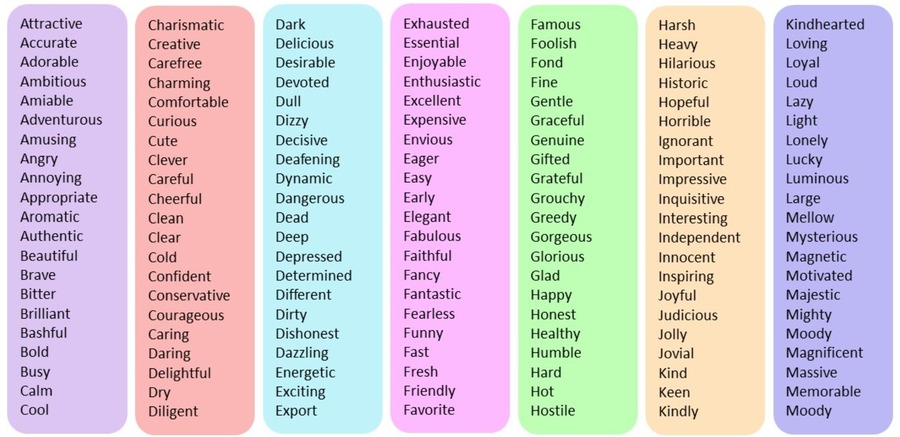
When kids begin learning English, they start discovering different word types like nouns, verbs, and adjectives. Among them, adjectives in English are some of the most colorful and fun! Adjectives help children describe the world around them, how things look, feel, sound, or even taste. They make sentences richer and more interesting. Let’s explore what an adjective in English is and learn how to use it in simple, fun ways!
What Is an Adjective in English?
Before diving into examples, let’s understand the basic idea. An adjective in English is a word that describes or gives more information about a noun (a person, place, or thing).
For example:
-
The blue sky is beautiful.
-
She has a big dog.
-
This pizza is delicious.
Adjectives tell us more details about what kind, how many, or which one. They help kids express themselves more clearly when talking about people, animals, or objects around them.
Types of Adjectives in English
To make learning easier, let’s look at different types of adjectives. Each type describes something in a special way.
|
Type of Adjective |
What It Describes |
Examples |
Example Sentences |
|
Descriptive Adjectives |
Describe color, shape, size, feeling |
big, red, happy |
The red balloon flies high. |
|
Quantitative Adjectives |
Show quantity or number |
some, few, many, ten |
She has two dolls. |
|
Demonstrative Adjectives |
Point out something specific |
this, that, these, those |
That apple is sweet. |
|
Possessive Adjectives |
Show ownership |
my, your, his, her |
This is my bag. |
|
Interrogative Adjectives |
Used to ask questions |
which, what, whose |
Which book do you want? |
By learning these types, children can easily describe things around them and make sentences more fun to say and write!
How to Use Adjectives in Sentences
Now that we know what adjectives are, let’s see how to use them correctly in English sentences. Adjectives usually come before nouns, but sometimes they appear after verbs like “be,” “feel,” or “seem.”
|
Position |
Usage Rule |
Example |
|
Before the noun |
Adjective + Noun |
She has a beautiful smile. |
|
After the verb |
Verb + Adjective |
The sky is blue. |
|
With linking verbs |
After “be,” “feel,” “look,” “seem” |
He feels tired. / The cake looks delicious. |
Tip for kids: Try describing things you see around you every day “a tall tree,” “a soft pillow,” or “a kind friend.” The more you practice, the easier it gets!
Comparative and Superlative Adjectives
Sometimes, adjectives are used to compare two or more things. Let’s see how they work:
|
Type |
Use |
Example Form |
Example Sentence |
|
Positive |
Describes one thing |
tall, fast |
She is smart. |
|
Comparative |
Compares two things |
taller, faster |
She is taller than her brother. |
|
Superlative |
Compares three or more things |
tallest, fastest |
She is the tallest in her class. |
Rules for forming comparative and superlative adjectives:
-
For short adjectives: add –er / –est → small → smaller → smallest
-
For long adjectives: use more / most → beautiful → more beautiful → most beautiful
-
Irregular forms: good → better → best, bad → worse → worst
Adjectives vs. Adverbs
Children sometimes mix up adjectives and adverbs. Here’s an easy way to tell them apart:
|
Adjectives |
Adverbs |
|
Describe nouns |
Describe verbs, adjectives, or other adverbs |
|
Example: She is happy. |
Example: She sings happily. |
|
Answers “What kind?” |
Answers “How?” |
Quick Trick: If the word ends in –ly, it’s often an adverb, not an adjective!
Practice Exercises: Adjective in English
Let’s make learning fun with some practice! Try the exercises below, then check your answers at the end.
1. Identify the Adjectives
Find the adjective in each sentence.
-
The tall man is running.
-
She wore a beautiful dress.
-
The soup tastes hot.
-
I have three pencils.
-
The little cat is sleeping.
2. Choose the Correct Word
-
It is a (cold / coldly) day.
-
The elephant is (big / bigger) than the cow.
-
This is the (good / best) cake I’ve ever had!
-
My sister is (happy / happily) today.
-
That is a (green / greenly) apple.
3. Fill in the Blank
-
The _______ flowers smell nice.
-
My dad is a _______ driver.
-
It was a _______ day for a picnic.
-
The water is too _______ to drink.
-
He has a _______ voice.
Answer Key
1. Identify the Adjectives: tall, beautiful, hot, three, little
2. Choose the Correct Word: 1. cold 2. bigger 3. best 4. happy 5. green
3. Fill in the Blank (Answers may vary): 1. colorful 2. careful 3. sunny 4. dirty 5. loud
Learn Adjectives in English with Monkey Junior
Learning adjectives in English becomes exciting and effortless with Monkey Junior, an award-winning English learning app designed for kids aged 0–11. Instead of memorizing grammar rules, children learn through games, videos, songs, and storytelling, where adjectives come to life naturally in real contexts.
In Monkey Junior, your child will:
-
Learn hundreds of common adjectives like happy, sad, tall, beautiful, and funny
-
Hear perfect pronunciation from native speakers
-
See adjectives used in colorful, animated stories
Practice comparing words interactively with pictures and sounds
Each lesson is short (10 - 15 minutes), fun, and designed to hold a child’s attention. Parents can track progress and watch how quickly kids start describing the world confidently in English!
Give your child a head start in English!
Download Monkey Junior today and let your child explore the world of adjectives in English through play and imagination.
Conclusion
Adjectives are the words that make language beautiful. They tell us how things look, feel, or sound and help children describe their world more vividly. By understanding the adjective in English, kids can build stronger sentences and express emotions more clearly. With daily practice and the help of Monkey Junior, learning adjectives becomes a fun and rewarding adventure!