

.png)
The near future tense is a key structure in English grammar that helps you talk about plans, intentions, and events that are expected to happen soon. Understanding how this tense works makes your communication clearer and more natural, especially in everyday conversations and real-life situations.
What is the near future tense?
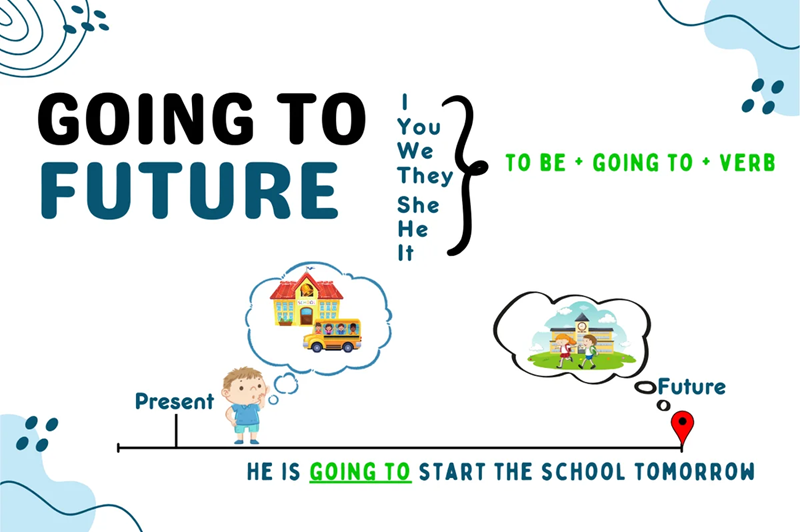
The near future tense is a structure formed with “be + going to + base verb” that expresses something expected to happen soon. It highlights an action that is planned, intended, or clearly about to occur based on present circumstances.
Unlike will, which expresses spontaneous decisions or general predictions, the near future tense focuses on pre-made plans and predictions supported by present evidence. It gives a sense of immediacy because the action is already in motion or has a clear reason to happen.
We use the near future tense when talking about personal intentions, scheduled actions, or situations where current signs strongly suggest a future outcome. It’s especially common in everyday English because it sounds natural, concrete, and closely tied to the speaker’s real-life plans.
Examples:
-
She is going to start her new job next Monday.
-
They are going to visit their grandparents this weekend.
-
I’m going to buy a new laptop because my old one just stopped working.
-
We are going to study together after school today.
Structure of the near future tense
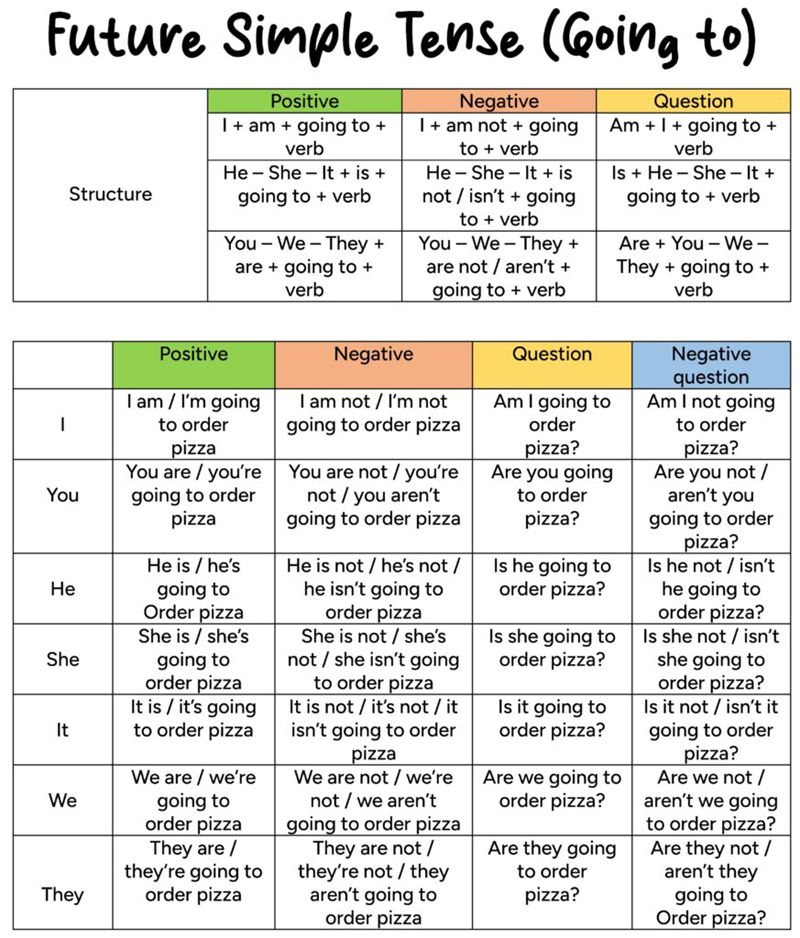
The near future tense is built with the verb “to be” + going to + base verb, and it stays consistent across subjects. It changes only when you form negative or question structures.
1. Basic Form
The basic pattern is Subject + am/is/are + going to + base verb. Use this form to express clear plans, intentions, or events expected to happen soon.
Examples:
-
They are going to watch a movie tonight.
-
I am going to start a new project next week.
2. Negative Form
To form the negative, simply add “not” after am/is/are. This structure shows that a plan will not happen or an intention has changed.
Examples:
-
He is not going to join the meeting tomorrow.
-
We are not going to buy a new car this year.
3. Question Form
Form a question by placing am/is/are before the subject, followed by going to + base verb. This pattern is used to ask about plans, intentions, or predictions.
Examples:
-
Is she going to move to a new apartment?
-
Am I going to meet them later today?
Uses of the near future tense
The near future tense is used to describe actions that are planned, expected, or clearly about to happen. It appears frequently in everyday English because it conveys certainty and immediacy.
1. Plans and intentions
Use this tense to talk about fixed plans, personal intentions, or actions you have already decided to do. It highlights that the decision was made before the moment of speaking.
Examples:
-
We are going to meet our friends for dinner tonight.
-
I am going to start guitar lessons this month.
2. Predictions based on present evidence
Use it to make predictions when current signs or facts clearly point to what will happen. This structure shows the future outcome is strongly supported by what you observe now.
Examples:
-
He’s running late again; he is going to miss the bus.
-
That plant looks weak; it is going to die without water.
3 Common contexts in daily english
This tense appears in everyday situations such as talking about schedules, making weekend plans, giving warnings, or describing things that are visibly about to happen. It keeps communication natural and closely tied to real-life actions and observations.
Near future tense vs. Other future forms
The near future tense and the simple future (will) both talk about future actions, but they differ in intention and certainty. The near future tense focuses on plans or predictions with evidence, while will expresses spontaneous decisions, promises, or general predictions.
Use the near future tense when the action is already planned or clearly developing. Use will when you decide on the spot, make an offer, or talk about something uncertain or opinion-based.
Comparison table:
|
Usage |
Near Future Tense (be + going to) |
Simple Future (will) |
|
Plans made earlier |
Yes - expresses fixed plans or intentions |
No - not used for pre-made plans |
|
Spontaneous decisions |
No |
Yes - used at the moment of speaking |
|
Predictions with evidence |
Yes - based on visible or present signs |
Sometimes - used for general predictions |
|
Promises, offers, requests |
No |
Yes |
|
Tone |
More certain and immediate |
More neutral or uncertain |
Practice exercises
These exercises help you reinforce how the near future tense works in real contexts. Each set focuses on a different skill so you can practice forming the tense accurately and naturally.
1. Fill in the Blanks
Use the correct form of am/is/are + going to + base verb.
-
She ________ (start) a new course next month.
-
We ________ (visit) our cousins this weekend.
-
I ________ (buy) a new phone because my old one broke.
-
They ________ (move) to a bigger apartment soon.
-
Look at those clouds — it ________ (rain).
2. Rewrite the Sentences
Rewrite each sentence using be going to.
-
She plans to cook dinner tonight.
-
They intend to open a small café next year.
-
I’ve decided to clean my room this afternoon.
-
He has made a decision to quit his job.
-
We have arranged to meet the teacher after class.
3. Question Formation
Form a question using am/is/are + subject + going to + base verb.
-
you / travel / this summer?
-
she / join / the meeting tomorrow?
-
they / buy / a new car?
-
we / study / together later?
-
I / see / them after school?
|
Give your child a strong English foundation from the very beginning with Monkey Junior. Start learning through fun games, native audio, and smart AI tools–perfect for kids aged 0-11. Help them build real skills in listening, speaking, reading, and writing step by step. Download Monkey Junior today and watch your child grow in confidence and English ability.
|

Answers
Exercises 1:
-
is going to start
-
are going to visit
-
am going to buy
-
are going to move
-
is going to rain
Exercises 2:
-
She is going to cook dinner tonight.
-
They are going to open a small café next year.
-
I am going to clean my room this afternoon.
-
He is going to quit his job.
-
We are going to meet the teacher after class.
Exercises 3:
-
Are you going to travel this summer?
-
Is she going to join the meeting tomorrow?
-
Are they going to buy a new car?
-
Are we going to study together later?
-
Am I going to see them after school?

Mastering the near future tense gives you a practical tool for expressing future actions with confidence and accuracy. By learning its definition, structure, and common uses, you can improve both your speaking and writing and sound more fluent in real-world English.