.png)
The article in English grammar is a small but essential part of sentence structure. Learning how to use articles correctly improves clarity and accuracy in English.
|
WATCH THE VIDEO SUMMARY OF THE ARTICLE |
What Is an Article in English Grammar?
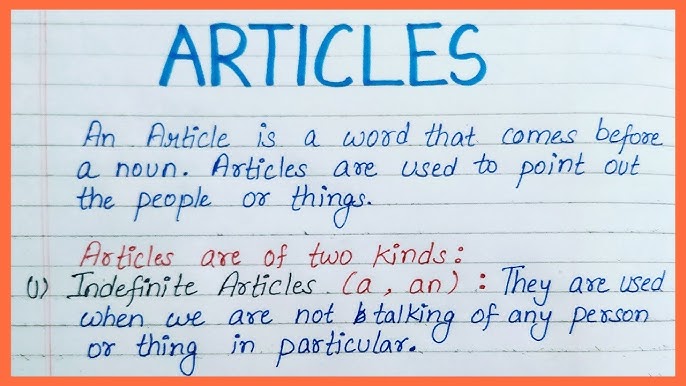
Before learning how to apply article rules, it is helpful to understand the basic definition. An article in English grammar is a word placed before a noun to show whether the noun is specific or general. Articles guide the reader by indicating if the speaker is referring to something known, unknown, unique, or countable.
English has three articles: a, an, and the.
-
a / an: indefinite articles → refer to non-specific nouns.
-
the: definite article → refers to specific nouns.
Articles appear before singular nouns and sometimes plural or uncountable nouns, depending on meaning. They are essential for proper sentence structure.
Why Articles Are Important in English
To understand why articles matter, imagine reading sentences without them. Without articles, English would become unclear, unnatural, or grammatically incorrect. Articles help identify whether a noun is general or specific, whether it has been mentioned before, and whether it refers to one item or many.
Examples:
-
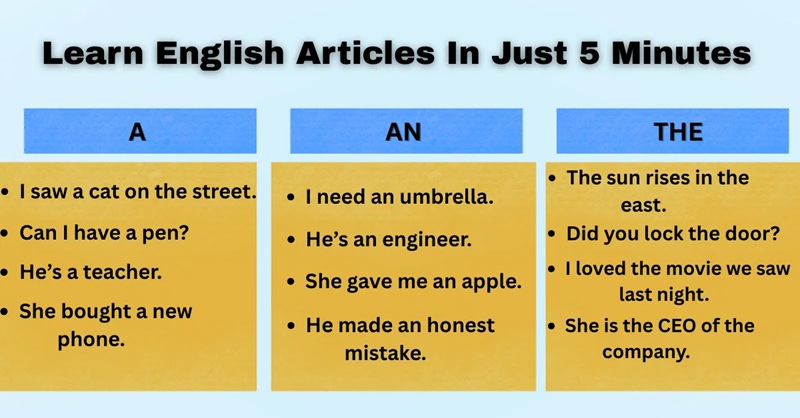
I saw a car. (any car; not specific)
-
I saw the car. (a specific car both speakers know about)
Mastering the article in English grammar allows learners to communicate more precisely.
Types of Articles in English Grammar
Before using articles confidently, it is useful to understand each type and how it functions. Each article changes the meaning of the noun it modifies, so knowing the types is essential.
Indefinite Articles: a / an
This section begins with the idea that indefinite articles introduce something for the first time or refer to something not specific.
Use a before words beginning with consonant sounds:
-
a dog
-
a teacher
-
a university (starts with consonant sound /ju/)
Use an before words beginning with vowel sounds:
-
an apple
-
an hour (silent h → vowel sound)
-
an umbrella
Indefinite articles are used with singular countable nouns only.
Definite Article: the
Before learning how to use “the,” remember that definite articles point to something specific. This may be known from context, previous mention, or shared knowledge.
Examples:
-
Please open the door. (the only door being referred to)
-
I cleaned the kitchen. (a specific kitchen)
-
The Earth moves around the Sun. (unique nouns)
“The” can be used with singular nouns, plural nouns, and uncountable nouns when referring to something specific.
Articles with Countable and Uncountable Nouns
Before applying articles correctly, it is important to understand how noun types affect article use. Countable and uncountable nouns follow different rules.
|
Noun Type |
Article Usage |
Examples |
|
Singular countable |
a / an / the |
a banana, an idea, the house |
|
Plural countable (general) |
no article |
Kids like games. |
|
Plural countable (specific) |
the |
The students in Class A |
|
Uncountable (general) |
no article |
Milk is healthy. |
|
Uncountable (specific) |
the |
The milk on the table is mine. |
Recognizing noun types helps prevent common article mistakes.
Key Rules for Using Articles in English Grammar
To apply articles correctly in writing and speaking, learners should follow several core rules.
Rule 1: Use a/an when introducing something for the first time
Example:
- I saw a movie last night.
- When mentioned again:
- The movie was exciting.
Rule 2: Use the when something is specific or previously known
Example:
Can you hand me the keys? (both know which keys)
Rule 3: Use a/an before professions or roles
Examples:
-
She is a doctor.
-
He wants to become an architect.
Rule 4: Use the with unique nouns
Examples:
-
The sky
-
The president of the United States
Rule 5: No article with general statements about plural or uncountable nouns
Examples:
-
Books are expensive.
-
Water is essential.
Rule 6: Use the with superlatives and ordinal numbers
Examples:
-
She is the smartest student in the class.
-
This is the first time I’ve visited London.
Special Cases in Article Usage
Before exploring examples, it is useful to understand exceptions and advanced patterns.
No article with some proper nouns
Examples:
-
I live in Japan.
-
She studies at Harvard University.
But use the when referring to groups of countries or geographic features:
-
the United States
-
the Alps
-
the Pacific Ocean
Articles with languages and subjects
No article is used:
-
He studies English.
-
Math is difficult.
But: He improved in the English he learned at school. (specific)
Articles with musical instruments and inventions
Examples:
-
She plays the piano.
-
Edison invented the light bulb.
Common Mistakes with Articles
Before correcting errors, it is helpful to observe how articles change meaning.
|
Incorrect |
Correct |
Explanation |
|
She is engineer. |
She is an engineer. |
Professions need a/an. |
|
I saw the tiger in the zoo. (not specific) |
I saw a tiger in the zoo. |
First mention → a/an. |
|
He drank a water. |
He drank water. |
Uncountable nouns → no article. |
|
Sun is hot. |
The sun is hot. |
Unique noun → the. |
Understanding these mistakes helps learners avoid confusion.
Examples of Articles in Sentences
To apply theory effectively, learners should review examples in natural sentences.
-
A cat is sleeping on the chair.
-
The car we bought last year is expensive.
-
She wants to buy an umbrella.
-
Water is necessary for life.
-
The mountains look beautiful today.
Exercises: Articles in English Grammar
Exercise 1: Fill in the blanks with a / an / the / or no article
-
I need ___ umbrella.
-
___ books on the desk are mine.
-
She is ___ engineer.
-
___ Earth orbits the sun.
-
We watched ___ movie last night.
Exercise 2: Correct the mistakes
-
He wants to buy an new phone.
-
I visited the Japan last year.
-
Water in bottle is cold.
-
She read a interesting book.
-
The cats are friendly animals. (general meaning)
Exercise 3: Write your own sentences
Write:
-
One sentence using a/an
-
One sentence using the
-
One sentence with no article
Answer Key
Exercise 1:
-
an
-
The
-
an
-
The
-
a
Exercise 2:
-
He wants to buy a new phone.
-
I visited Japan last year.
-
The water in the bottle is cold.
-
She read an interesting book.
-
Cats are friendly animals.
Learn English Grammar Effectively with Monkey Junior
If you want a structured method to master topics like articles in English grammar, Monkey Junior provides a complete learning pathway. The program includes detailed grammar explanations, native-speaker audio, interactive examples, and vocabulary lessons that help learners absorb grammar naturally.
Learners encounter articles repeatedly through stories, reading units, and practice activities, making the rules easy to remember and apply. Monkey Junior also supports daily learning through short, effective lessons and a clear progression system. It is a practical and enjoyable way to strengthen English grammar at any level.
Start your child’s learning journey today with Monkey Junior and let them express their emotions in English confidently and naturally.
Conclusion
Understanding the article in English grammar is essential for clear and accurate communication. By learning the difference between a, an, and the, and recognizing when to omit articles, learners can express ideas more naturally. With consistent practice and the structured support of Monkey Junior, mastering article usage becomes both achievable and enjoyable.