

.png)
The pronunciation of N in English is very common, but learners often confuse it with similar nasal sounds. Understanding how N is pronounced in different positions will help you speak more clearly and naturally.
What Is the Pronunciation of N in English?
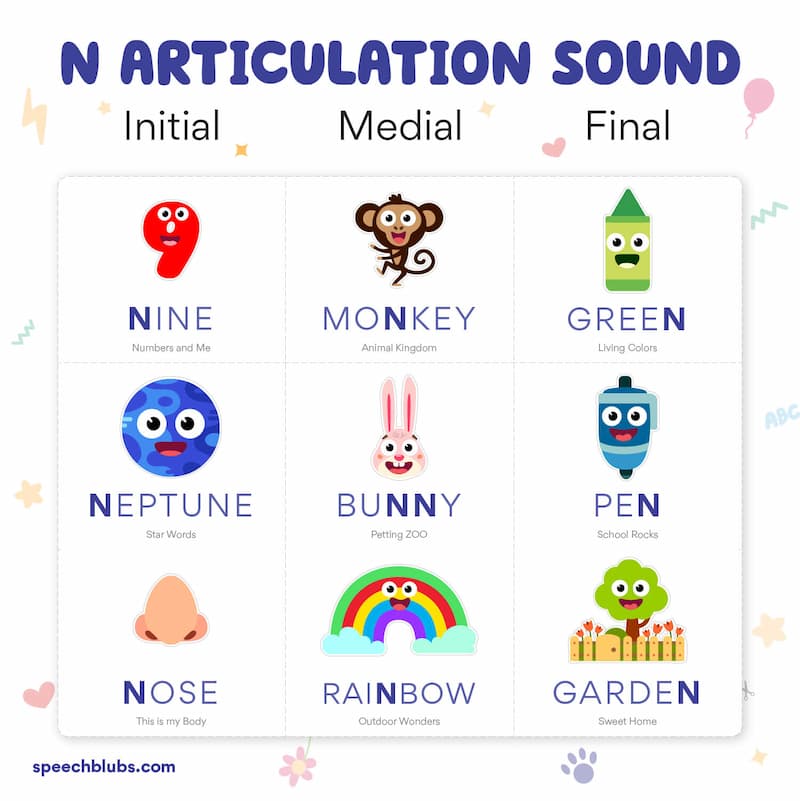
To start, learners should know that the pronunciation of N in English most often uses the /n/ sound. This is a voiced nasal consonant, meaning the vocal cords vibrate and air flows through the nose.
The /n/ sound is produced by touching the tip of the tongue to the ridge behind the upper front teeth while keeping the lips open.
Examples:
-
name
-
nose
-
Night
How to Pronounce the /n/ Sound Correctly
Before practicing words, it is important to focus on mouth position. In the pronunciation of N, the tongue blocks the airflow in the mouth, forcing air to pass through the nose.
You should feel vibration in your throat and steady airflow through your nose. This creates a clear and natural /n/ sound.
Examples:
-
net
-
number
-
nice
Pronunciation of N in Different Word Positions
The pronunciation of N stays consistent across most word positions, which makes it easier to learn than many other consonants.
At the beginning of words:
-
new
-
next
In the middle of words:
-
dinner
-
money
At the end of words:
-
ten
-
green
In all cases, the tongue position remains the same.
Pronunciation of NG (/ŋ/) Sound
An important variation related to the pronunciation of N is the /ŋ/ sound, commonly spelled as “ng”. This sound is produced at the back of the mouth, not with the tongue tip.
Unlike /n/, the tongue does not touch the teeth ridge. Instead, the back of the tongue touches the soft palate.
Examples:
-
sing
-
long
-
running
It is important not to pronounce a hard /g/ sound at the end of these words.
References: Ellii (formerly ESL Library)
N Sound vs Similar Sounds (N and M)
A common challenge in the pronunciation of N is confusing it with the /m/ sound. Both are nasal, but they use different mouth positions.
With /n/, the tongue touches the roof of the mouth. With /m/, the lips are closed.
Examples:
-
net vs met
-
sun vs sum
Practicing minimal pairs helps learners clearly hear and produce the difference.
Common Mistakes with the Pronunciation of N
Even though the pronunciation of N is relatively simple, learners still make common errors.
Typical mistakes include:
-
Pronouncing /ng/ as /n/ + /g/
-
Weak tongue contact
-
Confusing /n/ with /m/
Careful listening and repetition help correct these issues.
Exercises: Practice the Pronunciation of N
Exercise 1: Identify the Correct Sound
Decide whether the word contains /n/ or /ŋ/.
-
night
-
sing
-
nose
-
long
-
pen
Exercise 2: Choose the Correct Word
Choose the word that contains the /n/ sound.
-
net / met
-
sun / sum
-
nose / most
-
ten / them
Exercise 3: Read the Sentences Aloud
Focus on the pronunciation of N in each sentence.
-
The new notebook is on the table.
-
She enjoys listening to songs.
-
We need ten more minutes.
Answer Key
Exercise 1:
-
/n/
-
/ŋ/
-
/n/
-
/ŋ/
-
/n/
Exercise 2:
-
net
-
sun
-
nose
-
ten
Learn the Pronunciation of N with Monkey Junior and M-Speak
Improving the pronunciation of N is much easier with guided practice and accurate feedback. Monkey Junior provides a structured phonics learning path that helps learners master individual sounds before moving to words and sentences.
With M-Speak pronunciation scoring technology, learners receive instant feedback on sound accuracy, nasal airflow, and articulation. This allows learners to detect errors early and improve pronunciation efficiently.
Monkey Junior also integrates native-speaker audio, listening practice, speaking activities, and multiple supporting technologies into one comprehensive learning system. The clear roadmap ensures consistent progress and long-term improvement.

Start learning with Monkey Junior today to build strong and accurate English pronunciation using smart technology and guided practice.
Conclusion
The pronunciation of N in English includes the common /n/ sound and the related /ŋ/ sound. By understanding tongue placement and airflow and practicing regularly with Monkey Junior and M-Speak technology, learners can speak English more clearly, confidently, and naturally.