

.png)
Relative pronouns are essential tools that connect ideas smoothly and make sentences more precise in English grammar. In this complete guide to relative pronouns, you’ll learn their meanings, functions, and how to use them correctly through clear rules, examples, and practice exercises.
What are relative pronouns?
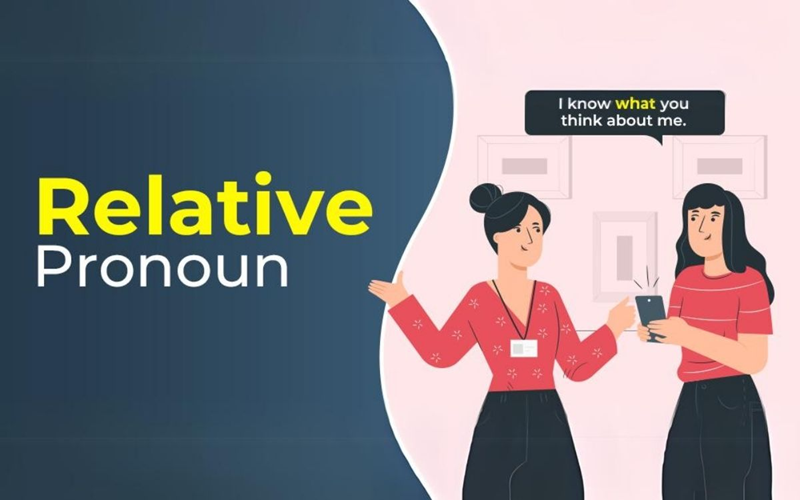
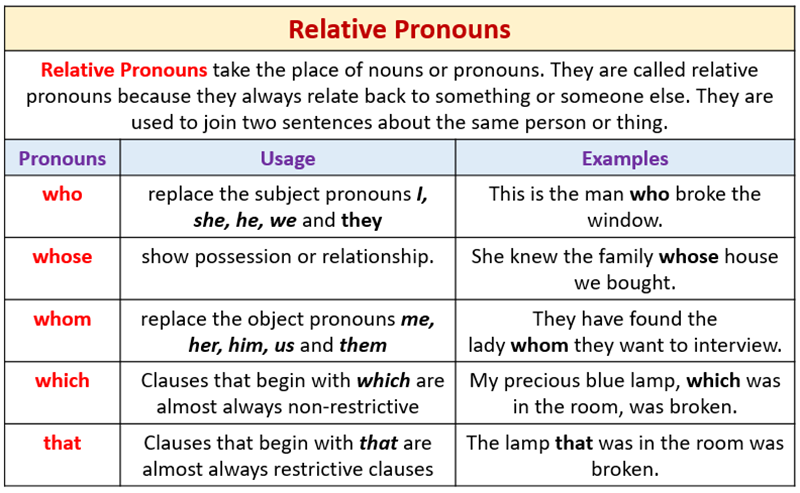
A relative pronoun is a word that introduces a relative clause and connects it to the noun it describes. It helps identify or add extra details about that noun without starting a new sentence.
Relative pronouns function as linking tools that blend ideas smoothly, making sentences more compact and easier to follow. They clarify relationships between clauses and prevent unnecessary repetition.
Examples:
-
The girl who lives next door is very friendly.
-
The book that you recommended was excellent.
-
The man whom we met yesterday works at the museum.
-
The cat whose tail is long belongs to my neighbor.
List of common relative pronouns
1. Who
“Who” refers to people and acts as the subject of the relative clause, helping identify the person performing the action.
Examples:
-
The woman who called earlier left a message for you.
-
The students who joined the workshop learned valuable skills.
2. Whom
“Whom” is used for people as the object of the verb or a preposition, mainly in more formal contexts.
Examples:
-
The manager whom you met yesterday will lead the project.
-
The friend to whom I sent the invitation hasn’t replied yet.
3. Whose
“Whose” shows possession and can refer to both people and things, adding ownership information smoothly.
Examples:
-
The writer whose book you enjoyed is releasing another novel.
-
The company whose logo changed recently is expanding globally.
4. Which
“Which” refers to animals or things and provides either essential details or extra information.
Examples:
-
The camera which I borrowed from you takes great photos.
-
The tree which stands in the garden is over a century old.
5. That
“That” is used in defining clauses for both people and things, giving necessary information about the noun.
Examples:
-
The dress that she bought yesterday fits perfectly.
-
The team that won the competition trained for months.
Types of relative clauses
1. Defining (restrictive) clauses
A defining relative clause provides essential information that identifies the specific person or thing being mentioned. It does not use commas because the meaning of the sentence depends on this information.
Example: The employee who handles customer complaints is on leave today.
2. Non-defining (non-restrictive) clauses
A non-defining relative clause adds extra, non-essential information about a noun that is already clearly identified. It always uses commas to show that the added detail is optional.
Example: My neighbor, who is a professional pianist, performs in concerts worldwide.
How to use relative pronouns correctly
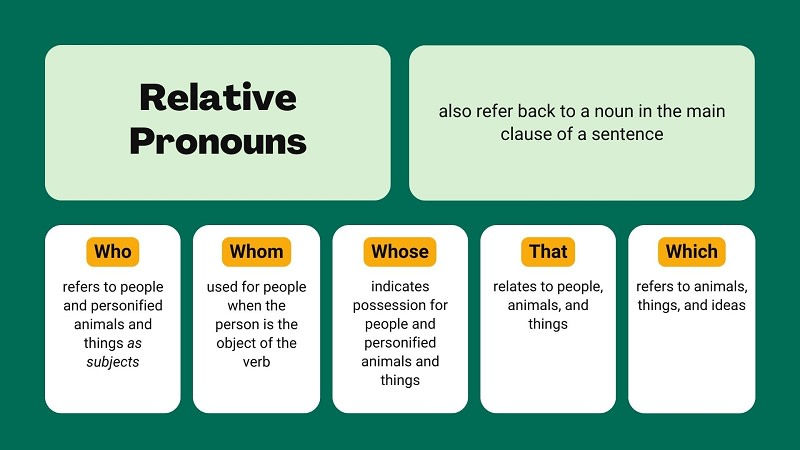
Choosing the right relative pronoun depends on whether you are referring to people, things, or possession, as well as the pronoun’s role in the clause. Use who for people as subjects, whom for people as objects, which for things, whose for possession, and that for essential information in defining clauses.
Commas are only used with non-defining clauses, where the extra detail is not required to identify the noun. For clarity and natural flow, avoid using that in non-defining clauses and use whom mainly in formal contexts.

Omitting relative pronouns
A relative pronoun can be omitted in defining clauses when it functions as the object of the verb, allowing the sentence to sound more natural and concise. It cannot be omitted when the pronoun acts as the subject of the relative clause.
Examples:
-
The report (that) you sent was very helpful.
-
The person (whom) we met yesterday was very kind.
|
Give your child a strong English foundation from the very beginning with Monkey Junior. Start learning through fun games, native audio, and smart AI tools–perfect for kids aged 0-11. Help them build real skills in listening, speaking, reading, and writing step by step. Download Monkey Junior today and watch your child grow in confidence and English ability.
|

Practice exercises
Below are three types of exercises to help reinforce the correct use of relative pronouns. Each set includes five questions followed by an answer key.
1. Fill-in-the-blank (Choose: who, whom, whose, which, that)
-
The scientist ___ discovered the formula won an international award.
-
The restaurant ___ we visited last night was fully booked.
-
The student ___ laptop was stolen reported it to the office.
-
The movie ___ you recommended turned out to be excellent.
-
The woman with ___ he spoke is a well-known author.
2. Sentence rewriting (Rewrite using a relative pronoun)
-
The boy is my cousin. He lives next door.
-
I bought a book. It explains basic photography.
-
She met a designer. You mentioned him yesterday.
-
The car belongs to my uncle. Its engine is extremely powerful.
-
I visited a museum. It opened only last month.
3. Multiple choice
1. The person ___ answered the phone was very polite.
a. which b. who c. whose
2. The house, ___ was built in 1920, has been renovated.
a. that b. whom c. which
3. The team ___ they supported won the final match.
a. who b. whom c. that
4. The singer ___ album you bought is performing tonight.
a. whose b. who c. which
5. The dog ___ bark kept the neighbors awake.
a. which b. whose c. Whom
Answers
Exercise 1:
-
who
-
that / which
-
whose
-
that / which
-
whom
Exercise 2:
-
The boy who lives next door is my cousin.
-
I bought a book that explains basic photography.
-
She met a designer whom you mentioned yesterday.
-
The car whose engine is extremely powerful belongs to my uncle.
-
I visited a museum which opened only last month.
Exercise 3:
-
b
-
c
-
c
-
a
-
b
Mastering relative pronouns helps you write clearer, more natural sentences and express detailed information without repetition. Keep practicing the structures in this guide to build stronger grammar skills and use relative clauses with confidence.