

.png)
A compound sentence is one of the core types of sentence structures in English that helps writers connect related ideas into a single, coherent sentence. Unlike simple sentences, compound sentences contain two or more independent clauses joined correctly with coordinating conjunctions or punctuation, making writing clearer and more engaging.
What is a compound sentence?
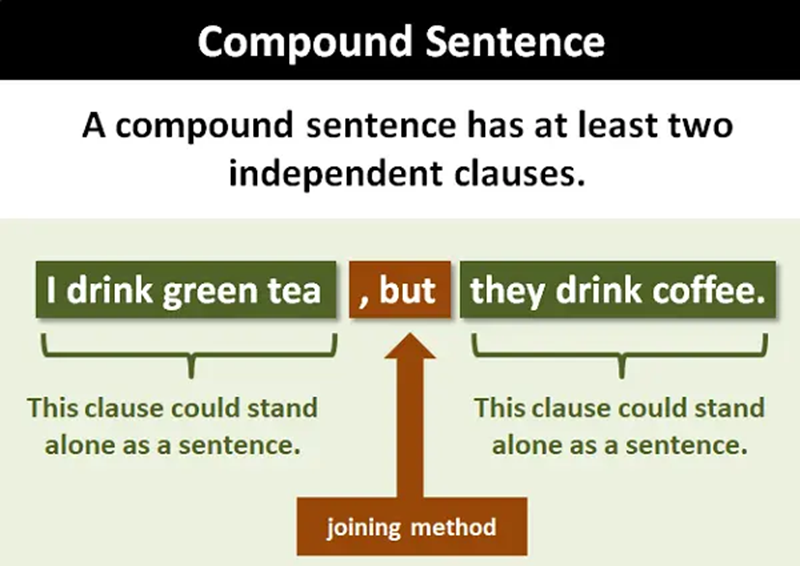
A compound sentence is a sentence made by joining two or more independent clauses with a coordinating conjunction or a semicolon. Each clause can stand alone as a complete sentence, but connecting them helps show how the ideas relate. This structure creates writing that feels smoother and more coherent.
An independent clause has a subject, a verb, and expresses a complete idea. Because each clause is grammatically complete, incorrect punctuation can easily lead to run-on sentences. Using the right conjunction or semicolon ensures the relationship between the ideas is clear.
A simple sentence contains only one independent clause, while a compound sentence contains two or more. Consider the contrast below:
-
Simple sentence: The sun set.
-
Compound sentence: The sun set, and the air grew cooler.
-
Compound sentence (semicolon): The sun set; the air grew cooler.
Compound sentences are especially useful when expressing related actions, adding information, or showing contrast. They help writers avoid short, choppy sentences and create more natural flow. When used intentionally, compound sentences greatly improve clarity and readability in English writing.
Compound sentence structure
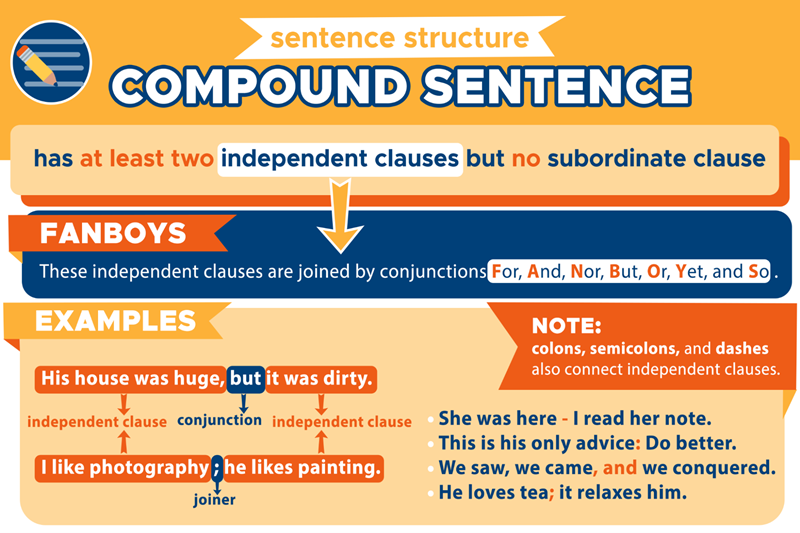
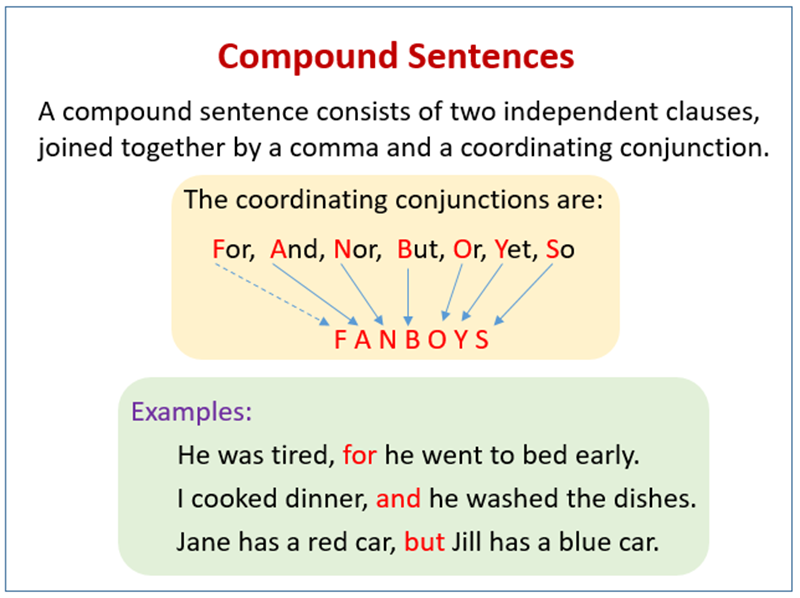
A compound sentence is formed by connecting two or more independent clauses in a clear and balanced way. The most common method uses coordinating conjunctions, remembered by the acronym FANBOYS: for, and, nor, but, or, yet, so. Each conjunction shows a different relationship between ideas, such as contrast, addition, or consequence.
The basic structure with a coordinating conjunction is:
Independent clause + comma + coordinating conjunction + independent clause.
The comma marks the boundary between the two complete ideas and prevents run-on sentences. This structure keeps the relationship between the clauses easy to understand.
A semicolon offers another way to join independent clauses. The structure is:
Independent clause + semicolon + independent clause.
This option is useful when the ideas are closely related but do not require a conjunction.
Punctuation choices strongly influence clarity and readability. A missing comma can confuse readers about where one idea ends and the next begins. Using the correct punctuation creates smoother flow and more precise meaning.
Examples:
-
I wanted to go for a walk, but it started raining.
-
She finished her report, and she submitted it before the deadline.
-
He didn’t see the message, nor did he check his email again.
-
The meeting ended early; everyone left the office right away.
-
The lights flickered; the storm was getting stronger.
Compound vs. complex sentences
Compound and complex sentences are often confused because both contain more than one clause, but their structures differ significantly. A compound sentence joins two independent clauses, each able to stand alone as a complete sentence. A complex sentence, however, combines an independent clause with a dependent clause that relies on the rest of the sentence for meaning.
Understanding this difference helps writers express ideas more accurately and with greater variety. Compound sentences work well when linking balanced or related ideas, while complex sentences convey relationships such as cause, condition, or contrast. Using both forms effectively leads to clearer, more engaging writing.
Comparison overview:
|
Feature |
Compound Sentence |
Complex Sentence |
|
Clause Structure |
Two independent clauses |
Independent + dependent clause |
|
Connector Type |
Coordinating conjunctions (FANBOYS) or semicolon |
Subordinating conjunctions (e.g., because, although, when) |
|
Example 1 |
I finished my work, and I went home early. |
I went home early because I finished my work. |
|
Example 2 |
The weather was warm; we opened the windows. |
Because the weather was warm, we opened the windows. |
Recognizing when to use each type improves sentence rhythm, tone, and clarity. It also helps writers avoid repetition and communicate relationships between ideas more precisely. Mastering both structures is essential for strong academic, professional, and everyday writing.
|
Give your child a strong English foundation from the very beginning with Monkey Junior. Start learning through fun games, native audio, and smart AI tools–perfect for kids aged 0-11. Help them build real skills in listening, speaking, reading, and writing step by step. Download Monkey Junior today and watch your child grow in confidence and English ability.
|


Common mistakes learners make
1. Run-on sentence
One of the most common mistakes learners make is creating run-on sentences by joining two independent clauses without the needed comma, conjunction, or semicolon. This causes the sentence to feel rushed and unclear. Proper punctuation prevents confusion and keeps the ideas well separated.
Examples:
-
[Wrong] I wanted to call you I was busy.
-
[Right] I wanted to call you, but I was busy.
2. Wrong conjunction choice
Another frequent issue is choosing the wrong coordinating conjunction. Each conjunction in FANBOYS expresses a specific relationship, so the wrong choice can distort the intended meaning. Using the correct connector ensures the sentence remains logical and accurate.
Examples:
-
[Wrong] She stayed home, for she was tired. (incorrect meaning)
-
[Right] She stayed home, because she was tired.
3. Mixing compound and complex rules
Learners also often mix compound and complex structures, especially when they confuse coordinating and subordinating conjunctions. This results in sentences that begin with one structure but accidentally shift into another. Keeping the two rule sets distinct helps avoid structural errors.
Examples:
-
[Wrong] The movie ended, although we left early.
-
[Right] The movie ended, and we left early.
-
[Right] Although we left early, the movie ended.
Understanding compound sentences is essential for anyone looking to improve English writing and communication skills. By mastering how to connect related ideas with coordinating conjunctions or semicolons, you can make your sentences clearer, more dynamic, and stylistically varied.