

.png)
A simple sentence is the most basic type of sentence in English grammar that expresses a complete idea using a single independent clause with a subject and a verb. Simple sentences are essential for building strong writing and speaking skills, as they form the foundation of clear communication in English.
What is a simple sentence?
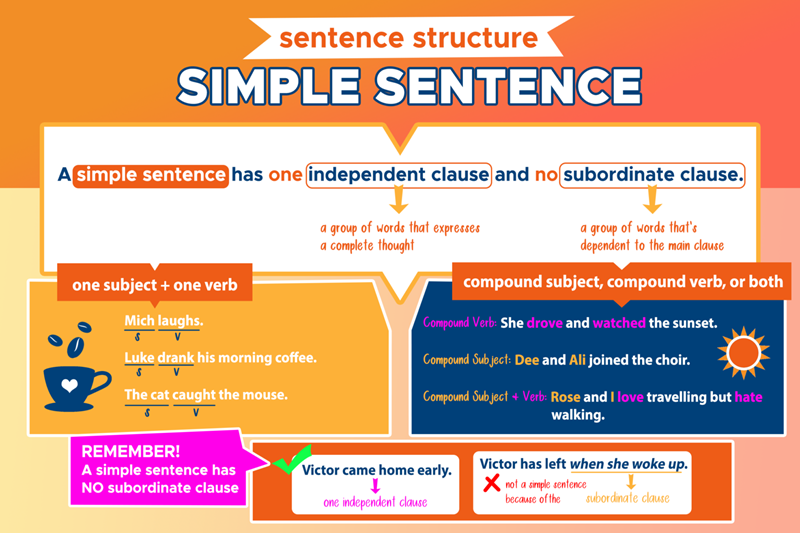
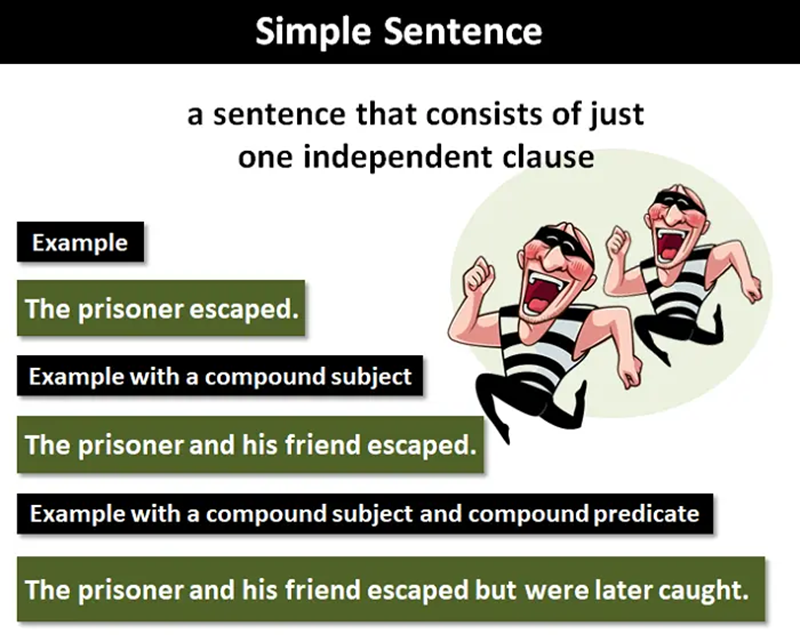
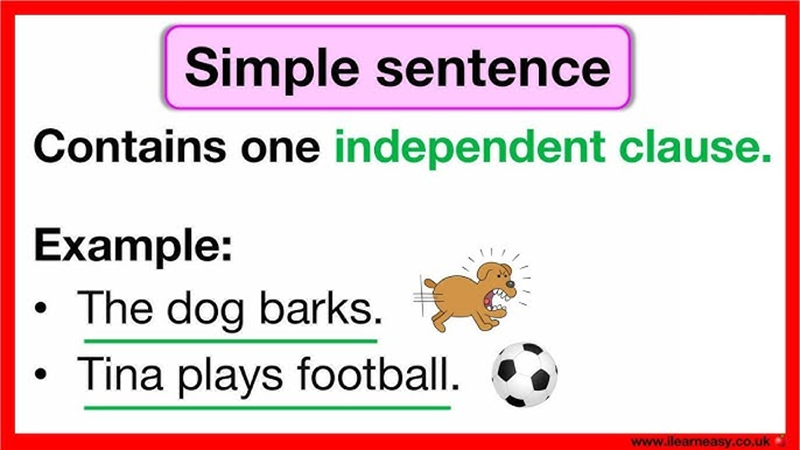
A simple sentence is a sentence that contains one independent clause with a clear subject and a verb. It expresses a complete idea on its own and does not rely on any additional clauses for meaning. This basic structure makes it the easiest and most essential sentence form in English.
A simple sentence matters because it forms the foundation of all English writing and speaking. Learners who master simple sentences can organize thoughts clearly and communicate with accuracy. It is also the first step to understanding more complex sentence types.
Examples:
-
The sun rises in the east.
-
She reads every morning.
-
They finished the project yesterday.
-
My brother is a doctor.
-
We played football after school.
Core components of a simple sentence
A subject is the element that tells us who or what the sentence is about. It can be a single noun, a pronoun, or a longer noun phrase depending on the context. For example: “The little boy”, “Sarah”, and “My new laptop” can all function as subjects.
The verb expresses the action or state of the subject, and it may appear alone or with helping verbs. A main verb shows the essential meaning, while helping verbs add tense, possibility, or emphasis. For instance: “runs”, “is sleeping”, and “will study” all contain a main verb with or without auxiliaries.
A sentence is considered complete when it communicates a full idea that the reader can understand without additional information. This completeness comes from having both a subject and a verb working together in a meaningful way. For example, “The dog barked” is complete, but “The dog” alone is not.
Simple sentence structures
1. S + V (Subject + Verb)
Structure: Subject + Verb
Example: Birds sing.
This structure is the most basic form of a simple sentence because it presents a subject performing an action. It works well for short statements or general truths.
2. S + V + O (Subject + Verb + Object)
Structure: Subject + Verb + Object
Example: The teacher explained the lesson.
Here, the object receives the action of the verb, making the sentence more informative. This structure is common in everyday communication.
3. S + V + Complement
Structure: Subject + Verb + Complement
Example: The room is quiet.
The complement provides essential information that completes the meaning of the verb, especially with linking verbs like be, become, or seem. Without the complement, the idea would feel incomplete.
4. S + V + Adverbial
Structure: Subject + Verb + Adverbial
Example: We met at the library.
The adverbial adds details such as time, place, or manner, making the sentence clearer and more specific. It enriches the sentence without creating additional clauses.
5. Variations with compound subjects or compound verbs
Structure: Compound Subject + Verb / Subject + Compound Verb
Example:
-
Anna and Leo traveled to Japan.
-
She cooked and cleaned yesterday.
Compound elements add variety to simple sentences while still keeping them within a single independent clause. They help convey multiple actions or shared subjects without forming a compound sentence.
|
Give your child a strong English foundation from the very beginning with Monkey Junior. Start learning through fun games, native audio, and smart AI tools–perfect for kids aged 0-11. Help them build real skills in listening, speaking, reading, and writing step by step. Download Monkey Junior today and watch your child grow in confidence and English ability.
|


Simple sentences vs other sentence types
Comparison table between simple sentences, compound sentences and complex sentences:
|
Feature |
Simple Sentence |
Compound Sentence |
Complex Sentence |
|
Number of Clauses |
1 independent clause |
2+ independent clauses |
1 independent clause + 1+ dependent clauses |
|
Key Components |
Subject + verb (may include objects/complements/adverbials) |
Independent clause + coordinating conjunction + independent clause |
Independent clause + subordinating conjunction + dependent clause |
|
Common Conjunctions |
Not required |
and, but, or, so, yet, nor, for |
because, although, when, if, since, while, unless |
|
Complexity Level |
Lowest; easiest structure |
Medium; combines equal ideas |
Highest; expresses detailed relationships |
|
Purpose |
State clear, simple ideas |
Connect related ideas of equal importance |
Add explanations, reasons, conditions, or background information |
|
When to Use |
For emphasis, clarity, or short statements |
To improve flow and avoid choppy writing |
When showing cause–effect, contrast, time, or conditions |
|
Advantages |
Direct, easy to understand, concise |
Balanced ideas, smooth transitions |
Adds depth, nuance, and rich information |
|
Disadvantages |
Can feel too short or repetitive if overused |
May sound mechanical if connectors are repeated |
Can become wordy or confusing if misused |
|
Examples |
She smiled. |
She smiled, and she waved. |
She smiled because she saw her friend. |
Understanding simple sentences is essential for mastering English grammar and improving communication skills. By learning the definition, structures, and examples, learners can build a strong foundation that supports more advanced writing and speaking tasks. Practicing simple sentences helps enhance clarity, accuracy, and confidence in English.