


.png)
Briefly explain that adverbs of degree are words that modify how much or to what extent something happens. Emphasize their role in making language more precise and expressive. Provide a simple overview of what the article will cover: definition, key types, examples, placement rules, and usage tips.
What are adverbs of degree?
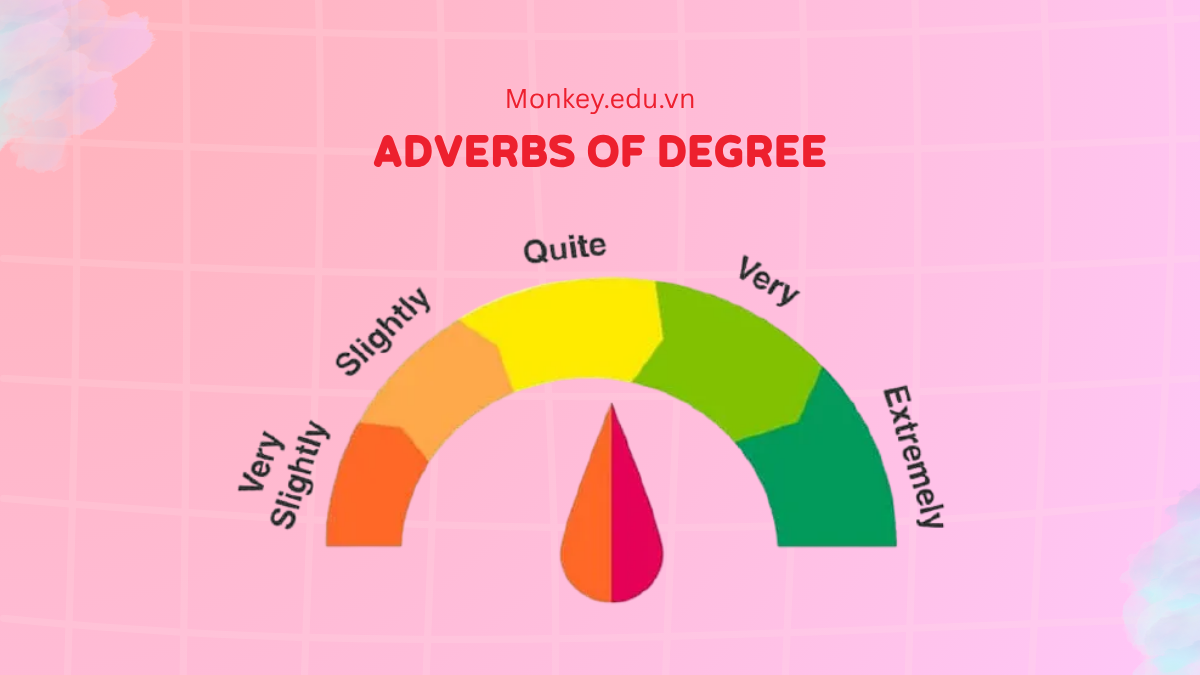
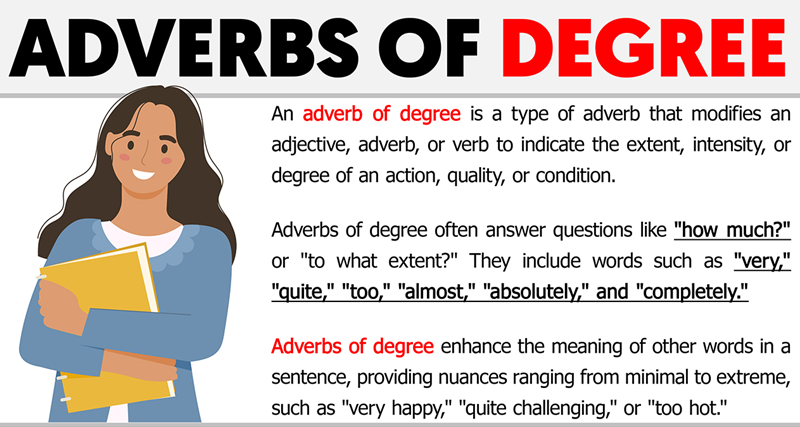
Adverbs of degree are words that show how much, how little, or to what extent an action, adjective, or another adverb is true. They answer the question “to what degree?” and provide clarity about intensity. Common examples include very, almost, extremely, slightly, and completely.
These adverbs are essential in English communication because they make descriptions more precise and meaningful. They help speakers express subtle differences instead of using vague or general statements. Without them, ideas often lose emotional weight or accuracy.
Examples:
-
She is very tired.
-
He almost finished the project.
-
The soup is too hot to eat.
-
They were completely surprised by the news.
-
The room is slightly messy today.
Types of adverbs of degree
Adverbs of degree can be grouped into three main types based on how they modify intensity: strengthening, diminishing, and limiting. Each type adds a different level of emphasis or detail to the meaning of a sentence. Understanding these categories helps learners choose the most accurate word for the message they want to express.
1. Strengthening adverbs (increase intensity)
Strengthening adverbs increase the force of an adjective, verb, or another adverb. They show a high level of intensity, making statements more emphatic and expressive. Common examples include very, extremely, and absolutely.
Examples:
-
The movie was very entertaining.
-
She felt extremely proud of her achievement.
-
The room was absolutely silent after the announcement.
2. Diminishing adverbs (reduce intensity)
Diminishing adverbs soften or lower the degree of an action or description. They are useful when the speaker wants to express a mild, partial, or reduced effect. Common examples include slightly, somewhat, and barely.
Examples:
-
The water was slightly warm.
-
He looked somewhat confused during the test.
-
She could barely hear the music from outside.
3. Limiting adverbs (specify extent)
Limiting adverbs show that an action or situation happens to a certain but incomplete extent. They often indicate approximation, restriction, or the point just before completion. Common examples include almost, just, and nearly.
Examples:
-
He almost reached the finish line.
-
The class just started a few minutes ago.
-
They nearly missed the last bus.
List common adverbs of degree
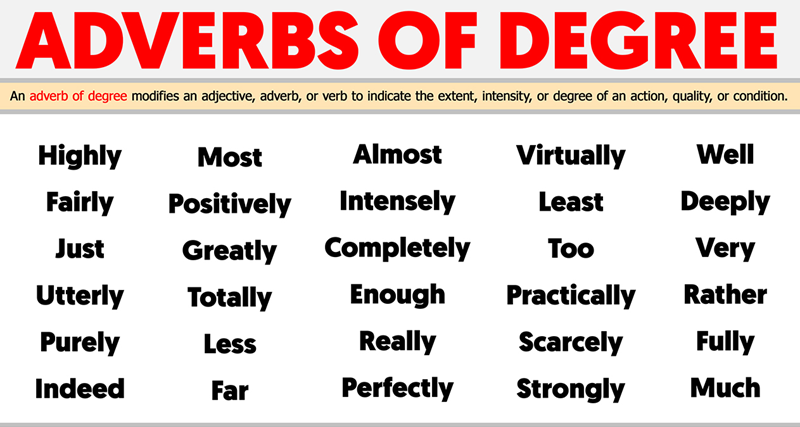
Adverbs of degree vary widely in meaning, but several appear frequently in everyday English. The table below highlights common options, their functions, and practical examples to show how each one modifies intensity. These examples are simple and clear, making them easy for learners to recognize and use correctly.
|
Adverb |
Function |
Example Sentence |
|
very |
Increases intensity |
The task was very easy to understand. |
|
too |
Shows excess or an undesirable degree |
The jacket is too large for him. |
|
almost |
Indicates something is close to happening |
She almost won the competition. |
|
nearly |
Shows close proximity to completion |
We nearly missed the turn. |
|
completely |
Shows total or full extent |
The room was completely decorated. |
|
entirely |
Shows total completion |
The plan was entirely revised. |
|
utterly |
Intensifies strong adjectives |
The news was utterly shocking. |
|
extremely |
Shows very high intensity |
He felt extremely nervous before the exam. |
|
highly |
Strengthens positive qualities |
The course is highly recommended. |
|
barely |
Shows a very small or minimal degree |
She could barely see through the fog. |
|
slightly |
Reduces intensity or shows a small amount |
The door was slightly open. |
|
somewhat |
Expresses mild or partial degree |
He was somewhat disappointed by the result. |
|
just |
Limits extent or means “exactly/only” |
They just finished the presentation. |
|
fairly |
Shows moderate degree |
The instructions were fairly simple. |
|
quite |
Shows medium to strong degree depending on context |
The movie was quite interesting. |
|
rather |
Indicates more intensity than expected |
The exam was rather difficult. |
|
totally |
Emphasizes full extent |
She was totally prepared for the interview. |
|
absolutely |
Adds strong emphasis |
The view was absolutely stunning. |
|
deeply |
Modifies emotional or abstract states |
He was deeply grateful for the support. |
|
strongly |
Emphasizes firm opinions or recommendations |
I strongly believe we should start early. |
Rules for placement in sentences
Adverbs of degree follow predictable placement rules that help express intensity clearly. Their position can change the meaning or emphasis of a sentence, so understanding where they typically appear is essential. The guidelines below highlight the most common and reliable patterns.
1. Before adjectives or adverbs
Adverbs of degree most often appear directly before the adjective or adverb they modify. This placement clarifies how strong, weak, or precise the description is.
Examples:
-
The weather is very cold today.
-
She ran extremely quickly in the final round.
2. Between the subject and the verb
Some degree adverbs can be placed between the subject and the main verb, especially when modifying the verb itself. This position is common with words like almost, barely, and just.
Examples:
-
They almost forgot the meeting.
-
He just finished his report.
|
Give your child a strong English foundation from the very beginning with Monkey Junior. Start learning through fun games, native audio, and smart AI tools–perfect for kids aged 0-11. Help them build real skills in listening, speaking, reading, and writing step by step. Download Monkey Junior today and watch your child grow in confidence and English ability.
|


3. After the verb “to be”
When the main verb is a form of “to be,” the adverb of degree usually comes after it. This structure keeps the sentence natural and easy to read.
Examples:
-
The results were completely unexpected.
-
Her explanation is quite clear.
4. Tips for avoiding common errors
Avoid placing degree adverbs too far from the word they modify, as this can make the sentence unclear. Use only one strong degree adverb at a time to prevent unnecessary repetition or exaggeration. When unsure, place the adverb directly before the adjective or adverb - it is the safest and most common structure.

Understanding Adverbs of Degree helps English learners express intensity, precision, and nuance with far greater accuracy. By mastering their types, meanings, and placement rules, you can make your sentences clearer and more natural in everyday communication. Keep practicing with real examples, and you’ll soon use Adverbs of Degree confidently in both speaking and writing.