.png)
The future perfect tense is a powerful structure that helps you describe actions that will be completed before a specific time in the future. In this complete guide, you’ll learn its definition, structure, common uses, time expressions, and clear examples so you can use it confidently in everyday English.
What is the future perfect tense?
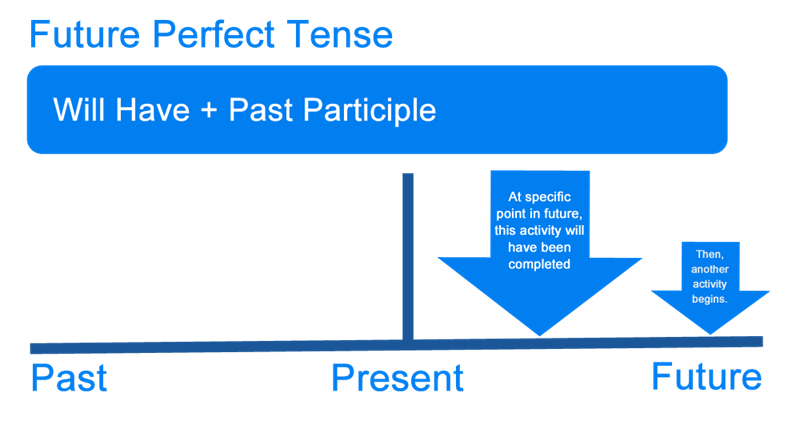
The future perfect tense is a grammatical structure used to describe an action that will be completed before a specific time or event in the future. It helps you highlight future results or achievements that will already be finished when another future moment arrives.
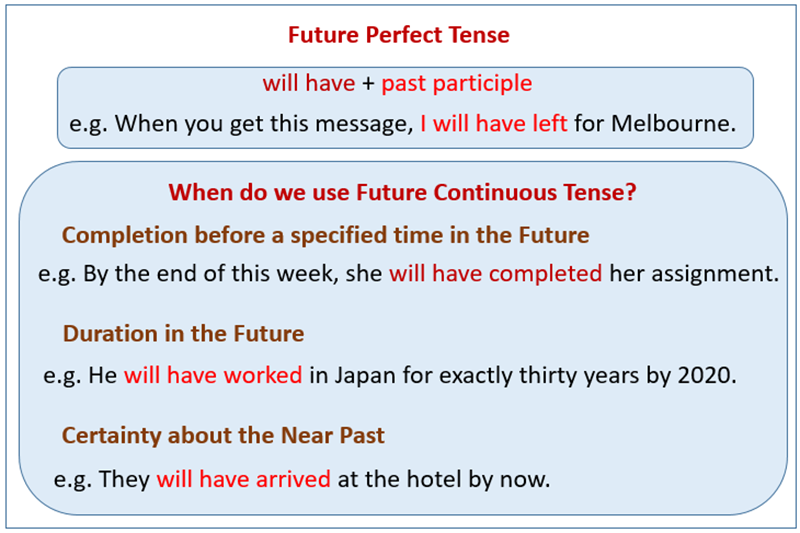
This tense is built with will have + past participle, and it emphasizes the sense of completion. We often use it to show deadlines, expectations, and sequences of future events.
Examples:
-
By next Monday, I will have finished the entire report.
-
She will have graduated by the time her family visits.
-
They will have left before the storm arrives.
Future perfect tense formula
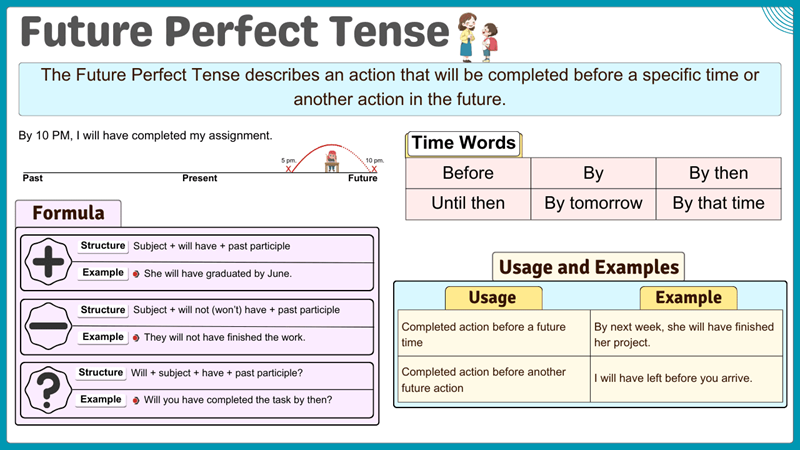
The future perfect tense follows a consistent structure that shows an action will be completed before a future point. Each form: affirmative, negative, and interrogative keeps will have as the core marker of the tense.
Basic structures:
|
Sentence Type |
Structure |
Example |
|
Affirmative |
Subject + will have + past participle |
By noon, I will have completed the task. |
|
Negative |
Subject + will not have + past participle |
She will not have finished her assignment by tonight. |
|
Question |
Will + subject + have + past participle? |
Will they have arrived before the meeting starts? |
When to use the future perfect tense
1. Before a specific future time or deadline
Use the future perfect tense to show that an action will be completed before a particular time in the future. This helps clarify deadlines or expected completion points.
Example: By tomorrow morning, she will have finished the presentation.
2. Before another future action
Use it when one future action will be completed before another future event happens. This highlights sequence and timing.
Example: They will have left the stadium before the match even starts.
3. To express expectations about future completion
This tense works well for predictions or assumptions about what will already be done at a certain future moment.
Example: By next month, he will have mastered all the course modules.
4. With time markers that indicate future deadlines
Time expressions like “by,” “before,” “by the time,” or “by next week” help signal the future point when the action will be finished.
Example: By the time you get home, we will have prepared dinner.
Common time expressions
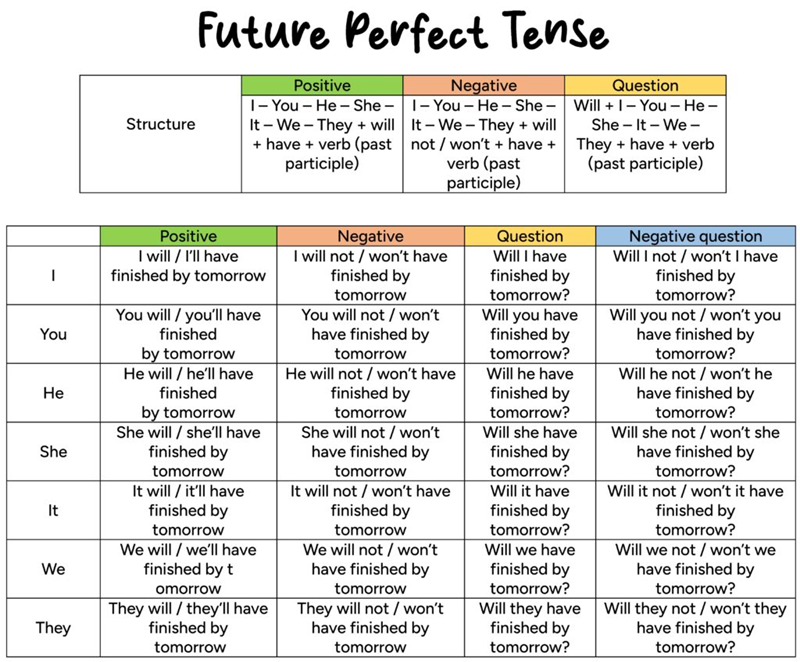
Time expressions used with the future perfect tense help specify the exact moment when an action will be completed. These markers make your sentence clearer and highlight the sense of future completion.
Common phrases include “by tomorrow,” “by next week,” “by the end of the day,” “before,” “by the time…,” “by next year,” and other deadline-focused expressions. These indicators show the point in the future when the action will already be finished.
Examples:
-
By next Friday, she will have submitted her thesis.
-
By the time the guests arrive, we will have set up the room.
Future perfect vs. Simple future
The future perfect tense emphasizes that an action will be completed before a future moment, making it ideal for deadlines, sequences, or expectations. In contrast, the simple future describes actions that will happen in the future but without stressing completion or a prior timeline.
Comparison table:
|
Feature |
Future Perfect Tense |
Simple Future Tense |
|
Purpose |
Shows an action that will be completed before a future point or another future action. |
Shows an action that will happen in the future without focusing on completion. |
|
Focus |
Completion + timing. |
Action + intention or prediction. |
|
Structure |
will have + past participle |
will + base verb |
|
Time Reference |
Usually includes deadlines or fixed future points. |
May include time, but not required. |
|
Common Use |
Planning, deadlines, expectations, and sequences. |
Promises, decisions, predictions, and general future events. |
|
Example 1 |
By 9 p.m., she will have finished her work. |
She will finish her work tonight. |
|
Example 2 |
By the time the movie starts, we will have arrived. |
We will arrive at the cinema at 7. |
|
Example 3 |
They will have completed the project by Friday. |
They will complete the project soon. |
Practice exercises
Below are short, focused exercises to help you master the future perfect tense. Each set contains five questions followed by a complete answer key.
1. Fill in the blanks
Complete each sentence using will have + past participle.
-
By next month, they __________ (complete) all the renovations.
-
She __________ (finish) the report before the team meeting starts.
-
By the time you land, we __________ (arrange) the transportation.
-
He __________ (save) enough money for the trip by summer.
-
By midnight, the storm __________ (pass) the coastline.
2. Rewrite the sentences
Rewrite each sentence to show the action will be completed before a specific future moment.
-
She will clean the house before you arrive.
-
They will submit the proposal by Friday.
-
I will learn the basics before the new course begins.
-
We will leave the city before the parade starts.
-
He will read all the chapters before the exam.
3. Choose the correct option
Select the sentence that correctly uses the future perfect tense.
1.
A. She will finish the work before noon.
B. She will have finished the work before noon.
2.
A. By next year, they will have expanded the business.
B. By next year, they will expand the business now.
3.
A. He will have eaten lunch by the time you arrive.
B. He will eat lunch by the time you arrive.
4.
A. We will have reached the station before 8 a.m.
B. We will reach the station before 8 a.m. yesterday.
5.
A. By the time the movie starts, I will have bought the tickets.
B. By the time the movie starts, I will buy the tickets yesterday.
|
Give your child a strong English foundation from the very beginning with Monkey Junior. Start learning through fun games, native audio, and smart AI tools–perfect for kids aged 0-11. Help them build real skills in listening, speaking, reading, and writing step by step. Download Monkey Junior today and watch your child grow in confidence and English ability.
|

Answers
Exercises 1:
-
will have completed
-
will have finished
-
will have arranged
-
will have saved
-
will have passed
Exercises 2:
-
She will have cleaned the house before you arrive.
-
They will have submitted the proposal by Friday.
-
I will have learned the basics before the new course begins.
-
We will have left the city before the parade starts.
-
He will have read all the chapters before the exam.
Exercises 3:
-
B
-
A
-
A
-
A
-
A
Mastering the future perfect tense allows you to express future completion with clarity and confidence. By understanding its structure, uses, and common time markers, you can describe future plans and expectations more accurately.