


.png)
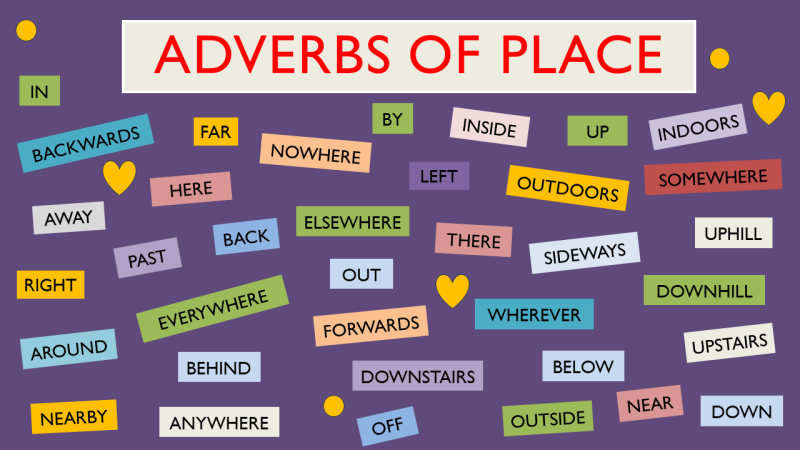
Adverbs of place are words that describe where an action happens, showing the location, direction, or distance of events in a sentence. They help learners answer the question “Where?” clearly and make writing more vivid and precise.
What are adverbs of place?
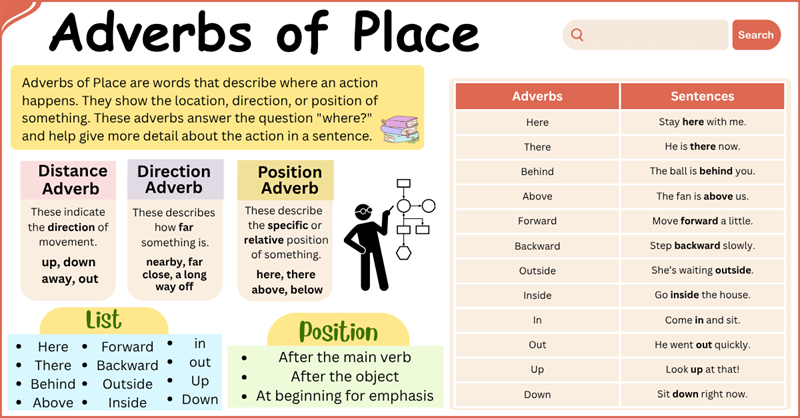
Adverbs of place are words that tell you where an action occurs, describing a location, direction, or distance. They modify verbs by adding clarity about the physical or implied space in which something happens. These adverbs answer the question “Where?” and make sentences more precise and informative.
Adverbs of place help speakers and writers express spatial meaning with accuracy, preventing ambiguity in descriptions. They make instructions, narratives, and everyday communication clearer by specifying locations or directions. Without them, sentences often feel incomplete or harder to visualize.
Examples:
-
The kids are playing outside.
-
She looked everywhere for her keys.
-
The cat is sleeping upstairs.
Types and categories of adverbs of place
1. Adverbs of position
Adverbs of position describe a fixed or specific location where an action happens. They help indicate whether something is situated in a place relative to the speaker or another object. Common examples include here, there, inside, and upstairs.
Examples:
-
The children are waiting here.
-
Your shoes are over there.
-
She is sitting upstairs.
2. Directional adverbs
Directional adverbs show the direction of a movement or action. They clarify how something moves from one point to another, making descriptions more dynamic. Words like forward, backward, upward, and across belong to this group.
Examples:
-
The car moved forward slowly.
-
He stepped backward in surprise.
-
They ran across to the other side.
3. Distance adverbs
Distance adverbs express how far an action occurs from the speaker or reference point. They help specify whether something is close, far, or somewhere in between. Common examples include nearby, far away, close, and along.
Examples:
-
A grocery store is located nearby.
-
The mountains look far away today.
-
She walked close to the river.
4. Indefinite adverbs of place
Indefinite adverbs of place refer to a non-specific or unknown location. They are used when the exact place is not important, unknown, or intentionally general. Examples include somewhere, anywhere, everywhere, and nowhere.
Examples:
-
I left my glasses somewhere in the house.
-
You can sit anywhere you like.
-
The kids searched everywhere for the puppy.
|
Give your child a strong English foundation from the very beginning with Monkey Junior. Start learning through fun games, native audio, and smart AI tools–perfect for kids aged 0-11. Help them build real skills in listening, speaking, reading, and writing step by step. Download Monkey Junior today and watch your child grow in confidence and English ability.
|


List common adverbs of place
|
Adverb |
Detailed Meaning |
Example Sentence |
|
Here |
Indicates a location very close to the speaker; often refers to the current spot or immediate surroundings. |
Come here and take a look at this report. |
|
There |
Refers to a place farther from the speaker; used to point out or direct attention to a specific location. |
Your water bottle is over there on the table. |
|
Everywhere |
Describes all possible locations; emphasizes a wide or complete range of places. |
They searched everywhere for the missing keys. |
|
Nowhere |
Indicates that no suitable or available place exists; expresses absence of location. |
There was nowhere to sit in the crowded hall. |
|
Inside |
Refers to being within a closed or bounded space; contrasts with outdoor areas. |
Please stay inside while the rain gets heavier. |
|
Outside |
Indicates being in the open air or external space; contrasts with being indoors. |
The kids are playing outside in the garden. |
|
Upstairs |
Shows that something or someone is located on a higher floor or upper level of a building. |
Your backpack is upstairs in your room. |
|
Downstairs |
Refers to a lower level of a building; often used when moving between floors. |
She left her phone downstairs on the sofa. |
|
Nearby |
Describes a place that is close in distance to the speaker or primary location. |
A convenience store is located nearby if you need anything. |
|
Far away |
Indicates a significant distance from the speaker; suggests remoteness or separation. |
The village is far away from the city center. |
Placement in sentences of adverbs of place
1. After the main verb
Adverbs of place most commonly appear after the main verb, especially in sentences that describe movement or location. This placement gives the action immediate clarity by showing exactly where it happens.
Examples:
-
She looked everywhere.
-
They walked outside.
-
The dog slept upstairs.
2. After the object (if present)
When a sentence contains an object, the adverb of place typically comes right after it. This structure keeps the sentence natural and prevents confusion about what the adverb is modifying.
Examples:
-
He put the keys there.
-
She placed the boxes inside.
-
They found the cat outside.
3. Beginning of sentences (for style)
Adverbs of place can be placed at the beginning of a sentence to add emphasis or create a descriptive, narrative tone. This style is common in storytelling or when highlighting a setting.
Examples:
-
Upstairs, the music played softly.
-
Outside, the rain continued to fall.
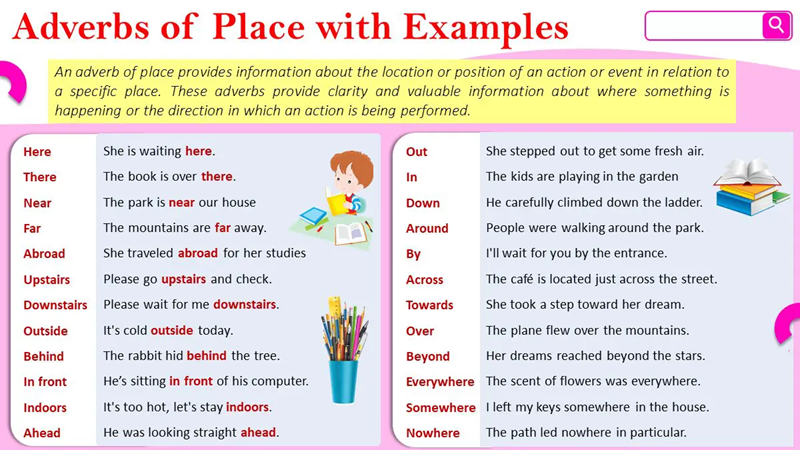
Understanding adverbs of place enhances your English writing and speaking by clearly showing where things happen. Practice using them in different sentence positions to gain confidence and improve clarity.