

.png)
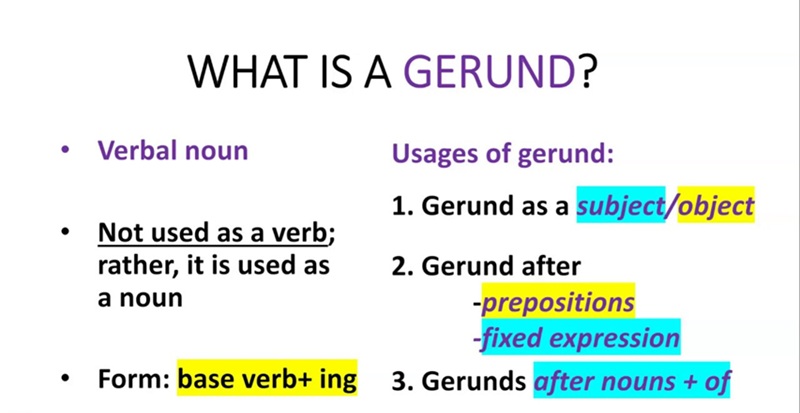
A gerund in English is a verb ending in “-ing” that functions as a noun. Understanding gerunds helps learners express actions, ideas, and activities more naturally.
|
WATCH THE VIDEO SUMMARY OF THE ARTICLE |
What Is a Gerund in English?
To understand how gerunds work, it’s important to first recognize their unique role. A gerund looks like a verb because it ends in “-ing,” but it behaves like a noun in the sentence. This allows it to act as the subject, object, or complement of a sentence.
Examples:
-
Reading helps improve vocabulary.
-
I enjoy swimming.
-
Playing chess is relaxing.
Gerunds allow speakers to talk about activities, habits, and general actions smoothly.
How to Form a Gerund in English
Before using gerunds correctly, you need to know how they are formed. While most verbs simply add “-ing,” some verbs require small spelling adjustments.
|
Verb Type |
Rule |
Example |
|
Regular verbs |
Add -ing |
jump → jumping |
|
Verbs ending in “e” |
Drop “e” + ing |
write → writing |
|
Short vowel + consonant |
Double consonant + ing |
run → running |
|
Verbs ending in “ie” |
Change “ie” to “y” + ing |
tie → tying |
These rules ensure gerunds are spelled correctly in all contexts.
How to Use Gerunds in English Sentences
Now that the structure is clear, learners can begin applying gerunds in actual sentences. Gerunds can serve different grammatical roles depending on the structure.
Gerund as the Subject
When the action itself is the focus of the sentence, the gerund serves as the subject. This is common in formal and written English.
Examples:
-
Cooking at home saves money.
-
Jogging early in the morning feels refreshing.
Gerund as the Object
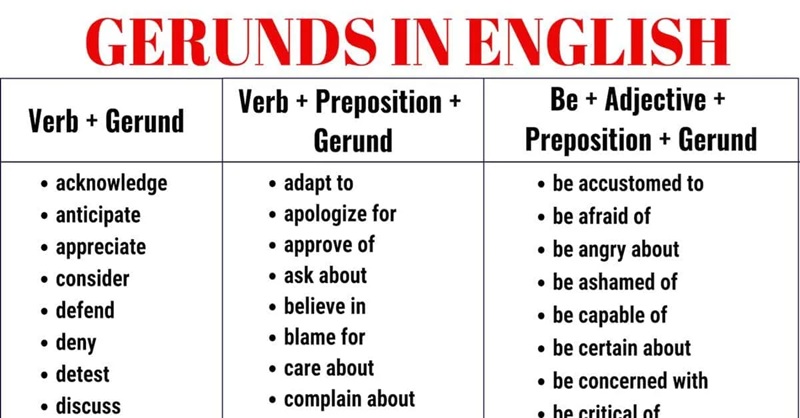
Many verbs in English must be followed by a gerund, not an infinitive. Understanding this pattern helps learners avoid common mistakes.
Examples:
-
She enjoys dancing.
-
They suggested waiting for the next bus.
-
He avoids eating late at night.
Gerund After Prepositions
A key rule in English grammar is that a verb after a preposition must always be in gerund form. This rule applies across all levels of writing.
Examples:
-
He is interested in learning French.
-
They talked about going on a trip.
-
She left without saying goodbye.
Gerund in Fixed Expressions
Certain English expressions always use gerunds. Knowing these helps learners sound more fluent and natural.
Examples:
-
It’s worth trying.
-
There’s no avoiding it.
-
I can’t help laughing.
Gerunds vs. Present Participle
Because both gerunds and present participles end in “-ing,” many learners confuse them. A quick distinction helps avoid mistakes.
|
Form |
Function |
Example |
|
Gerund |
Acts as noun |
Reading is fun. |
|
Present participle |
Acts as verb (continuous tense) or adjective |
She is reading. / The running water is cold. |
A useful tip: If “-ing” word is naming an activity, it’s a gerund.
Common Mistakes with Gerunds in English
Learners often rely on direct translations, leading to errors. Understanding the mistakes helps strengthen accuracy.
|
Incorrect |
Correct |
Explanation |
|
I enjoy to swim. |
I enjoy swimming. |
“Enjoy” takes gerund. |
|
He suggested to go. |
He suggested going. |
“Suggest” requires gerund. |
|
She is good in sing. |
She is good at singing. |
After preposition → gerund. |
|
To read books is fun. |
Reading books is fun. |
Gerund is preferred as subject. |
Practice Exercises: Gerund in English
Exercise 1: Fill in the Blank
Write the correct gerund form of the verb in parentheses.
-
I enjoy ______ (cook) new recipes.
-
______ (travel) around the world is my dream.
-
She is afraid of ______ (fly).
-
They talked about ______ (start) a business.
-
He suggested ______ (meet) earlier tomorrow.
Exercise 2: Choose the Correct Option
-
(Running / Run) every morning keeps me active.
-
She can’t stand (wait / waiting) in long lines.
-
He left without (say / saying) anything.
-
They finished (clean / cleaning) the room.
-
(Swim / Swimming) in the ocean is refreshing.
Exercise 3: Make Your Own Sentences
Write:
-
One sentence with a gerund as subject
-
One sentence with a gerund as object
-
One sentence with a gerund after a preposition
Answer Key
Exercise 1:
-
cooking
-
Traveling
-
flying
-
starting
-
meeting
Exercise 2:
-
Running
-
waiting
-
saying
-
cleaning
-
Swimming
Learn Gerund in English with Monkey Junior
If you want to strengthen your understanding of gerund in English through structured lessons, clear explanations, and native pronunciation, Monkey Junior is an effective learning tool. The program offers thousands of vocabulary and sentence patterns where gerunds appear naturally, helping learners understand how they function in real contexts.
Monkey Junior uses short lessons, spaced repetition, and interactive activities to reinforce grammar patterns, including gerunds, without overwhelming learners. Its step-by-step approach ensures that users can gradually move from recognizing gerunds to using them accurately in writing and speech.
For learners who want an engaging, well-organized program to improve their English grammar and overall fluency, Monkey Junior provides a strong foundation. You can start today and explore how gerunds, verbs, and other grammar structures work through intuitive lessons and practical examples.
Start your child’s learning journey today with Monkey Junior and let them express their emotions in English confidently and naturally.

Conclusion
Understanding gerund in English is essential for building natural and fluent sentences. Gerunds help express daily activities, preferences, and ideas with clarity. With the rules, examples, and practice exercises above, learners can confidently apply gerunds in both writing and conversation. For ongoing improvement, Monkey Junior’s structured lessons offer an effective way to master gerunds and other grammar concepts.