

.png)
Understanding complement in English helps you build complete and meaningful sentences. Complements give essential information that makes sentences clear and grammatically correct.
|
LISTEN TO A QUICK AUDIO SUMMARY OF THE ARTICLE |
What Is a Complement in English?
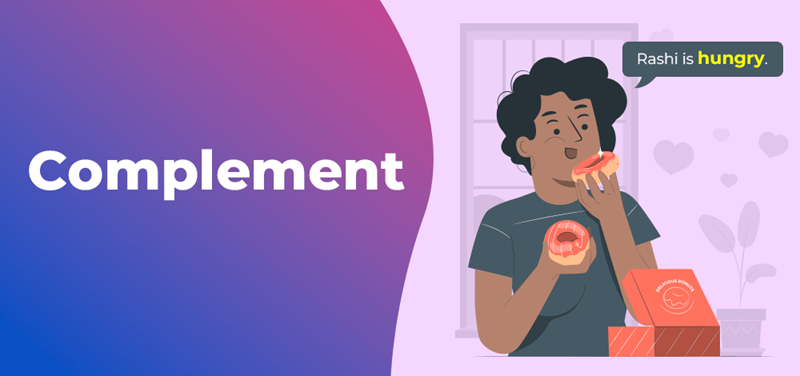
Before learning the different types, it is important to understand the basic idea. A complement in English is a word or group of words that completes the meaning of a sentence. Without a complement, many sentences sound incomplete or unclear.
A complement usually comes after a verb, adjective, or noun and provides necessary information about the subject or object.
Examples:
-
She is happy.
-
He became a teacher.
-
We found the movie interesting.
In all these examples, the complements finish the meaning of the sentence.
Why Complements Are Important in English Grammar
To understand why complements matter, imagine removing them from a sentence. Many verbs and structures require extra information to make sense. Complements help explain who someone is, what something becomes, or how something feels.
Examples:
-
She seems… (incomplete)
-
She seems tired. (complete)
Learning complement in English helps learners speak and write more naturally and avoid incomplete sentences.
Main Types of Complements in English
Before using complements confidently, learners should know that complements appear in different forms depending on sentence structure. Each type plays a different grammatical role.
Subject Complement
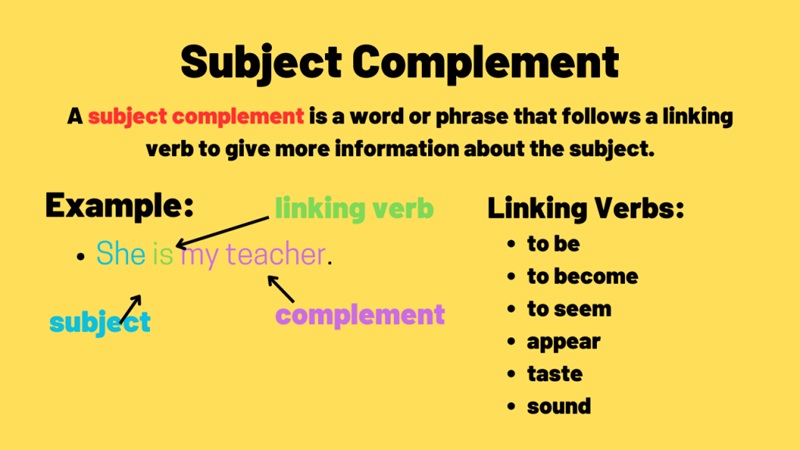
This section introduces one of the most common types. A subject complement follows a linking verb and gives more information about the subject. It does not show action but describes or renames the subject.
Linking verbs commonly used: be, seem, become, feel, look, appear.
Examples:
-
She is a doctor.
-
The sky looks blue.
-
He became angry.
Subject complements can be nouns, pronouns, or adjectives.
Object Complement
Before learning this type, remember that some verbs need extra information after the object. An object complement follows the object and gives more details about it.
Examples:
-
They elected him president.
-
We found the lesson useful.
-
She painted the room white.
Without the complement, the meaning would be incomplete or unclear.
Verb Complement
This part focuses on complements that complete the meaning of verbs. A verb complement can be a noun, pronoun, infinitive, gerund, or clause that follows certain verbs.
Examples:
-
She enjoys reading.
-
He decided to leave.
-
We know that she is right.
Verb complements are required by the verb to finish the sentence meaning.
Adjective Complement
Before using adjectives fully, learners should know that some adjectives need complements. An adjective complement gives extra information after an adjective, often using prepositions or clauses.
Examples:
-
She is afraid of spiders.
-
I am happy to help.
-
They are interested in learning English.
These complements explain the feeling or condition expressed by the adjective.
Noun Complement
This type explains or completes the meaning of a noun. A noun complement often comes in the form of a clause or prepositional phrase.
Examples:
-
The idea that we should leave early makes sense.
-
His belief in honesty is strong.
Noun complements clarify what the noun refers to.
Complements vs. Modifiers
Before continuing, it is important to distinguish complements from modifiers. Complements are necessary to complete meaning, while modifiers only add extra information.
|
Feature |
Complement |
Modifier |
|
Necessity |
Required |
Optional |
|
Function |
Completes meaning |
Adds description |
|
Example |
She is a teacher |
She is a kind teacher |
Understanding this difference helps avoid grammar confusion.
Common Mistakes with Complements in English
Before practicing, learners should recognize typical errors related to complements.
|
Incorrect |
Correct |
Explanation |
|
She became happily. |
She became happy. |
Subject complements use adjectives. |
|
They made him to leader. |
They made him leader. |
Object complements do not use “to”. |
|
I am interested on music. |
I am interested in music. |
Correct preposition needed. |
Avoiding these mistakes improves sentence accuracy.
Examples of Complement in English Sentences
Seeing complements in real sentences helps learners understand usage clearly.
-
The teacher seems confident.
-
We consider this plan effective.
-
She feels proud of her work.
-
He promised to help us.
-
The fact that she won surprised everyone.
Exercises: Complement in English
Exercise 1: Identify the Complement
Underline the complement in each sentence.
-
She is tired.
-
They chose him captain.
-
I am glad to see you.
-
He enjoys swimming.
-
The news that he passed is exciting.
Exercise 2: Choose the Correct Complement
-
She became (angry / angrily).
-
We found the test (difficult / difficulty).
-
He is interested (in / on) science.
-
They expect her (to win / winning).
-
The idea (that / which) he suggested was good.
Exercise 3: Complete the Sentences
-
She looks _______.
-
We consider him _______.
-
I am happy _______.
-
He decided _______.
-
The belief _______ is important.
Answer Key
Exercise 1:
-
tired
-
captain
-
to see you
-
swimming
-
that he passed
Exercise 2:
-
angry
-
difficult
-
in
-
to win
-
that
Exercise 3 (sample answers):
-
confident
-
responsible
-
to help
-
to stay
-
that honesty matters
Learn Complement in English Effectively with Monkey Junior
Learning complement in English becomes much easier with a structured learning system like Monkey Junior. The program introduces grammar naturally through sentences, stories, and examples, allowing learners to see how complements work in real contexts.
Lessons combine vocabulary, grammar, and listening practice with native-speaker audio, helping learners understand how complements fit into everyday English. With short daily lessons and a clear progression, Monkey Junior supports consistent improvement and long-term retention of grammar knowledge.
Start your child’s learning journey today with Monkey Junior and let them express their emotions in English confidently and naturally.

Conclusion
Understanding complement in English is essential for building complete and meaningful sentences. By learning the different types of complements and practicing them regularly, learners can improve both accuracy and confidence. With clear rules, examples, exercises, and the structured support of Monkey Junior, mastering complements becomes an achievable goal.