

.png)
The future continuous tense is a key structure in English that helps you describe actions that will be in progress at a specific time in the future. This easy guide breaks down its rules, uses, structure, and examples so you can understand and apply it with confidence.
What is the future continuous tense?
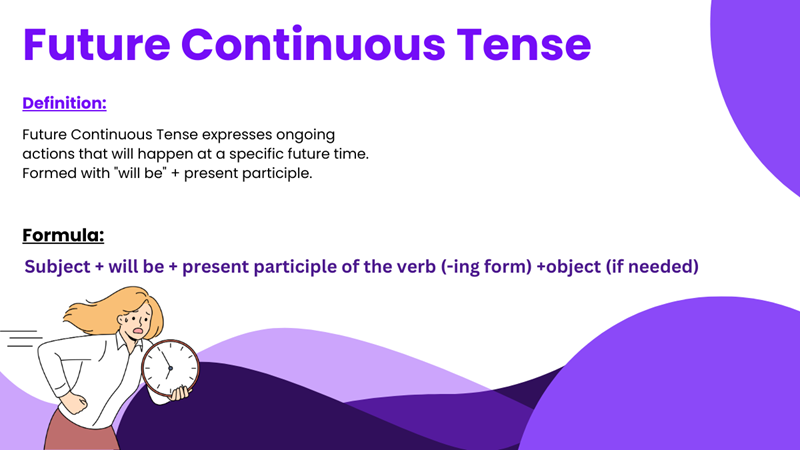
The future continuous tense describes an action that will be in progress at a specific time in the future, showing that the activity happens over a period rather than at a single moment. It highlights the ongoing nature of a future event, which makes it different from other future tenses that focus on completion or simple intention.
Compared with other future forms, the simple future (will + V1) states that something will happen, while the continuous future emphasizes that something will be happening at a particular future time. In contrast, the future perfect focuses on an action completed before a future point, not one still unfolding.
We use the future continuous tense when we want to talk about scheduled or expected activities, describe what will be happening at a set time, or provide background actions in future narratives. It also helps show polite inquiries about someone’s plans without sounding intrusive.
Examples:
-
This time tomorrow, I will be flying to Singapore for a business trip.
-
At 8 p.m. tonight, they will be rehearsing for the school performance.
-
Next week, our team will be working on the final phase of the project.
-
When you arrive, we will be having dinner on the balcony.
Structure of the future continuous tense
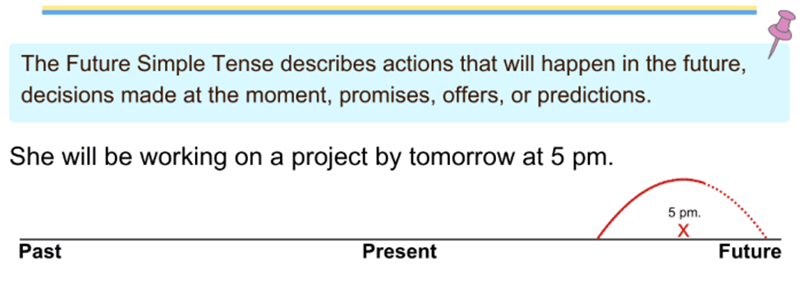
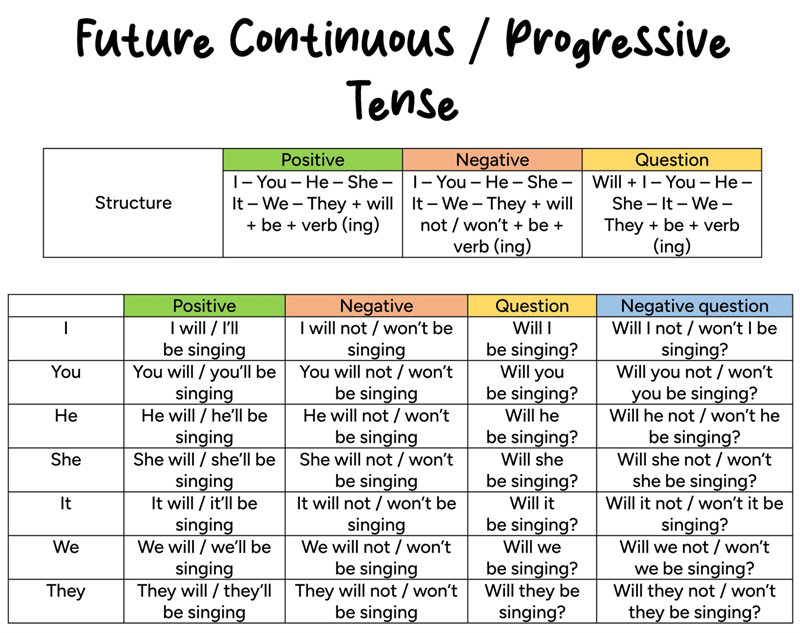
The future continuous tense follows a consistent pattern using will be + verb-ing to show an action in progress at a future moment. Below are the core forms you need to use correctly.
1. Affirmative form
The structure is subject + will be + verb-ing, used to express an ongoing future action.
Example: She will be studying for her exam at this time tomorrow.
2. Negative form
Use subject + will not be + verb-ing to say an action will not be happening at a certain time.
Example: They will not be attending the meeting tonight.
3. Question form
Form questions by placing Will + subject + be + verb-ing?, often to ask about someone’s plans or expected activities.
Example: Will you be joining us for dinner later?
4. Notes on contractions
In everyday conversation, will often contracts to ’ll, and will not become won’t, making sentences sound more natural.
Examples: I’ll be waiting for your call. / He won’t be working this weekend.
Uses of the future continuous tense
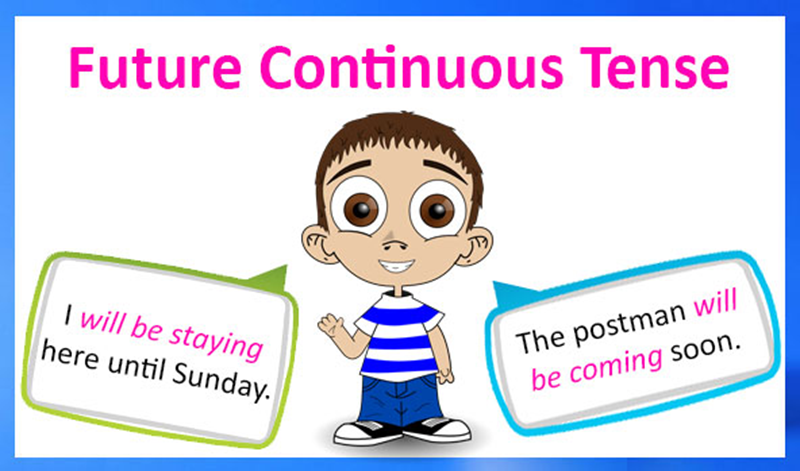
The future continuous tense is used to describe actions that will be in progress at a specific point in the future. It helps express plans, expectations, background events, and temporary future situations with clarity.
1. Ongoing actions at a specific time in the future
We use this tense to show that an action will be happening at a particular moment in the future. It highlights the duration or flow of the activity rather than its completion.
Example: At 8 p.m. tomorrow, I will be eating dinner.
2. Future plans & intentions
The future continuous can express scheduled or arranged activities, especially when something is already planned or set to take place. It gives a sense of routine or organized expectation.
Example: Next Monday, our team will be meeting with the new clients.
3. Predictions / expectations
We use it to predict actions that will likely be in progress in the future based on current patterns or logical assumptions. This makes the sentence sound natural and confident.
Example: By this evening, the children will be playing in the backyard as usual.
4. Background information in narratives
This tense adds background action to stories or descriptions set in the future, helping create a fuller picture of what will be happening around the main event.
Example: When you arrive at the resort, guests will be relaxing by the pool and enjoying the sunset.
5. Temporary future states
It can describe temporary situations or conditions that will exist for a limited time in the future, often emphasizing that the state is not permanent.
Example: During the renovation, we will be staying at a nearby hotel.
Future Continuous vs Similar Tenses
The future continuous often gets compared with other future forms because they all describe future events, but each tense highlights a different aspect of time. Understanding these distinctions helps you choose the structure that best matches your meaning.
1. Future Continuous vs Simple Future
The simple future (will + base verb) states that an action will happen, focusing only on the fact or decision. The future continuous, on the other hand, emphasizes that the action will be in progress at a particular moment in the future.
Example:
-
Simple future: She will start her shift at 7 p.m. (a future action)
-
Future continuous: She will be working at 7 p.m. (action in progress at that time)
2. Future Continuous vs Future Perfect Continuous
The future continuous describes an action that will be happening at a specific future point, without focusing on how long it has been happening. In contrast, the future perfect continuous highlights duration up to a future moment using will have been + verb-ing.
Example:
-
Future continuous: By noon, they will be driving through the city. (ongoing action at that time)
-
Future perfect continuous: By noon, they will have been driving for five hours. (how long the action has lasted)
|
Give your child a strong English foundation from the very beginning with Monkey Junior. Start learning through fun games, native audio, and smart AI tools–perfect for kids aged 0-11. Help them build real skills in listening, speaking, reading, and writing step by step. Download Monkey Junior today and watch your child grow in confidence and English ability.
|


Practice exercises
The following exercises help reinforce how the future continuous tense works in real contexts. Each task focuses on a different skill: sentence completion, transformation, and error correction.
1. Fill-in-the-blank sentences
Use the future continuous tense.
-
At this time tomorrow, we __________ (travel) to the coastal city.
-
When you call me tonight, I __________ (cook) dinner for my family.
-
By next week, the team __________ (work) on the new marketing plan.
-
At 9 a.m. on Monday, the students __________ (take) their placement test.
-
During the conference, she __________ (present) her research findings.
2. Convert to future continuous
Rewrite each sentence using the future continuous tense.
-
She will start typing the report at 3 p.m.
-
They will watch the live broadcast tonight.
-
I will wait for you at the front gate.
-
The children will play outside after lunch.
-
We will review the proposal this afternoon.
3. Error correction
Each sentence contains an error related to future continuous usage. Correct it.
-
At noon tomorrow, I will be to meet my supervisor.
-
They will be works on the project all evening.
-
Will you be attend the workshop next Friday?
-
She won’t be study when you arrive.
-
By this time next week, we will be finish the final report.
Answers
Exercises 1:
-
will be traveling
-
will be cooking
-
will be working
-
will be taking
-
will be presenting
Exercises 2:
-
She will be typing the report at 3 p.m.
-
They will be watching the live broadcast tonight.
-
I will be waiting for you at the front gate.
-
The children will be playing outside after lunch.
-
We will be reviewing the proposal this afternoon.
Exercises 3:
-
At noon tomorrow, I will be meeting my supervisor.
-
They will be working on the project all evening.
-
Will you be attending the workshop next Friday?
-
She won’t be studying when you arrive.
-
By this time next week, we will be finishing the final report.
Mastering the future continuous tense allows you to express future actions more clearly, naturally, and with the right level of detail. Keep practicing the rules, uses, and examples in this guide to build strong grammar skills and communicate more accurately.