.png)
Understanding the difference between much and many is essential for learning how to talk about quantity accurately in English. This guide compares both words through clear explanations and easy-to-understand examples to help learners use them with confidence.
Compare Much and Many
1. Similarities between Much and Many
Much and many are both used as quantifiers, meaning they help describe the amount or quantity of something. They appear in sentences to answer the question “How much/many?” and help make ideas more specific. Both words also commonly appear in negative sentences, questions, and comparative structures like much/many more.
Both quantifiers are used when the exact number or amount is not known or not necessary to mention. They help learners talk about quantity in a natural, flexible way. Additionally, much and many often come before nouns or can be part of expressions such as too much, too many, so much, or so many.
Examples:
-
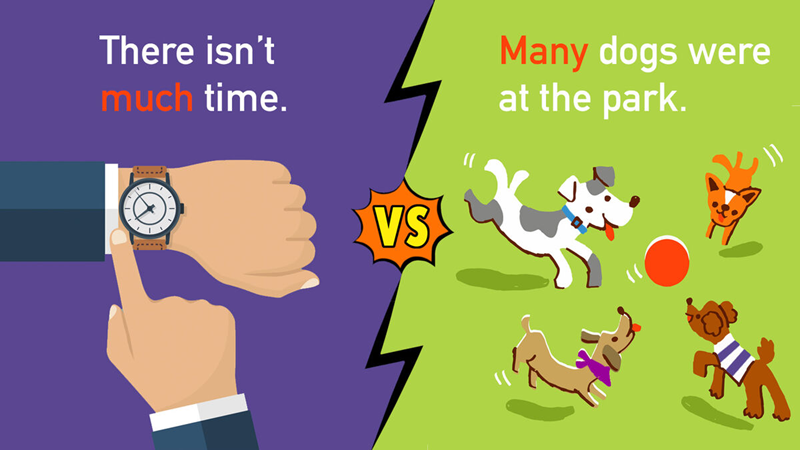
I don’t have much time and she doesn’t have many friends.
-
Are there many students in the room, or is there too much noise outside?
2. Differences between Much and Many
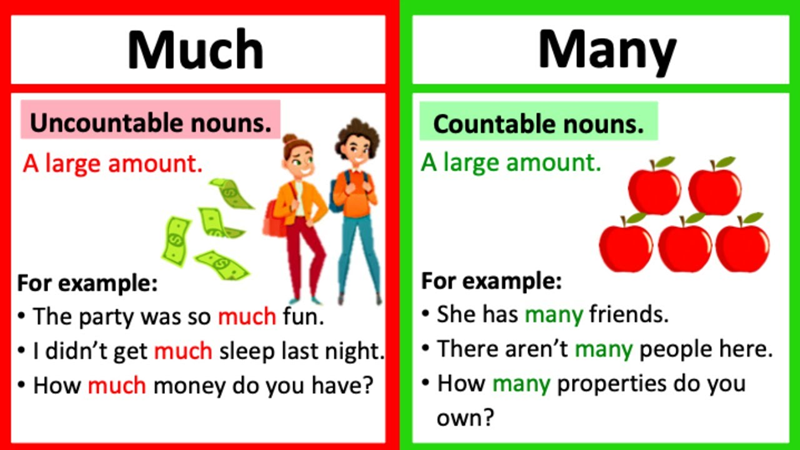
Another key difference is that much often sounds more formal in positive sentences, while many is more natural across both spoken and written English. Choosing between the two depends entirely on whether the noun is countable.
Comparison table:
|
Feature |
Much |
Many |
|
Type of noun |
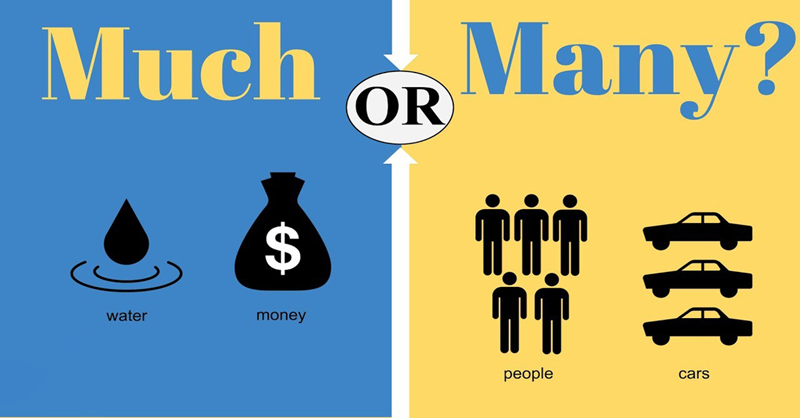
Used with uncountable nouns (water, money, milk, homework) |
Used with countable plural nouns (books, apples, friends, toys) |
|
Common sentence types |
Mainly in questions and negative sentences |
Used in questions, negatives, and affirmatives |
|
Affirmative sentence usage |
Less common; can sound formal (much time, much support) |
Very common and natural (many people, many ideas) |
|
Meaning |
Large amount/quantity |
Large number |
|
Typical expressions |
too much, so much, much more |
too many, so many, many more |
|
Example |
She doesn’t have much information, but she has many questions. |
There aren’t many apples left, and we don’t have much juice either. |
Sentence structures with Much/Many
1. Sentence structures with Much
Sentence structures with Much include:
-
Much + uncountable noun: Use much before uncountable nouns to express a large amount of something. This structure appears mostly in questions and negative sentences. (Example: I don’t have much time today.)
-
How much + uncountable noun?: Use this structure to ask about the quantity of something uncountable. (Example: How much water do you drink every day?)
-
Too much + uncountable noun: Use this structure to describe an excessive amount. (Example: There is too much noise in the hallway.)
-
So much + uncountable noun: Use this pattern to emphasize a very large amount of something. (Example: She has so much homework tonight.)
-
Much + comparative adjective: Use much to strengthen comparative adjectives. (Example: This book is much better than the last one.)
-
Much + past participle (formal expressions): Common in formal English to show appreciation or emphasis. (Example: Your help is much appreciated.)
2. Sentence structures with Many
Sentence structures with Many include:
-
Many + plural countable noun: Use many before plural countable nouns to express a large number of items or people. This structure works in all sentence types. (Example: She has many friends at school.)
-
How many + plural countable noun?: Use this structure to ask about the number of countable items. (Example: How many books do you read each month?)
-
Too many + plural countable noun: Use this pattern to describe an excessive number of something. (Example: There are too many cars on the road today.)
-
So many + plural countable noun: Use this structure to emphasize a very large number. (Example: He received so many messages yesterday.)
-
Many + plural countable noun + verb: A basic structure used in everyday statements. (Example: Many students enjoy learning English.)
-
Many + more + plural countable noun: Use this form to express "a lot more" of something. (Example: We need many more volunteers for the event.)
Much and Many exercises (with answers)
Fill in the blanks with much or many:
- There aren’t ________ chairs in the classroom.
- How ________ sugar do you put in your tea?
- She doesn’t have ________ free time during the week.
- Are there ________ students absent today?
- He bought too ________ snacks for the trip.
- I don’t know ________ about this topic.
- We saw so ________ beautiful flowers in the garden.
- How ________ money do we need for the tickets?
- There are too ________ mistakes in your essay.
- She received ________ support from her friends.
Answers:
-
many
-
much
-
much
-
many
-
many
-
much
-
many
-
much
-
many
-
much
|
Give your child a strong English foundation from the very beginning with Monkey Junior. Start learning through fun games, native audio, and smart AI tools–perfect for kids aged 0-11. Help them build real skills in listening, speaking, reading, and writing step by step. Download Monkey Junior today and watch your child grow in confidence and English ability.
|


Frequently asked questions
1. Can “much” be used in affirmative sentences?
Yes, but it is less common in everyday speech and often sounds formal. It appears more naturally in writing or fixed expressions.
2. Can I use “much” with plural nouns?
No. Much is only used with uncountable nouns. Plural nouns require many.
3. Is “a lot of” interchangeable with both “much” and “many”?
Yes. A lot of can be used with both countable and uncountable nouns and is more common in affirmative sentences.
4. What’s the difference between “too much” and “too many”?
Too much describes an excessive amount of an uncountable noun, while too many describes an excessive number of a plural countable noun.
5. Can I use “many” in formal writing?
Yes. Many is acceptable and natural in both formal and informal contexts.
Mastering much and many becomes easier when you follow the rules, review examples, and practice with targeted exercises. For young learners who want a strong foundation in English, Monkey Junior offers interactive lessons that make grammar simple, fun, and effective.