

.png)
Understanding syllables and word stress is essential for improving your English pronunciation and speaking fluency. Many learners focus on grammar and vocabulary but overlook pronunciation patterns, which can make their speech difficult to understand. By mastering syllables and stress, you can sound more natural and communicate more effectively.
Why Syllables and Word Stress Are Important
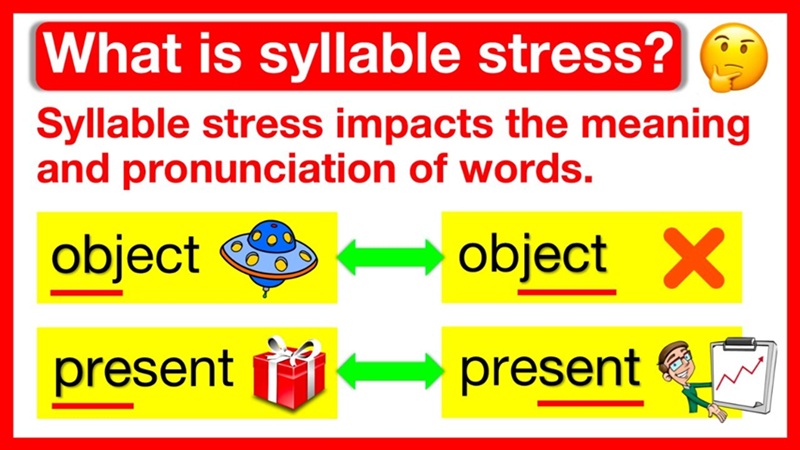
Before learning the rules, it is important to understand why syllables and word stress matter in English. English is a stress-timed language, meaning some syllables are emphasized more than others. Incorrect stress can change meaning or make words hard to recognize.
For example:
-
REcord (noun) vs reCORD (verb)
-
PREsent (noun) vs preSENT (verb)
Correct stress improves:
-
Speaking clarity
-
Listening comprehension
-
Fluency and natural rhythm
-
Confidence in communication
What Are Syllables?
To understand stress, you first need to understand syllables. A syllable is a unit of sound in a word, usually containing a vowel sound.
Examples of Syllables
|
Word |
Syllables |
|
cat |
1 syllable |
|
teacher |
teach-er (2) |
|
computer |
com-pu-ter (3) |
|
information |
in-for-ma-tion (4) |
How to Identify Syllables
You can identify syllables by:
-
Counting vowel sounds
-
Clapping while saying the word
-
Listening to how the word is naturally divided
Practice tip: Say the word slowly and clap each beat. Each clap represents one syllable.
What Is Word Stress?
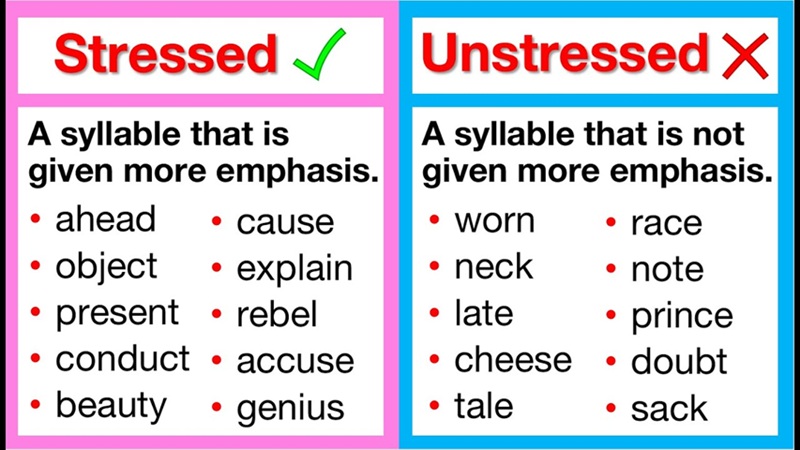
Now that you understand syllables, the next step is word stress. Word stress refers to the syllable in a word that is pronounced more strongly than the others.
A stressed syllable is:
-
Louder
-
Longer
-
Higher in pitch
Example:
-
TAble → stress on the first syllable
-
aBOUT → stress on the second syllable
-
comPUter → stress on the second syllable
Common Patterns of Word Stress
English word stress follows certain patterns. While there are exceptions, these rules help learners predict stress placement.
1. Two-Syllable Words
Understanding patterns in two-syllable words is a good starting point.
-
Nouns and adjectives usually stress the first syllable:
-
TAble
-
HAPpy
-
DOCtor
-
Verbs usually stress the second syllable:
-
reLAX
-
aRRIVE
-
deCIDE
2. Words Ending in Specific Suffixes
Certain suffixes influence stress placement.
-
Stress comes before the suffix:
-
-tion → eduCAtion
-
-sion → deCIssion
-
-ic → geoGRAphic
-
Stress falls on the suffix (less common cases):
-
-ee → employEE
-
-eer → enginEER
3. Compound Words
Compound words have their own stress patterns.
-
Nouns: stress on the first word
-
BLACKboard
-
TOOTHbrush
-
Verbs: stress on the second word
-
underSTAND
-
overCOME
Common Mistakes in Syllables and Word Stress
Before practicing, it is helpful to recognize common mistakes:
-
Stressing the wrong syllable
-
Giving equal stress to all syllables
-
Ignoring stress in longer words
-
Mispronouncing words due to native language influence
These mistakes can make speech sound unnatural or difficult to understand.
Practical Exercises to Improve Syllables and Word Stress
To master syllables and word stress, consistent practice is essential. Here are effective exercises:
1. Listening Practice
Listen to native speakers and focus on which syllables are stressed. Use resources like podcasts, audiobooks, or pronunciation videos.
2. Shadowing Technique
Repeat sentences immediately after a native speaker.
Try to copy:
-
Rhythm
-
Stress
-
Intonation
Example: “I decided to buy a new computer.” Pay attention to stress: deCIed, comPUter
3. Marking Stress
Write words and mark the stressed syllable in uppercase:
-
comPUter
-
aBOUT
-
TAble
This helps you visually remember stress patterns.
4. Practice with Sentences
Practice stress in context, not just individual words.
Examples:
-
“She is a DOCtor.”
-
“They deCIDed to TRAVEL abroad.”
Additional Tips to Master Syllables and Word Stress
-
Learn words with their pronunciation, not just spelling
-
Use dictionaries with phonetic transcription
-
Practice speaking slowly, then increase speed
-
Record yourself and compare with native speakers
-
Focus on rhythm, not just individual sounds
Conclusion
Mastering syllables and word stress is a key step toward natural and fluent English pronunciation. By understanding syllable structure, learning stress patterns, and practicing regularly with real examples, you can significantly improve your speaking and listening skills. Over time, correct stress will become automatic, helping you communicate clearly and confidently.