

.png)
Adverbs of time are essential elements that show when, how long, or how often an action happens. They help make your sentences clearer and more precise by adding important time-related details. Understanding adverbs of time will improve both your grammar accuracy and overall English communication.
What are adverbs of time?
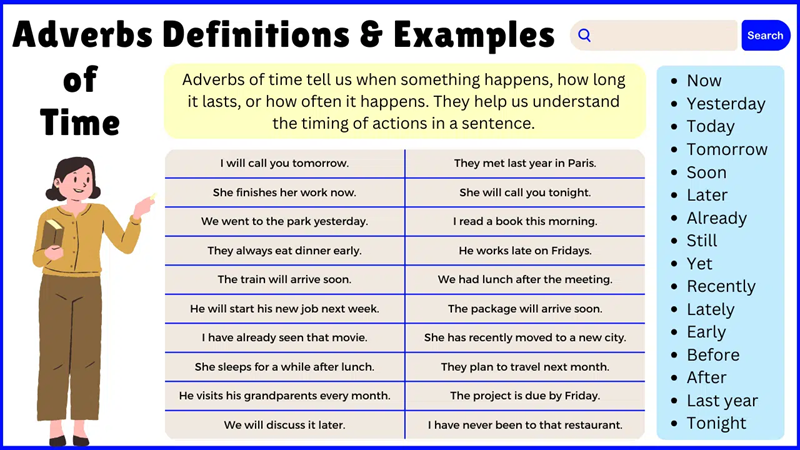
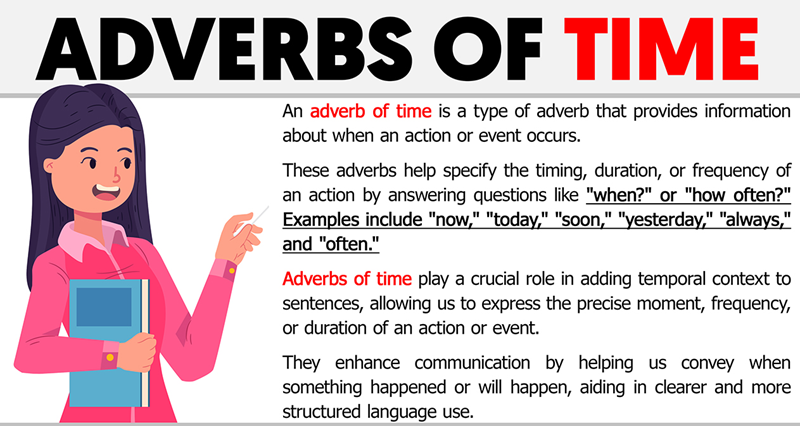
Adverbs of time are words or phrases that indicate when an action happens, how long it lasts, or how often it occurs in a sentence. These adverbs provide temporal details that help readers understand the timing, duration, or frequency of events more precisely. Common questions they answer include “when?”, “how long?”, and “how often?”.
Adverbs of time differ from other adverb types because they focus specifically on time-related information rather than describing place, manner, degree, or reason. While adverbs of place tell us where something happens and adverbs of manner explain how it happens, adverbs of time strictly clarify the temporal context. This distinction helps learners choose the right adverb type to convey meaning accurately.
Examples:
-
I will call you tomorrow.
-
She visited last week.
-
They are leaving now.
-
He waited all day.
-
The rain lasted for hours.
Common adverbs of time
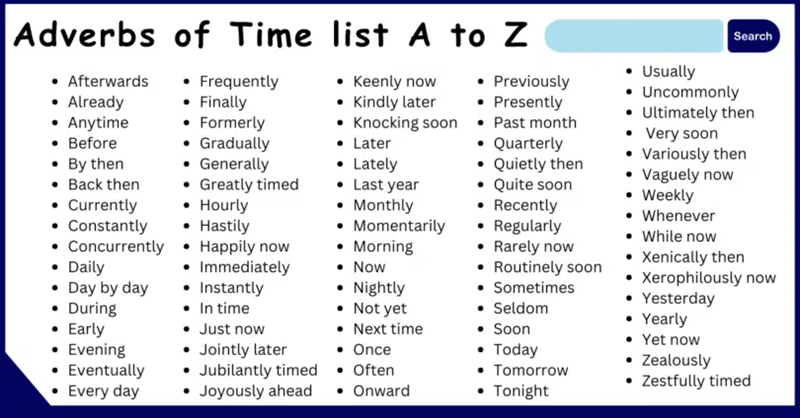
Common adverbs of time include everyday words such as now, yesterday, tomorrow, soon, always, and often. These adverbs help indicate the timing, duration, or frequency of an action, making sentences more precise and informative. They appear frequently in both spoken and written English.
Table common adverbs of time:
|
Category |
Function (Detailed Description) |
Examples |
Example Sentences |
|
Point in Time |
Indicates the specific moment an action happens, showing whether it occurs in the past, present, or future. |
now, yesterday, today, tonight, tomorrow, later, soon |
- I need your answer now. - She met him yesterday. - We will travel tomorrow. |
|
Duration |
Describes how long an action continues, expressing the length or span of time involved. |
briefly, temporarily, forever, all day, for hours, for a while |
- The system was down briefly. - He stayed in the city for hours. - She will live abroad temporarily. |
|
Frequency |
Shows how often an action occurs, indicating repeated, habitual, or rare actions. |
always, usually, often, sometimes, rarely, never |
- I always wake up early. - They often study at night. - He never drinks coffee. |
How to use the adverbs of time
1. Position rules
Adverbs of time can appear in different parts of a sentence depending on the emphasis. The three main positions are:
-
End position (most common): She finished her work yesterday.
-
Beginning position (for emphasis): Tomorrow, we will start early.
-
Middle position (mainly frequency adverbs): He often arrives early.
2. Examples with different tenses
Adverbs of time work with all tenses to clarify when an action happens. Below are simple examples:
-
Present tense: He always eats breakfast at 7 a.m.
-
Past tense: They arrived late yesterday.
-
Future tense: I will call you soon.
|
Give your child a strong English foundation from the very beginning with Monkey Junior. Start learning through fun games, native audio, and smart AI tools–perfect for kids aged 0-11. Help them build real skills in listening, speaking, reading, and writing step by step. Download Monkey Junior today and watch your child grow in confidence and English ability.
|


3. Using multiple adverbs in one sentence
You can combine multiple adverbs of time to give more detailed information. The natural English order is: frequency → duration → point in time.
Examples:
-
She will travel to Japan often for two weeks next summer.
-
They practice usually for an hour every morning.
Placement of adverbs of time in a sentence
1. Standard positions & emphasis
Adverbs of time are most commonly placed at the end of a sentence, which sounds natural and is preferred in everyday English. They can move to the beginning when the speaker wants to highlight or emphasize the time element. Frequency adverbs (like always, often, usually) typically appear in the middle of a sentence, usually before the main verb.
Examples:
-
She will submit the report tomorrow.
-
Tomorrow, she will submit the report.
-
She often submits the report on time.
2. Order with other adverbs
When a sentence contains several types of adverbs, English follows a natural order: manner → place → time. This order keeps the sentence smooth and easy to understand, especially when describing complex actions. Time adverbs almost always come last in the sequence.
Examples:
-
He spoke calmly (manner) in the meeting (place) yesterday (time).
-
They practiced carefully (manner) at home (place) last night (time).
Adverbs of time vs. Adverbs of frequency
To better understand how these two adverb types differ, it helps to compare their meanings, functions, and usage patterns side by side. The table below highlights the key distinctions between adverbs of time and adverbs of frequency, along with examples of how each is used in real sentences.
Comparison table adverbs of time vs. adverbs of frequency:
|
Feature |
Adverbs of Time |
Adverbs of Frequency |
|
Core Meaning |
Shows when an action happens or how long it lasts. |
Shows how often an action happens. |
|
Focus |
Specific points in time or durations. |
Repetition, habits, or regularity of actions. |
|
Typical Questions Answered |
When? How long? |
How often? |
|
Common Examples |
yesterday, today, tomorrow, soon, now, last night, for hours |
always, usually, often, sometimes, rarely, never |
|
Sentence Position |
Usually end or beginning of a sentence. |
Usually before the main verb or after “to be.” |
|
Overlap? |
Some express time directly (no overlap). |
Some relate to time indirectly but still show frequency (e.g., often, sometimes). |
|
Examples |
She will leave tomorrow. He slept for hours. |
She often studies at night. He is always late. |
Mastering adverbs of time is a simple way to express timing and frequency more effectively in English. When you use these adverbs correctly, your speaking and writing sound clearer and more natural. Keep practicing adverbs of time in different sentence structures to build confidence and fluency.