
.png)
The present simple tense is one of the most important tenses in English, used to talk about habits, routines, and facts. This guide will help you understand it clearly and practise through simple exercises with answers.
What is the present simple tense?
The present simple tense describes actions, habits, and facts that are true in the present.
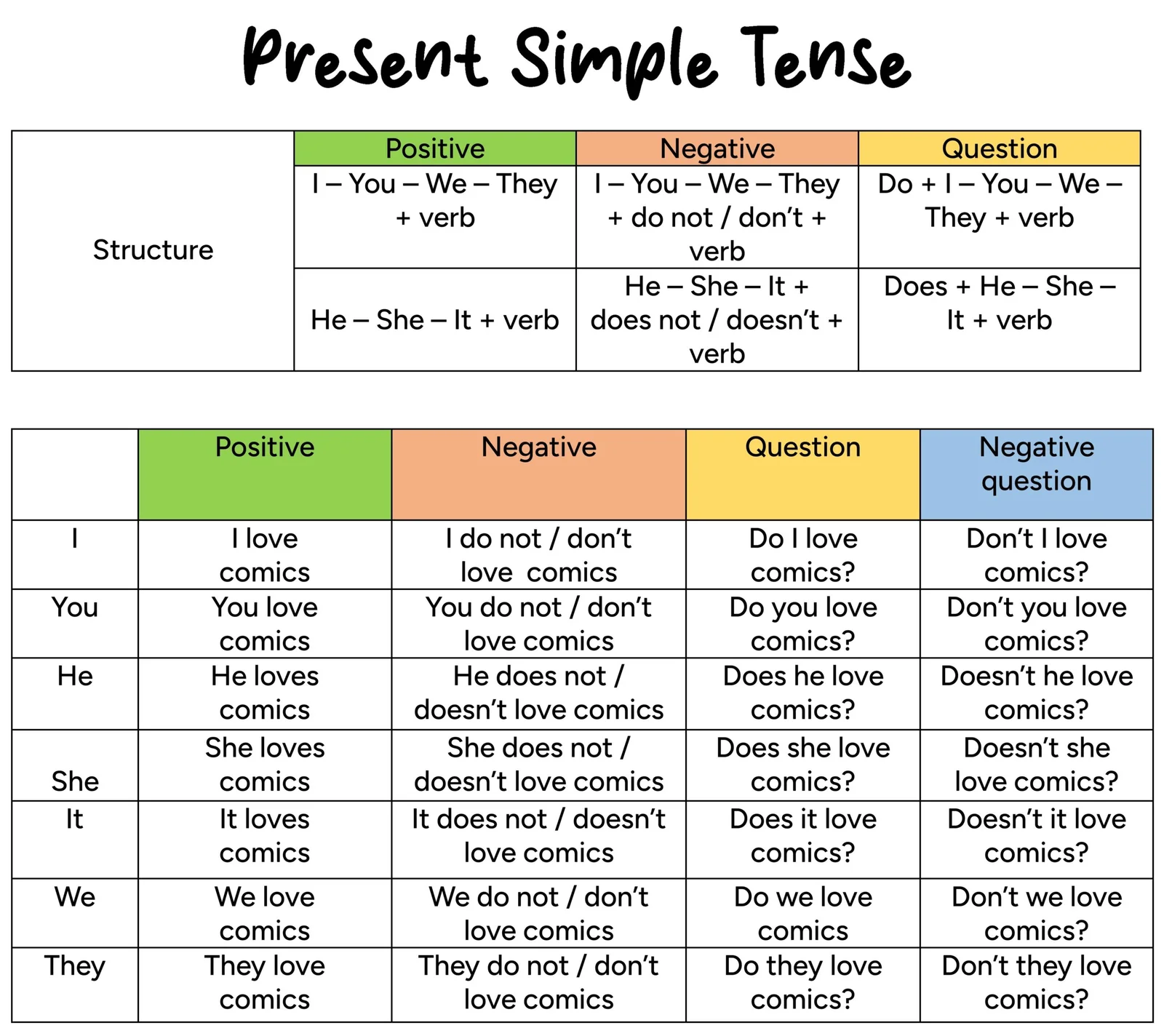
It uses the base form of the verb for most subjects, and adds –s/–es with he/she/it.
Example:
-
I work in London.
-
She works in London.
|
Extra uses (advanced): The present simple can describe past events when telling a story to make it feel more vivid. It is also used to summarise books, films, or plays, presenting events as if they are happening now. |
What are the present simple questions?
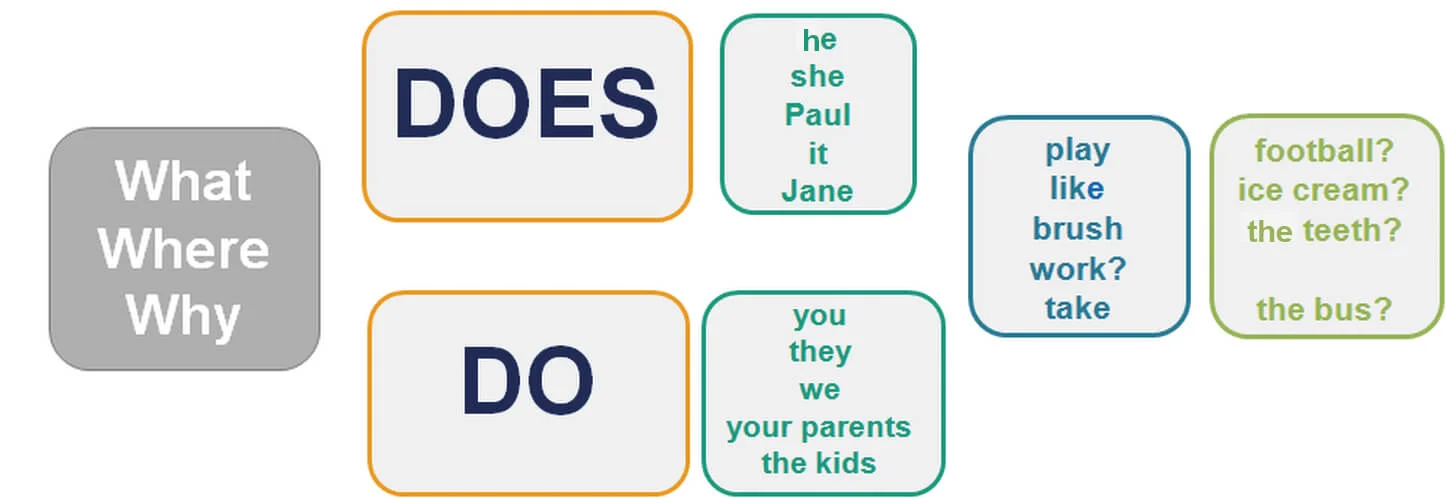
Present simple questions are formed using do/does + the base verb to ask about habits, facts, and routines. We use does for he/she/it and do for all other subjects.
1. With question words:
We place where/what/when before do/does to ask for more information.
Example: Where do you live? / What does he do?
2. Special case – who questions:
When who is the subject, we usually do not use do/does.
Example: Who lives in London?
What are the present simple negatives?
Negative sentences in the Present Simple are used to deny facts, habits, or truths. To form them, we use the auxiliary verb do/does + not + the base form of the main verb.
Subject rules: Use doesn’t with he/she/it, and don’t with all other subjects.
Example: I don’t play football. / She doesn’t drive to work.
|
Give your child a strong English foundation from the very beginning with Monkey Junior. Start learning through fun games, native audio, and smart AI tools–perfect for kids aged 0-11. Help them build real skills in listening, speaking, reading, and writing step by step. Download Monkey Junior today and watch your child grow in confidence and English ability.
|

Present simple and Present time
The present simple is used to talk about situations and facts that are true right now, such as age, job, or place of living.
-
Habits and routines: We also use the present simple for actions that happen regularly, like hobbies or daily routines. (Example: I play football every weekend.)
-
General or scientific truths: The tense describes things that are always true, including universal facts. (Example: Light travels at almost 300,000 kilometres per second.)
-
Frequency adverbs: Words like always, often, sometimes, and never help show how often something happens. (Example: I sometimes go to the cinema. She never plays football.)
Present simple and Future time
In English, we often use the Present Simple to discuss future events in two specific scenarios: Fixed Schedules and Subordinate Time Clauses.
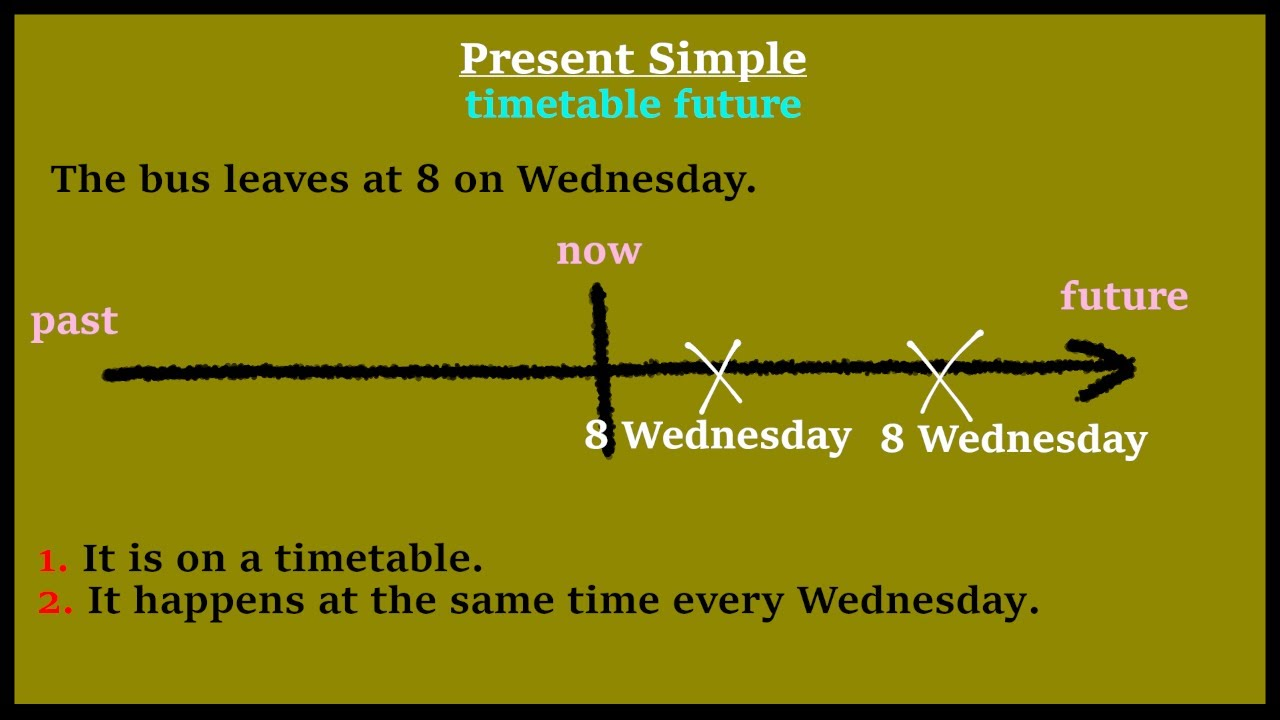
1. Scheduled Events (Timetables)
We use the Present Simple for future events that are part of a fixed timetable, program, or calendar. These events are "set in stone" and usually involve public transport, cinema listings, or official start times.
The Rule: Use the Present Simple for events the speaker cannot easily change.
Examples:
-
The train leaves at 19:45 tonight.
-
The semester ends on Friday.
-
What time does the film start?
2. After Time Conjunctions & Conditionals
When we talk about the future using words like when, after, before, as soon as, if, or unless, we do not use "will" in that specific part of the sentence (the clause). Instead, we use the Present Simple.
The Structure: [Future Tense Clause] + [Time Word] + [Present Simple Clause]
Examples:
-
I’ll talk to John when I see him. (Not: ~~when I will see him~~)
-
We can go out after it stops raining.
-
I won't leave unless you tell me the truth.
Practice Exercises for the Simple Present
Exercise 1: Fill in the blanks with the correct form of the verb in the simple present.
-
She ___ (live) in London.
-
I ___ (go) to school every day.
-
They ___ (not/play) football on Fridays.
-
My dad ___ (cook) dinner on weekends.
-
The sun ___ (rise) in the east.
-
We ___ (study) English at school.
-
He ___ (not/like) ice cream.
-
Water ___ (boil) at 100 degrees Celsius.
-
I ___ (not/watch) TV at night.
-
She ___ (speak) Spanish very well.
Exercise 2: Make questions using the simple present.
-
___ he play football?
-
Where ___ you live?
-
___ they go to school by bus?
-
What time ___ she wake up?
-
___ your dad work on Sunday?
-
What ___ you do on weekends?
-
___ he speak French?
-
Where ___ they come from?
-
___ you like pizza?
-
Why ___ she study English?
Exercise 3: Write negative sentences in the simple present.
-
She likes coffee → She ___ coffee.
-
They play tennis → They ___ tennis.
-
He gets up early → He ___ early.
-
I speak German → I ___ German.
-
We watch TV → We ___ TV.
-
She goes to work by car → She ___ to work by car.
-
He lives in New York → He ___ in New York.
-
The shop opens on Sunday → The shop ___ on Sunday.
-
They drink milk → They ___ milk.
-
She teaches French → She ___ French.
Answer Key
Exercise 1:
-
lives
-
go
-
do not (don’t) play
-
cooks
-
rises
-
study
-
does not (doesn’t) like
-
boils
-
do not (don’t) watch
-
speaks
Exercise 2:
-
Does he play football?
-
Where do you live?
-
Do they go to school by bus?
-
What time does she wake up?
-
Does your dad work on Sunday?
-
What do you do on weekends?
-
Does he speak French?
-
Where do they come from?
-
Do you like pizza?
-
Why does she study English?
Exercise 3:
-
does not (doesn’t) like
-
do not (don’t) play
-
does not (doesn’t) get up early
-
do not (don’t) speak German
-
do not (don’t) watch TV
-
does not (doesn’t) go to work by car
-
does not (doesn’t) live in New York
-
does not (doesn’t) open on Sunday
-
do not (don’t) drink milk
-
does not (doesn’t) teach French
Mastering the present simple tense becomes much easier when you learn the rules and practise regularly. Try the exercises above, check your answers, and build stronger grammar skills every day.