

.png)
The pronunciation of V in English is simple in theory but often difficult in practice. Many learners confuse it with similar sounds, which can affect clarity and meaning in communication.
What Is the Pronunciation of V in English?
To understand the pronunciation of V, learners should know that the letter V represents one main sound in English: /v/. This sound is voiced, meaning the vocal cords vibrate when it is pronounced.
Although V has only one standard pronunciation, it is commonly confused with /f/, especially by learners whose native languages do not include the /v/ sound. Mastering this sound is essential for clear English pronunciation.
How to Produce the /v/ Sound Correctly
The foundation of the pronunciation of V lies in correct mouth and lip placement. To pronounce /v/, the top teeth gently touch the lower lip while air flows out and the voice vibrates.
Key features of the /v/ sound:
-
Voiced consonant
-
Lower lip touches upper teeth
-
Continuous airflow
Examples:
-
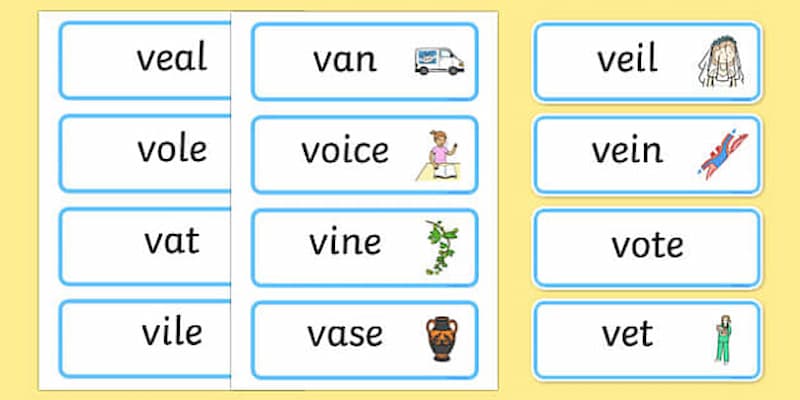
van
-
very
-
voice
-
visit
Placing the lips correctly helps learners avoid mispronunciation.
Pronunciation of V at the Beginning of Words
At the beginning of words, the pronunciation of V is usually clear and strong. This position makes the sound easier to recognize and practice.
Examples:
-
value
-
video
-
village
-
victory
Learners should focus on voicing the sound and not replacing it with /f/.
Pronunciation of V in the Middle of Words
When V appears in the middle of words, the pronunciation of V remains /v/, but it may sound softer in fast speech.
Examples:
-
seven
-
travel
-
river
-
living
Practicing these words helps improve fluency and natural rhythm.
Pronunciation of V at the End of Words
At the end of words, the pronunciation of V is still voiced and should not be dropped or devoiced.
Examples:
-
love
-
give
-
live
-
move
Learners often forget to voice final consonants, which can change the meaning of words.
Pronunciation of V vs F: Common Confusion
One of the biggest challenges with the pronunciation of V is distinguishing it from /f/. While both sounds use similar mouth positions, /f/ is voiceless and /v/ is voiced.
Comparison examples:
-
fan – van
-
fine – vine
-
safe – save
-
leaf – leave
Feeling throat vibration helps learners tell the difference.
References: Ellii (formerly ESL Library)
Common Mistakes with the Pronunciation of V
Many learners make similar errors when practicing the pronunciation of V.
Common mistakes include:
-
Pronouncing /v/ as /f/
-
Not using voice
-
Replacing V with B or W
-
Weak pronunciation at the end of words
Awareness of these mistakes is the first step to correction.
Exercises: Practice the Pronunciation of V
Exercise 1: Identify the Sound
Decide whether the word contains /v/ or /f/.
-
very
-
fish
-
love
-
leaf
-
voice
-
fine
Exercise 2: Minimal Pair Practice
Read each pair aloud and feel the vibration.
-
fan – van
-
ferry – very
-
fine – vine
-
leaf – leave
-
safe – save
Exercise 3: Choose the Correct Word
-
I ___ this song. (love / loaf)
-
She has a strong ___. (voice / foice)
-
Please ___ the door. (leave / leaf)
-
He wants to ___ abroad. (live / life)
Exercise 4: Read Aloud
-
very
-
visit
-
seven
-
river
-
give
-
move
Exercise 5: Sentence Practice
-
She loves visiting new places.
-
The video was very interesting.
-
Please give me five minutes.
-
They live near the river.
-
His voice sounds confident.
Answer Key
Exercise 1:
-
/v/
-
/f/
-
/v/
-
/f/
-
/v/
-
/f/
Exercise 3:
-
love
-
voice
-
leave
-
live
Improve the Pronunciation of V with Monkey Junior and M-Speak
Perfecting the pronunciation of V is much easier with guided practice and instant feedback. Monkey Junior offers a clear pronunciation roadmap that helps learners understand mouth placement, voicing, and sound contrast.
With M-Speak pronunciation scoring technology, learners receive immediate evaluations of sound accuracy and voicing. This allows learners to spot mistakes, adjust mouth position, and improve pronunciation effectively.
Monkey Junior also integrates native-speaker audio, listening exercises, speaking practice, and interactive lessons. Multiple supporting technologies work together to help learners build strong pronunciation skills step by step.

Start practicing with Monkey Junior today and master the pronunciation of V with confidence and accuracy.
Conclusion
The pronunciation of V in English focuses on one voiced sound, but it requires careful attention to mouth position and vocal vibration. By understanding common patterns, practicing regularly, and using Monkey Junior with M-Speak technology, learners can pronounce V clearly, naturally, and confidently.