

.png)
Understanding countable and uncountable nouns is essential for speaking and writing English accurately because they affect articles, plurals, and quantifiers. This guide breaks down their key rules, clear examples, and real usage patterns to help you master them quickly.
What are countable nouns?
1. Definition & key characteristics
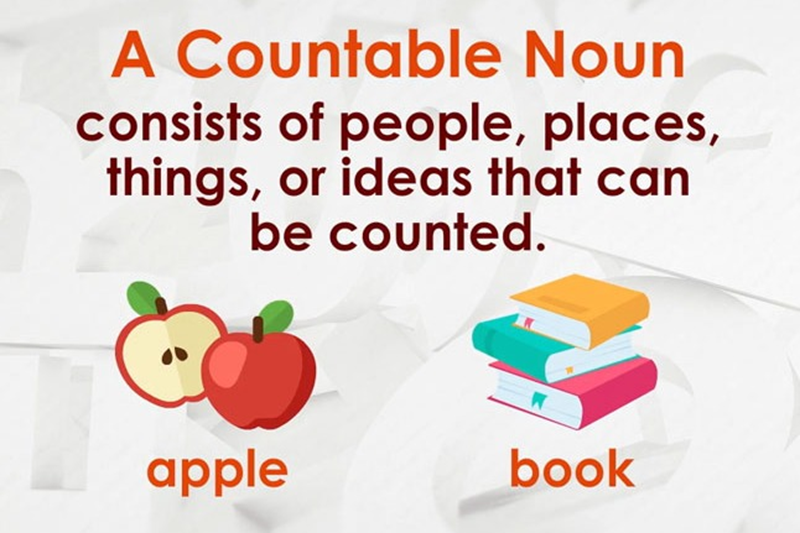
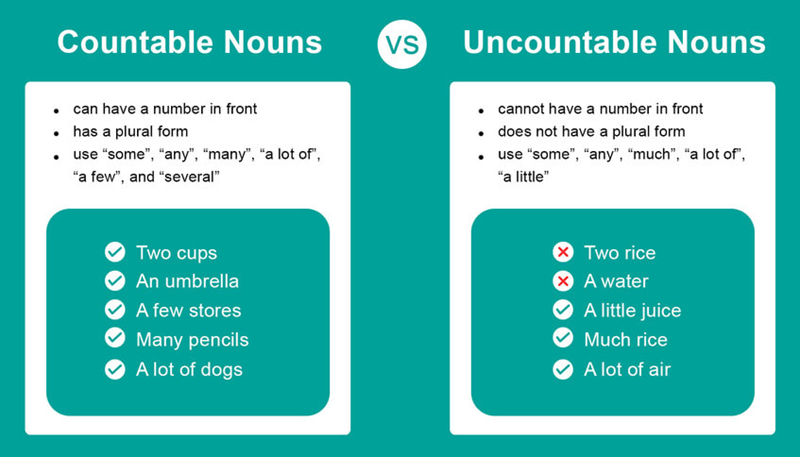
Countable nouns are nouns that refer to items you can count individually, so they can appear in both singular and plural forms. They work with numbers and quantifiers such as one, two, many, or a few, making their quantity easy to specify.
2. How plural forms work
Regular plural nouns typically end in -s or -es, following predictable spelling rules like book → books or bus → buses. Some nouns form irregular plurals, such as child → children or man → men, which must be memorized because they don’t follow standard patterns.
3. Common examples
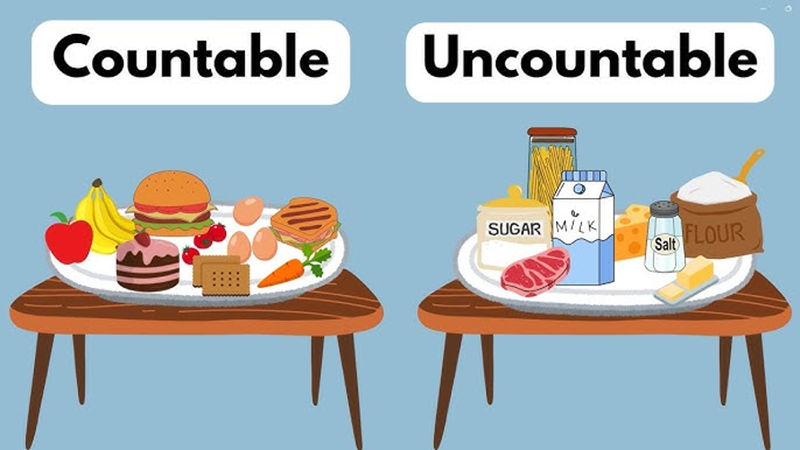
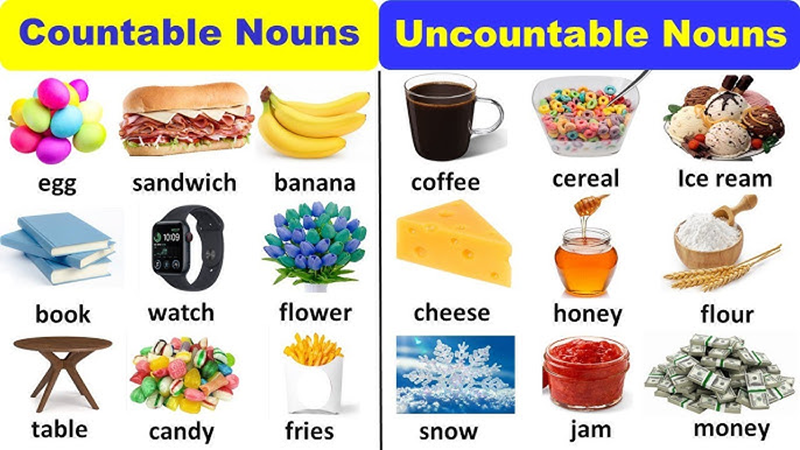
Common countable nouns include everyday items like apple, chair, idea, student, and city. These nouns clearly represent separate units that can be counted one by one.
Sample sentences:
-
I bought three apples for lunch.
-
There are several new students in the class.
-
She shared a brilliant idea during the meeting.
-
Two chairs were placed near the window.
-
They visited five cities on their trip.
What are uncountable nouns?
1. Definition & common categories
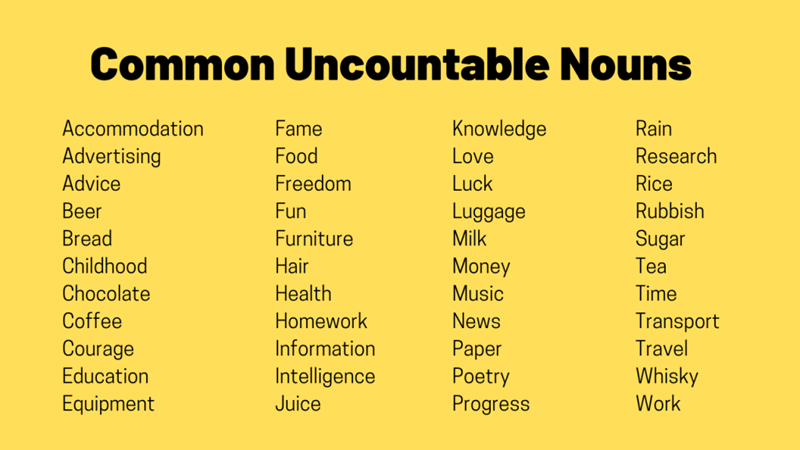
Uncountable nouns refer to substances, concepts, or activities that cannot be separated into individual units, so they do not have plural forms. They often describe categories like materials (water, sand), liquids (milk, oil), abstract ideas (happiness, information), and activities (travel, homework).
2. Usage rules
Uncountable nouns do not use “a” or “an” because they represent undivided wholes rather than countable items. Instead, they work with quantifiers or measurement phrases like some water, a piece of advice, or a bowl of rice to express specific amounts.
3. Common examples
Typical uncountable nouns include bread, rice, furniture, knowledge, equipment, coffee, and music. These words describe things that cannot be counted individually without adding a unit of measure.
Sample sentences:
-
She gave me useful advice before the interview.
-
There is too much traffic on the road today.
-
Could you buy some rice on your way home?
-
The furniture in this room looks modern and elegant.
-
He doesn’t have enough information to make a decision.
Quantifiers & structures
Quantifiers help show quantity, and each noun type requires specific ones to keep sentences clear and grammatically correct. Countable nouns work with many, a few, and several, while uncountable nouns take much, a little, and a bit of to express amount.
When referring to uncountable nouns, English uses measurement phrases to turn mass nouns into countable units. Common structures include a piece of bread, a bottle of water, a cup of coffee, and a bowl of rice, all of which specify quantity without breaking grammatical rules.
|
Give your child a strong English foundation from the very beginning with Monkey Junior. Start learning through fun games, native audio, and smart AI tools–perfect for kids aged 0-11. Help them build real skills in listening, speaking, reading, and writing step by step. Download Monkey Junior today and watch your child grow in confidence and English ability.
|


Nouns that can be both
Some nouns can be either countable or uncountable depending on meaning, and the category changes based on whether the noun refers to a general concept or individual units. Common examples include hair, room, time, and chicken, each carrying different meanings in different contexts.
Examples:
-
Hair: Hair (uncountable) refers to all the hair on your head, while a hair (countable) means a single strand.
-
Chicken: Chicken (uncountable) describes the meat, while a chicken (countable) refers to the animal.
-
Room: Room (uncountable) means available space (There isn’t much room left), while a room (countable) refers to a specific area (The house has three rooms).
-
Time: Time (uncountable) describes the general concept (Time moves fast), while a time (countable) refers to specific occurrences (We met three times).
Common mistakes
Learners often misuse articles by adding a/an before uncountable nouns or omitting them when referring to singular countable nouns. To avoid confusion, remember that countable nouns need a/an in the singular form, while uncountable nouns require the zero article.
Another mistake is incorrectly pluralizing uncountable nouns, such as writing informations, furnitures, or advices, which are all grammatically wrong. These nouns should stay singular unless paired with a measurement unit like pieces of information or items of furniture.
Misusing quantifiers also leads to errors, such as using much with countable nouns or many with uncountable nouns. Correct usage should pair many with countables (many books) and much or a little with uncountables (much water, a little sugar).
Corrected examples:
-
Wrong: She gave me an advice. → Correct: She gave me some advice.
-
Wrong: There are much people here. → Correct: There are many people here.
-
Wrong: I bought two breads. → Correct: I bought two loaves of bread.
Practice exercises
1. Classify the nouns (Countable or Uncountable)
Decide whether each noun is countable or uncountable based on its meaning.
-
Luggage
-
Tomato
-
Furniture
-
Idea
-
Juice
2. Fill in the blanks (Correct quantifier or article)
Choose the correct option: many / much / a few / a little / a / an / some.
-
She bought ___ apples for the picnic.
-
We don’t have ___ milk left in the fridge.
-
He gave me ___ advice before the test.
-
There are ___ chairs missing from the meeting room.
-
I need ___ umbrella because it’s raining.
3. Rewrite the sentences correctly
Fix the grammar mistakes related to countable and uncountable nouns.
-
She gave me an information yesterday.
-
There are much people at the event.
-
I bought two breads this morning.
-
He doesn’t have many money with him.
-
They served three coffees for the guests.
Answers
Exercise 1:
-
Uncountable
-
Countable
-
Uncountable
-
Countable
-
Uncountable
Exercise 2:
-
a few
-
much / a little (both possible depending on meaning)
-
some
-
many
-
an
Exercise 3:
-
She gave me some information yesterday.
-
There are many people at the event.
-
I bought two loaves of bread this morning.
-
He doesn’t have much money with him.
-
They served three cups of coffee for the guests.
Mastering countable and uncountable nouns helps you choose the right quantifiers, avoid common grammar errors, and express quantities naturally. With the rules and examples in this guide, you can apply them confidently in everyday English communication.