

.png)
The past continuous tense is a key part of English grammar that helps you describe actions in progress at a specific time in the past. It is especially useful for telling stories and giving background details.
In this easy guide, you will learn the definition, rules, and examples of the past continuous tense step by step. With support from Monkey, mastering this tense becomes simple and effective for real-life communication.
What is the past continuous tense?
The past continuous tense describes actions that were happening at a certain moment in the past. It focuses on the process, not just the result.
We use the past continuous to show that an action was in progress at a specific time before now. The action may have been interrupted or happening in the background.
Examples:
-
I was studying at 8 p.m. last night.
-
They were watching TV at that time.
Common time expressions with the past continuous include at 8 p.m., at that time, while, and when. These words help set the exact moment or situation in the past.
Example: She was cooking while he was driving home.
How to form the past continuous tense
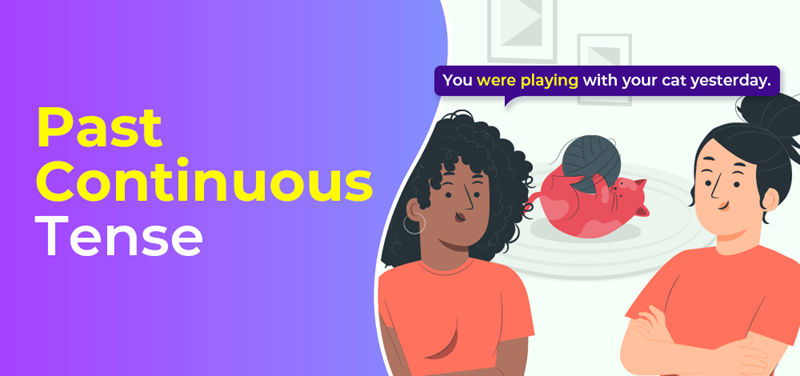
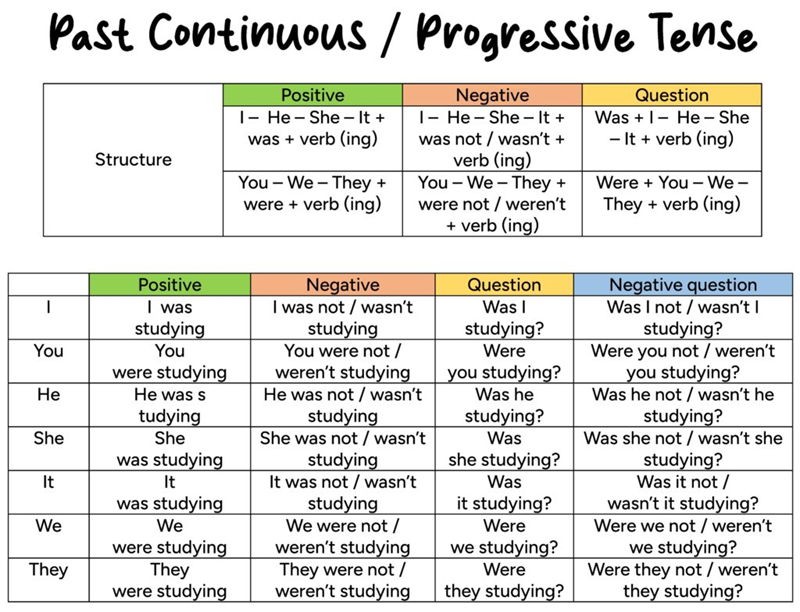
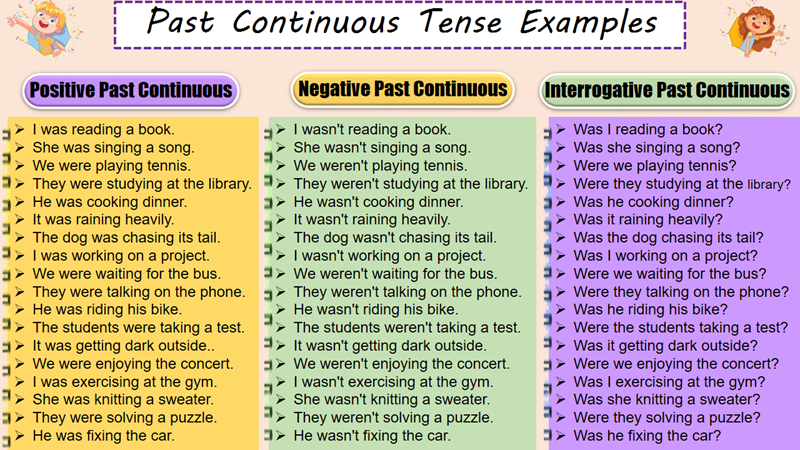
The past continuous tense is formed with the verb to be in the past and the -ing form of the main verb. The form changes for affirmative sentences, negatives, and questions.
1. Affirmative form
Use subject + was/were + verb-ing to describe an action in progress in the past. Choose was for I, he, she, it and were for you, we, they.
Examples:
-
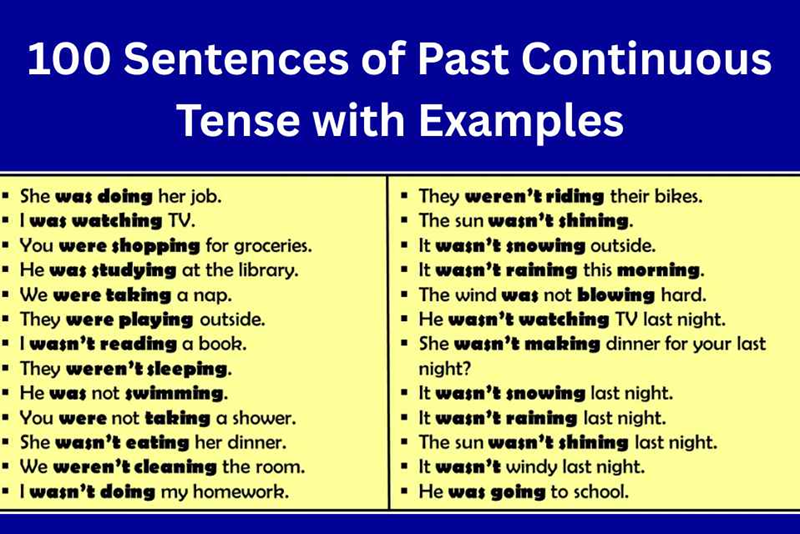
I was studying.
-
They were playing.
2. Negative form
Use subject + was/were not + verb-ing to say an action was not happening. You can also use the short forms wasn’t and weren’t.
Examples:
-
She wasn’t listening.
-
We weren’t working.
3. Question form
Use Was/Were + subject + verb-ing? to ask about an action in progress in the past. Place was or were at the beginning of the sentence.
Examples:
-
Were you sleeping?
-
Was he driving?
Uses of the past continuous tense
The past continuous tense is used to describe actions that were happening at a certain time in the past. It often shows background activity rather than completed results.
1. Actions in progress at a specific time
Use the past continuous to talk about what was happening at a particular moment in the past. The exact time is usually mentioned or implied.
Example: I was studying at 9 p.m. last night.
2. Two actions happening at the same time
Use the past continuous for two longer actions that were happening simultaneously. This is often linked with while.
Example: She was cooking while he was setting the table.
3. Background action interrupted by a short action
Use the past continuous for the longer background action and the simple past for the shorter action that interrupts it. This pattern is common with when.
Example: We were talking when the teacher entered the room.
4. Setting the scene in stories
Use the past continuous to describe the situation or atmosphere at the start of a story. It helps create context before main events happen.
Example: The sun was setting, and people were walking along the beach.
Past continuous with “When” and “While”
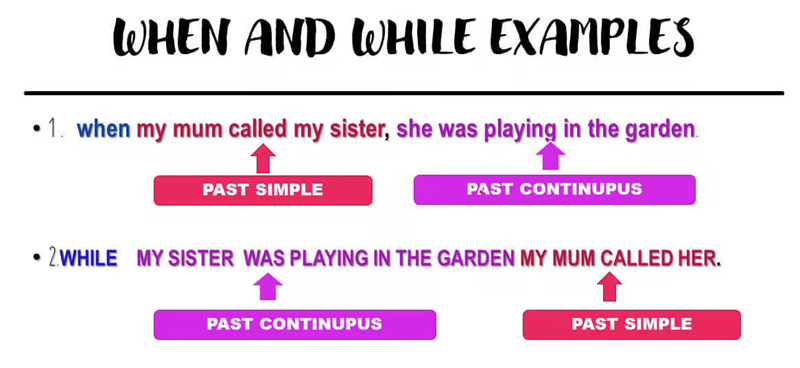
When and while are often used with the past continuous to link actions in the past. They help show which action was longer and which was shorter.
1. Using “While” for the longer action
Use while with the past continuous to describe a longer action in progress. Another action may happen at the same time.
Example: She was reading while her brother was playing games.
2. Using “When” for the short action
Use when to introduce a short action that interrupts a longer action in the past. The longer action is usually in the past continuous.
Example: I was taking a shower when the phone rang.
3. Example sentences with both
These sentences show how when and while work together in context. They make the timing of past actions clear.
Examples:
-
We were walking home when it started to rain.
-
While they were watching TV, their parents were cooking dinner.
Past continuous vs Simple past
The past continuous and the simple past both talk about the past, but they focus on different ideas. One shows actions in progress, while the other shows completed actions.
Comparison table:
|
Criteria |
Past Continuous |
Simple Past |
|
Definition |
Describes an action that was happening at a specific moment in the past. |
Describes an action that started and finished in the past. |
|
Focus |
Emphasizes the process or duration of the action. |
Emphasizes the completion or result of the action. |
|
Main Use |
Used for background actions or actions in progress. |
Used for short, completed actions or events. |
|
Common Time Markers |
at 8 p.m., while, when, at that moment,... |
yesterday, last night, ago, in 2005,... |
|
Example 1 |
I was reading at 9 p.m. last night. |
I read a book last night. |
|
Example 2 |
They were playing when it started to rain. |
It started to rain at 8 p.m. |
Practice exercises
Use these exercises to practice the past continuous tense in real contexts. Write your answers before checking them.
1. Fill in the blanks
Complete each sentence using the correct past continuous form of the verb in brackets.
-
She ___ (study) when I called her.
-
They ___ (play) football at 5 p.m. yesterday.
-
We ___ (watch) TV while it was raining.
-
He ___ (drive) home at that time.
-
I ___ (work) on my project all evening.
2. Choose the correct tense
Choose the correct form: past continuous or simple past.
-
I ___ (was reading / read) when she arrived.
-
They ___ (were cooking / cooked) dinner at 7 p.m.
-
He ___ (was sleeping / slept) when the alarm rang.
-
We ___ (were talking / talked) during the movie.
-
She ___ (was doing / did) her homework last night.
3. Make questions
Change each sentence into a question using the past continuous.
-
You were waiting for the bus.
-
She was studying at midnight.
-
They were playing in the yard.
-
He was fixing the bike.
-
We were having dinner at 8 p.m.
4. Rewrite sentences
Rewrite each sentence using the past continuous where possible.
-
I watched TV at 9 p.m. last night.
-
She studied when I came in.
-
They played in the park while it was raining.
-
He worked at that time yesterday.
-
We talked when the lights went out.
|
Give your child a strong English foundation from the very beginning with Monkey Junior. Start learning through fun games, native audio, and smart AI tools–perfect for kids aged 0-11. Help them build real skills in listening, speaking, reading, and writing step by step. Download Monkey Junior today and watch your child grow in confidence and English ability.
|

Answers
Exercises 1:
-
She was studying when I called her.
-
They were playing football at 5 p.m. yesterday.
-
We were watching TV while it was raining.
-
He was driving home at that time.
-
I was working on my project all evening.
Exercises 2:
-
I was reading when she arrived.
-
They were cooking dinner at 7 p.m.
-
He was sleeping when the alarm rang.
-
We were talking during the movie.
-
She did her homework last night.
Exercises 3:
-
Were you waiting for the bus?
-
Was she studying at midnight?
-
Were they playing in the yard?
-
Was he fixing the bike?
-
Were we having dinner at 8 p.m.?
Exercises 4:
-
I was watching TV at 9 p.m. last night.
-
She was studying when I came in.
-
They were playing in the park while it was raining.
-
He was working at that time yesterday.
-
We were talking when the lights went out.
The past continuous tense allows you to talk about what was happening in the past with clarity and detail. By understanding its structure and uses, you can make your English sound more natural.
Keep practicing with real examples to build confidence and accuracy. With helpful lessons from Monkey, you can master the past continuous tense and move closer to fluent English.