.png)
The pronunciation of T in English can change depending on its position in a word and the sounds around it. Understanding these variations helps learners speak more naturally and confidently.
What Is the Pronunciation of T in English?
Before practicing, learners should know that the pronunciation of T is not always a clear /t/ sound. In real English, T can sound strong, soft, or even disappear completely.
The most common pronunciations of T include:
-
/t/ (clear sound)
-
/ɾ/ (flap T, common in American English)
-
/ʔ/ (glottal stop)
-
Silent T
Learning these patterns makes spoken English sound smoother and more natural.
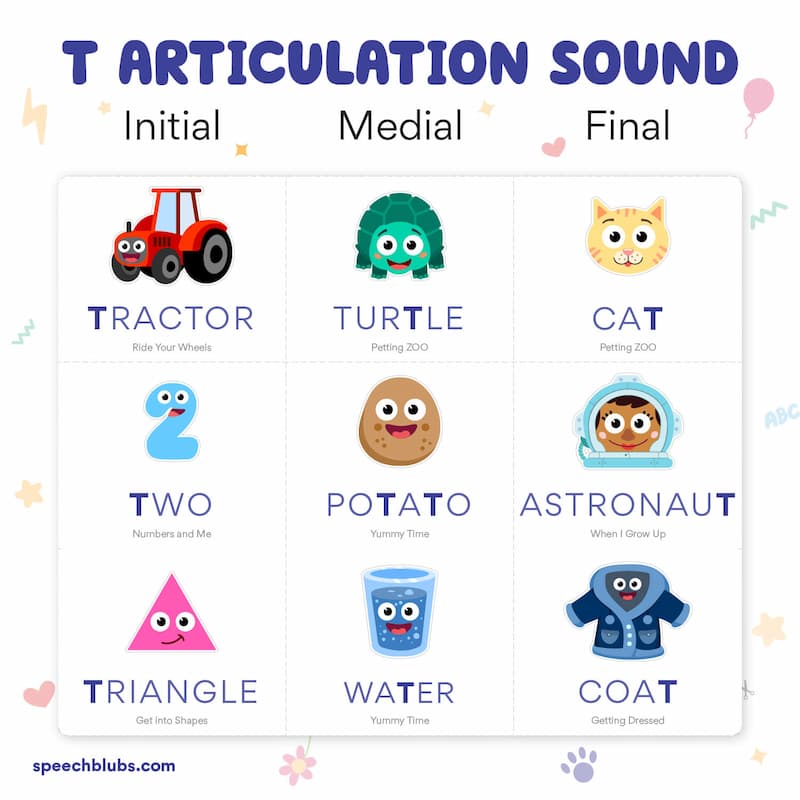
The Clear /t/ Sound in the Pronunciation of T
The clear /t/ sound is the basic form of the pronunciation of T. It is a voiceless sound made by touching the tongue to the ridge behind the upper teeth, then releasing air.
This sound often appears at the beginning of words or when T is stressed.
Examples:
-
top
-
time
-
take
-
teacher
Pronunciation of T at the End of Words
At the end of words, the pronunciation of T may be clearly released or only lightly pronounced, especially in fast speech.
Examples with a clear ending sound:
-
cat
-
hat
-
sit
In casual conversation, native speakers may stop the airflow quickly, making the T sound softer.
Flap T (/ɾ/) in the Pronunciation of T
One of the most important features of the pronunciation of T in American English is the flap T, written as /ɾ/.
This happens when T appears between two vowel sounds and the second syllable is unstressed. The sound becomes similar to a quick “d”.
Examples:
-
water
-
better
-
city
-
little
This pronunciation is key to sounding natural in American English.
Glottal Stop (/ʔ/) in the Pronunciation of T
In some cases, the pronunciation of T becomes a glottal stop, meaning the airflow stops briefly in the throat instead of producing a clear T sound.
This often happens before syllabic “n” or in informal speech.
Examples:
-
button
-
mountain
-
football
The T is not fully pronounced but still affects the rhythm of the word.
Silent T in English Pronunciation
In certain words, the pronunciation of T disappears completely. These words must be memorized because the spelling does not match the sound.
Common examples:
-
listen
-
castle
-
often (T may be silent or lightly pronounced)
Knowing silent T words prevents over-pronunciation.
Pronunciation of T in Common Letter Combinations
The pronunciation of T can change when combined with other letters.
Examples include:
-
TH: think, this
-
TION: nation, action (/ʃ/)
-
TURE: future, nature (/tʃ/)
Recognizing these patterns helps learners read and pronounce new words more accurately.
References: Ellii (formerly ESL Library)
Common Mistakes with the Pronunciation of T
Learners often struggle with the pronunciation of T due to spelling habits or first-language influence.
Common mistakes include:
-
Always pronouncing a strong /t/ in every position
-
Missing the flap T in connected speech
-
Pronouncing silent T words
-
Confusing /t/ with /d/ or /θ/
Focused listening and repetition help correct these errors.
Exercises: Practice the Pronunciation of T
Exercise 1: Identify the T Sound
Choose the correct T pronunciation.
-
water
-
cat
-
listen
-
city
-
button
-
teacher
Exercise 2: Choose the Correct Pronunciation Type
Match each word with /t/, /ɾ/, /ʔ/, or silent T.
-
better
-
mountain
-
top
-
castle
-
little
Exercise 3: Minimal Pair Practice
Choose the word you hear or say both aloud.
-
bet – bed
-
writer – rider
-
cat – cad
-
waiting – wading
Exercise 4: Read Aloud
Practice reading these words clearly.
-
time
-
water
-
city
-
football
-
often
-
teacher
Exercise 5: Sentence Practice
The teacher wrote a note on the table.
-
I drank water after the meeting.
-
The little cat sat quietly.
-
He often listens to music at night.
-
The city is beautiful in the winter.
Answer Key
Exercise 1:
-
/ɾ/
-
/t/
-
silent T
-
/ɾ/
-
/ʔ/
-
/t/
Exercise 2:
-
/ɾ/
-
/ʔ/
-
/t/
-
silent T
-
/ɾ/
Improve the Pronunciation of T with Monkey Junior and M-Speak
Learning the pronunciation of T becomes much easier with clear guidance and instant feedback. Monkey Junior provides a structured pronunciation roadmap that helps learners understand when and how T changes in real speech.
With M-Speak pronunciation scoring technology, learners receive detailed feedback on sound accuracy, stress, and fluency. This allows immediate correction and steady improvement.
Monkey Junior also combines native-speaker audio, listening drills, speaking practice, and interactive lessons. Multiple supporting technologies work together to build strong pronunciation skills step by step.

Start practicing with Monkey Junior today to master the pronunciation of T and speak English more naturally.
Conclusion
The pronunciation of T in English includes clear /t/, flap /ɾ/, glottal stop /ʔ/, and silent forms. By understanding these patterns and practicing regularly with Monkey Junior and M-Speak technology, learners can improve clarity, rhythm, and confidence in spoken English.