

.png)
Understanding interrogative pronouns is essential for forming clear and accurate questions in English. This guide explains their definition, full list, and practical usage so you can use them confidently in both speaking and writing.
What are interrogative pronouns?
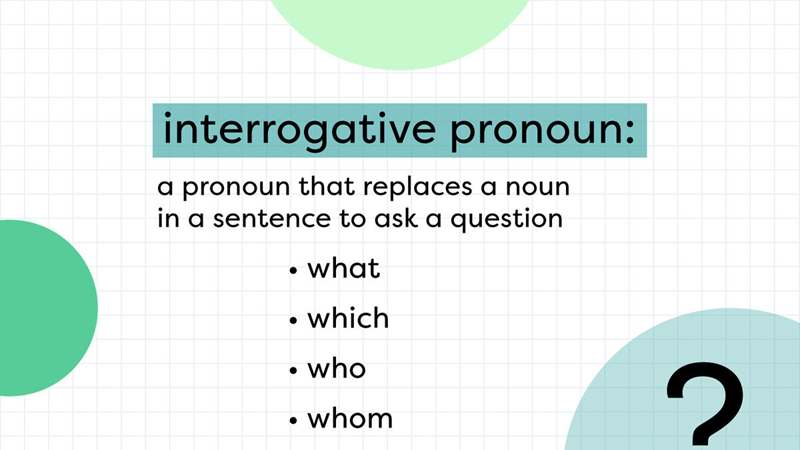
Interrogative pronouns are pronouns used to form questions by standing in for information the speaker does not yet know. They help identify people, things, choices, or ownership without naming them directly.
Unlike general or indefinite pronouns, which refer to nonspecific people or things, interrogative pronouns explicitly request missing details. Their purpose is to gather new information rather than describe or refer to something already mentioned.
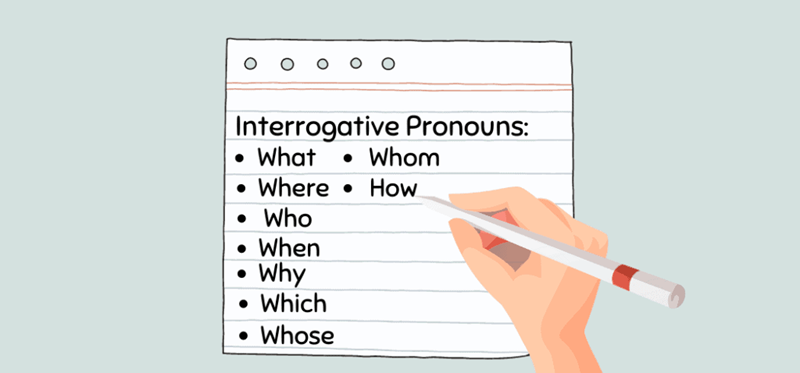
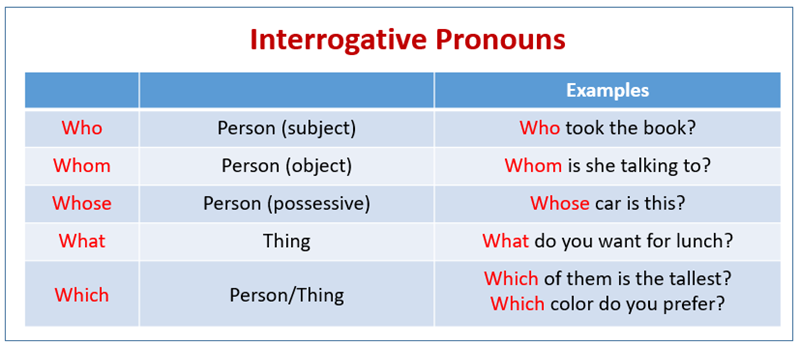
Common interrogative pronouns include who, whom, whose, what, and which, each used to ask about different types of nouns. For example:
-
Who called you last night?
-
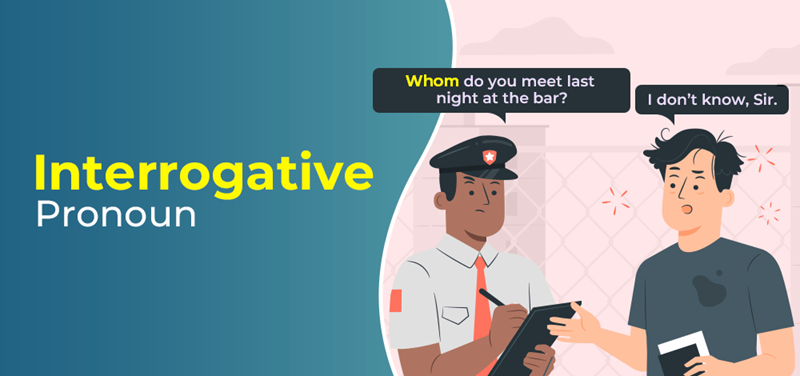
Whom did you meet at the event?
-
Whose keys are on the table?
-
What caused the delay?
-
Which route is faster?
Complete list of interrogative pronouns
1. Main interrogative pronouns
The primary interrogative pronouns are who, whom, whose, what, and which, each used to identify different kinds of unknown nouns. They allow you to ask about people, things, possession, or specific options with precision.
Examples:
-
Who fixed the report?
-
Which color do you prefer?
2. Compound interrogative pronouns
Compound forms such as whoever, whomever, whatever, and whichever create broader or more open-ended questions. They often imply that any person, option, or thing could fit the answer.
Examples:
-
Whoever arrives first can choose the seat.
-
Whichever option you pick will work for the project.
How interrogative pronouns work
Interrogative pronouns function by replacing unknown nouns in a question, helping the speaker request specific information. Their role depends on whether they refer to people, things, ownership, or available options.
1. As Subject vs. Object
Who is used as the subject when the person being asked about performs the action, while whom appears as the object receiving that action.
Examples:
-
Who made this decision?
-
Whom did you invite to the meeting?
2. Asking about possession (whose)
Whose is used to ask about ownership when the item is known but the owner is not. It can refer to both people and things in a single, concise question.
Examples:
-
Whose laptop is on the desk?
-
Whose idea was selected for the campaign?
3. Options & choices (which, what)
Which is used when the choices are limited or clearly defined, while what applies to broader or unspecified possibilities. The difference helps the speaker signal whether the listener should choose from a set list or think more freely.
Examples:
-
Which route should we take?
-
What topic do you want to present?
Examples of interrogative pronoun usage
-
Who is coming? > This question asks for the identity of the person performing the action, so who acts as the subject of the sentence.
-
Whom did you call? > Here, whom refers to the person receiving the action, making it the object of the verb call.
-
What is your favorite book? > What is used to request information about things rather than people, focusing on a specific preference.
-
Which one do you want? > Which signals that the listener must choose from a known or limited set of options.
-
Whose bag is this? > Whose asks about ownership, identifying the person to whom the item belongs.
|
Give your child a strong English foundation from the very beginning with Monkey Junior. Start learning through fun games, native audio, and smart AI tools–perfect for kids aged 0-11. Help them build real skills in listening, speaking, reading, and writing step by step. Download Monkey Junior today and watch your child grow in confidence and English ability.
|


Common mistakes & clarifications
1. Who vs. Whom confusion
Many learners mix up who and whom, but the rule is simple: who acts as the subject, and whom functions as the object. A quick test is to replace the word with he (subject) or him (object) - if him fits, whom is correct.
2. Interrogative pronoun vs. interrogative adjective
An interrogative pronoun stands on its own and replaces the noun being asked about, like What happened? In contrast, an interrogative adjective modifies a noun directly, as in Which book did you buy?, where which describes the noun book instead of replacing it.
Practice exercises
Questions
Fill in the blank with the correct interrogative pronoun (who, whom, whose, what, which).
-
_______ opened the presentation this morning?
-
To _______ should we send the final report?
-
_______ ideas were chosen for the new campaign?
-
_______ caused the system to crash last night?
-
_______ of these two schedules works better for you?
-
_______ are you planning to invite to the workshop?
-
_______ is the main topic of your research?
-
_______ jacket did you leave in the meeting room?
-
_______ of the candidates impressed you the most?
-
_______ did they ask to lead the project?
Rewrite the sentence as a question using the correct interrogative pronoun.
-
“The manager approved the proposal.” → Ask who did this.
-
“You selected this option.” → Ask which option.
-
“The report belongs to Anna.” → Ask whose report.
-
“They contacted our supplier.” → Ask whom they contacted.
-
“This device malfunctioned.” → Ask what malfunctioned.
Answers
-
Who
-
Whom
-
Whose
-
What
-
Which
-
Whom / Who
-
What
-
Whose
-
Which
-
Who
-
Who approved the proposal?
-
Which option did you select?
-
Whose report is it?
-
Whom did they contact?
-
What malfunctioned?
FAQs
1. What is an interrogative pronoun?
An interrogative pronoun is a word used to ask questions by replacing an unknown person, thing, or idea. It helps gather specific information without naming the noun directly.
2. How many interrogative pronouns are there?
English commonly uses five main interrogative pronouns: who, whom, whose, what, and which. Several compound forms, such as whoever and whatever, also function in questions.
3. What is the difference between interrogative pronouns and interrogative adverbs?
Interrogative pronouns ask about people, things, possession, or choices, while interrogative adverbs ask about time, place, reason, or manner. Words like when, where, why, and how fall into the adverb category because they describe circumstances, not nouns.
Mastering interrogative pronouns helps you ask precise questions and improve your overall communication skills. Use the definitions, lists, and examples in this guide as a quick reference whenever you need to review how they work.