


.png)
Possessive pronouns play an essential role in English grammar because they help clarify ownership without repeating nouns. This guide explains their definitions, full list, and practical examples so you can use possessive pronouns accurately and confidently.
What are possessive pronouns?
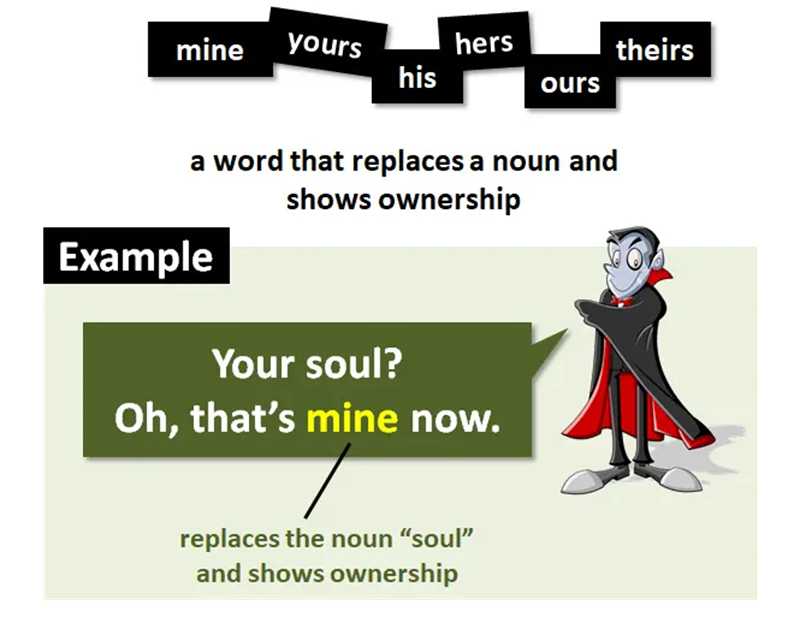
Possessive pronouns are words that replace a noun to show ownership without repeating the original noun. They help your sentences stay clear, concise, and avoid unnecessary repetition.
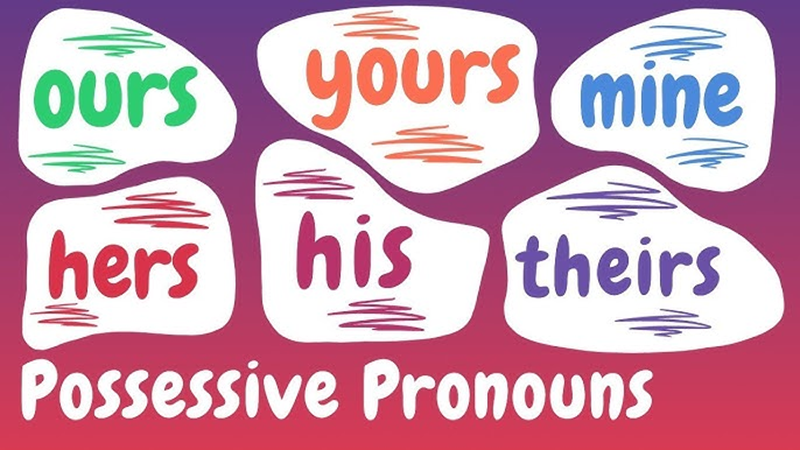
A possessive pronoun stands alone and indicates who something belongs to. Common examples include mine, yours, his, hers, ours, and theirs, and they never appear directly before a noun.
Difference between possessive pronouns and possessive determiners:
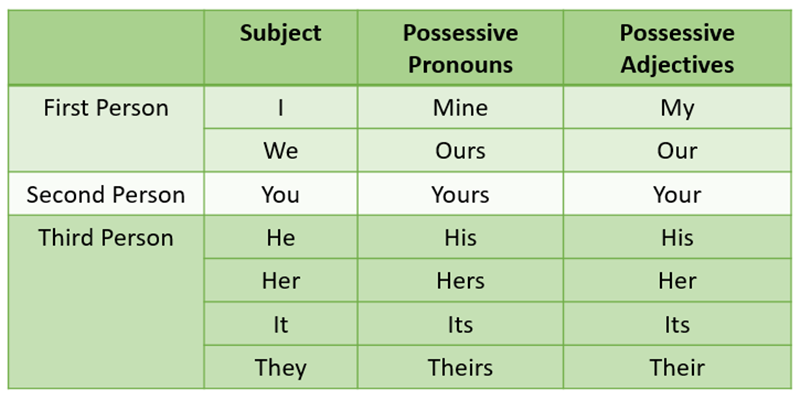
Possessive pronouns replace a noun entirely (e.g., This book is mine), while possessive determiners come before a noun to describe ownership (e.g., This is my book). In short, determiners modify a noun, but pronouns stand alone and take the place of the noun.
List of possessive pronouns
Possessive pronouns form a small, fixed group of words that replace a noun to show ownership, helping you avoid repeating information that the reader already knows. The full set includes mine, yours, his, hers, ours, and theirs, with its sometimes mentioned in theory but almost never used in everyday English.
Each pronoun stands alone and cannot be placed in front of a noun, because its role is to take the place of that noun entirely. For example, instead of saying “This is my bag and that is your bag” , you can shorten it to “This is mine and that is yours”.
These pronouns are essential for making sentences smoother and more natural, especially in conversations where objects are already clear from context. They also help distinguish ownership without repeating names or items, creating cleaner and more efficient communication.
How possessive pronouns work
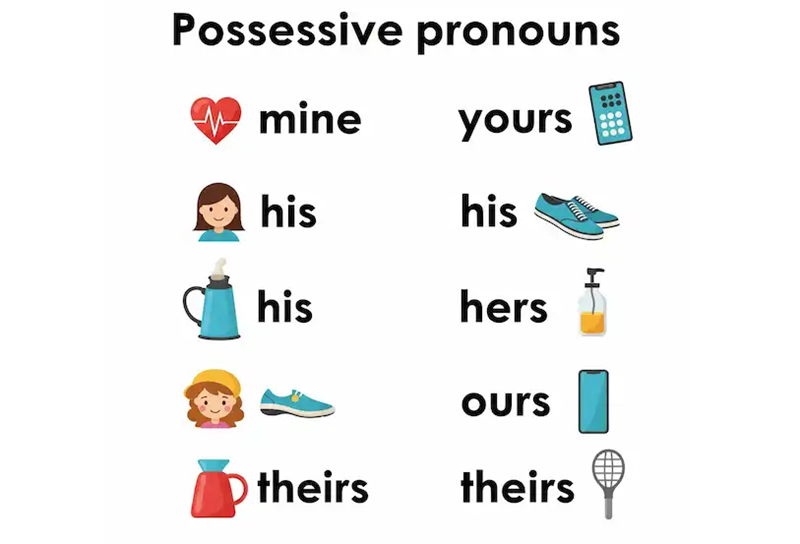
Possessive pronouns function by replacing a noun that has already been mentioned, allowing you to avoid repeating the same object or phrase. This makes sentences more natural and efficient, especially in contexts where ownership is already clear.
These pronouns stand alone and never appear directly before a noun, because their job is to take the noun’s place entirely. For example, instead of saying “Is this your phone?” - “Yes, it is your phone,” we simply say, “Yes, it is yours.”
They also help maintain smooth conversation flow, as English speakers often rely on them to keep speech compact and easy to follow. As emphasized in grammar guides like LearnEnglish by the British Council, a possessive pronoun must always act independently and cannot modify a noun the way possessive determiners do.
Possessive pronouns vs. Possessive adjectives
Possessive pronouns replace a noun entirely to show ownership, while possessive adjectives (also called possessive determiners) appear before a noun to describe who it belongs to. For example, “This book is mine” uses a pronoun, while “This is my book” uses an adjective.
You should use a possessive pronoun when the noun is already known or mentioned and you want to avoid repetition. Use a possessive adjective when you need to identify ownership before introducing the noun, such as “my car”, “his jacket”, or “their home”.
|
Give your child a strong English foundation from the very beginning with Monkey Junior. Start learning through fun games, native audio, and smart AI tools–perfect for kids aged 0-11. Help them build real skills in listening, speaking, reading, and writing step by step. Download Monkey Junior today and watch your child grow in confidence and English ability.
|


Practice exercises
1. Multiple choice
Choose the correct possessive pronoun to complete each sentence.
1. This bag isn’t mine — I think it’s ________.
a. hers b. her c. she
2. We finished our project, and they finished ________.
a. theirs b. their c. them
3. He brought his laptop, and I brought ________.
a. my b. mine c. me
4. These seats are reserved, but those seats over there are ________.
a. our b. ours c. us
5. She said the idea wasn’t ________, but she still liked it.
a. her b. hers c. She
2. Fill-in-the-blank
Complete each sentence using the correct possessive pronoun.
-
Your explanation was clear, but ________ was even easier to understand.
-
They forgot their keys, so we lent them ________.
-
The decision is ultimately ________, not the manager’s.
-
These notebooks belong to the students; the red one is ________.
-
I looked for my umbrella, but the one on the table isn’t ________.
3. Sentence transformation
Rewrite each sentence using a possessive pronoun without changing the meaning.
-
This is my jacket. → Rewrite using a possessive pronoun.
-
That is your responsibility. → Rewrite using a possessive pronoun.
-
These books belong to them. → Rewrite using a possessive pronoun.
-
Her solution was more effective than my solution. → Rewrite using possessive pronouns.
-
The final decision is his decision. → Rewrite using a possessive pronoun.
Answers
Exercise 1:
-
a. hers
-
a. theirs
-
b. mine
-
b. ours
-
b. hers
Exercise 2:
-
yours
-
ours
-
theirs
-
theirs
-
mine
Exercise 3:
-
This jacket is mine.
-
That responsibility is yours.
-
These books are theirs.
-
Her solution was more effective than mine.
-
The final decision is his.
Mastering possessive pronouns will make your writing clearer, more concise, and more natural. Use the definitions, lists, and examples in this guide as your quick reference to strengthen your English grammar skills.